The South African Communist Party and Mozambique
Introduction
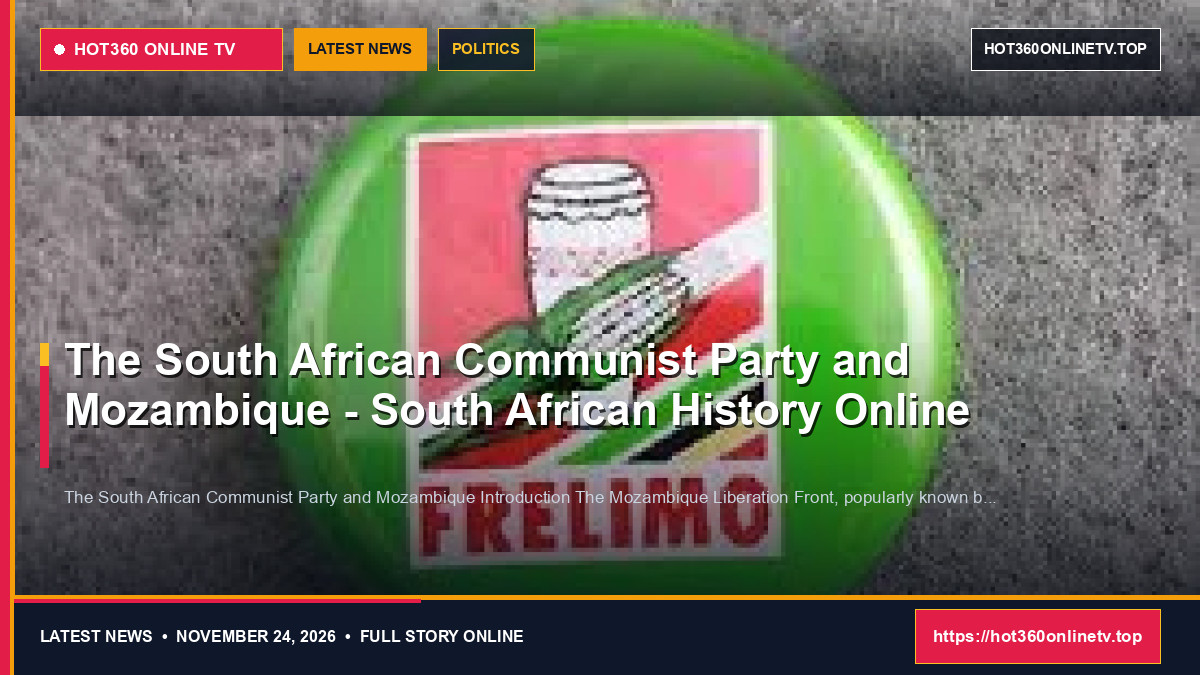
The Mozambique Liberation Front, popularly known by its Portuguese acronym, FRELIMO (Frente de Libertação Moçambique) is a communist party from Mozambique. It was founded in 1962 and formed a part of the Mozambican liberation movement, eventually winning power in 1975. When FRELIMO gained power in 1975, the South African Communist Party (SACP) warmly congratulated FRELIMO on its election into government:
On this momentous day – 25 June 1975 – the day on which Mozambique takes her rightful place in the community of independent sovereign nations, the Central Committee of the South African Communist Party warmly embraces the people of Mozambique and its revolutionary vanguard, FRELIMO. The assumption of power by FRELIMO and the installation of the People’s Government of Mozambique marks an historic turning point.[1]
This statement of congratulations indicated an intertwined relationship between the SACP and FRELIMO and a mutual commitment between the two parties to issues plaguing southern Africa.
The Collapse of Portuguese Colonialism and the growth of FRELIMO - SACP Connections, 1963-1975
In 1963, the year FRELIMO was formed, Samora Machel, a founder of the party (and later, the president of Mozambique), was able to catch a lift on a SACP-chartered flight between Botswana and Tanzania. Joe Slovo had helped usher Machel onto the aeroplane and admitted that he wasn’t aware of the “valuable cargo” they were carrying until much later. Historian Iain Christie suggests this event was momentous: “in taking Samora Machel to Tanzania [where he was due to attend a guerrilla training camp], Joe Slovo and J.B. Marks had unwittingly played a dramatic role in the struggle against colonialism in southern Africa. The thin, energetic young man was to prove political dynamite”.[2]
The early interaction between the SACP and FRELIMO was but a speck in a long and fruitful relationship between the two communist parties. In South Africa, by 1960 political organisations like the African National Congress (ANC), SACP, Pan Africanist Congress (PAC) and other organisations had been sent into exile following the Suppression of Communism Act (1950) and the Unlawful Organisations Act (1960). From independence in 1975, the FRELIMO government in Mozambique showed a “commitment towards the regional liberation struggle” through “offering its territory as a rear-guard to the ANC, SACP and South African Congress of Trade Unions (SACTU)”.[3]
The independence of southern African neighbours was critical for both the ANC and SACP. In 1974 and 1975, Mozambique and Angola won their independence respectively. From this time the communist governments in both counties were able to “host white South African communists as long-term residents” as well as uMkhonto weSizwe (MK) operatives and other banned activists.[4] Aware of the fact that Portuguese colonialism had collapsed and needed territory to conduct the armed struggle, the ANC persuaded FRELIMO to allow transit and the guerrilla camps within Mozambican territory. FRELIMO was thus determined to provide both ANC and SACP activists “with a welcoming environment”.[5]
Summing up the fruitful between the SACP and FRELIMO, Joaquim Chissano, the FRELIMO and Mozambiquan president from 1986, noted that:
After the Lusaka Accord [signed on 7 September 1974, whereby Portugal recognised Mozambique’s independence], FRELIMO had to adopt a strategy of support to the liberation struggle in southern Africa. Conditions were created for Mozambique to serve as a safe rear-guard, and after independence, in we accepted that the ANC should have offices in Mozambique and that its leaders should live amongst us. That is how President Oliver Tambo, and the secretary-general of the SACP, Moses Mabhida, came to have homes in Mozambique. Various other leaders of the struggle, Joe Slovo, Ruth First and Albie Sachs, also resided in Mozambique, although there was no military base as such. Leaders of the armed struggle who were based in Mozambique carried out clandestine operations in South Africa despite the risks that such operations implied for our country [...] Our country served as a clandestine base for South Africa.[6]
After the Lusaka Accord [signed on 7 September 1974, whereby Portugal recognised Mozambique’s independence], FRELIMO had to adopt a strategy of support to the liberation struggle in southern Africa. Conditions were created for Mozambique to serve as a safe rear-guard, and after independence, in we accepted that the ANC should have offices in Mozambique and that its leaders should live amongst us. That is how President Oliver Tambo, and the secretary-general of the SACP, Moses Mabhida, came to have homes in Mozambique. Various other leaders of the struggle, Joe Slovo, Ruth First and Albie Sachs, also resided in Mozambique, although there was no military base as such. Leaders of the armed struggle who were based in Mozambique carried out clandestine operations in South Africa despite the risks that such operations implied for our country [...] Our country served as a clandestine base for South Africa.[6]
A Home, an Intellectual Space and a Military Base for Exiled SACP Activists: the SACP in Mozambique until the Nkomati Accord, 1975-1984
Between 1975 and 1984, the political situation in Mozambique became increasingly complicated. The Resistência Nacional Moçambicana (RENAMO), a movement led by Alphonso Dhlakama which opposed FRELIMO’s socialist government, launched a military offensive against FRELIMO and started a civil war. The civil war in Mozambique ravaged the countryside and was premised on contestations over power in the newly independent country. Ethnic differences, economic challenges to FRELIMO’s socialist government, the politics in countryside regions all underpinned the war. Many civilians were displaced by RENAMO’s offensive – small villages, civilians and infrastructure were the main targets.[7] Most relevant for the SACP was the fact that the South African government and Western powers provided support to RENAMO, which challenged the safety and security of the SACP in Mozambique.
Exiled SACP activists, many of whom were intellectuals, began working at Eduardo Mondlane University (UEM) where they used their intellectual prowess to further their activism in Mozambique. The SACP members who worked at UEM engaged critically with the character of socialism in Mozambique, through the Centre for African Studies (CEM). The SACP felt that FRELIMO’s victory was instructive for struggles for socialism around the world. In January 1978, A. Bakaya, writing in the SACP’s newspaper The African Communist, praised FRELIMO’s “commitment to real revolution” and meticulously detailed FRELIMO’s struggle for power, their revolutionary process and their establishment of a socialist Mozambique.[8] This form of engagement with the political economy of Mozambique was characteristic of SACP activists.
Ruth First lived in Maputo, Mozambique in 1977, where she conducted her research at the Eduardo Mondlane University (UEM). Bridget O’Loughlin argues that Ruth spent time in Mozambique because she experienced “a rupture with capitalism in Southern Africa and [moved her] investigative analysis beyond opposition to the construction of socialist alternatives”.[9] Ruth worked at the Centre for African Studies (CEA) at UEM. Here, she spent time understanding the character of FRELIMO’s socialist government and helped contribute ideas and plans for the government’s socialist programmes.[10] Ruth was determined to present criticisms of the FRELIMO government, the SACP’s relationship with the Soviet Union and worried about the successes of socialism in Mozambique and its influence on South Africa.[11] This, according to O’Loughlin was her contribution to the Southern African revolutionary process. Ruth believed that for socialism to be successful in Mozambique, “it was necessary to understand South Africa’s politics and society”.[12]
Other members of the SACP also set up at UEM. For example, Albie Sachs worked at Eduardo Mondlane University in 1977 for eleven years; Rob Davies and Dan O’Meara joined First in Mozambique in 1979. Sachs’ work at the UEM embraced debates about arts and culture. For example, he sent a letter to the Medu Art Ensemble decrying how art is focused on images that negate the oppressor, rather than engaging in the construction of a new society, as he had seen in Mozambique. Sachs followed his critique up with the book Images of Revolution (Mural Art in Mozambique), where he showed the intimate link between art and the liberation of people.[13] All of the academics at the UEM helped develop a strong research unit, which presented seminars, drafted papers, taught new degrees and contributed critical insights to the Mozambican government and South African liberation movement. Describing the impact of the research unit, a retired academic at UEM, Dr Manuel Araujo stated that “the empirical research produced by the CEA wasn’t only important to Mozambique but also to South Africa and the entire world. The CEA’s approach influenced students’ paradigms and thinking at the time”.[14] The CEA was a space in Mozambique where other South African intellectuals could meet.
Sue Rabkin arrived in Maputo in 1979 and was deployed as part of the ANC’s revolutionary council, in a unit called “Internal Political Reconstruction”. She worked with Indres Naidoo and Sunny Singh, under the supervision of Mac Maharaj as underground operatives for the ANC. Rabkin and Naidoo were also in Ruth Firsts’ SACP unit in Maputo. Rabkin admired Ruth because, in her own words, Ruth “used the tools of Marxism without ever mentioning … the myriad of terms used by Marxists”.[15] June Stephen and her husband Michael Stephen moved to Mozambique from London to do SACP work in 1977. June remembered interviewing migrant workers with Ruth in the Mozambican countryside.[16]
Ruth First also recruited Dr Alpheus Manghezi, an intellectual, social worker and member of the ANC, to the CEM. She worked with Manghezi on “labour migration, forced labour and on the newly established communal villages and agricultural producer cooperatives”.[17] Manghezi remembered that the academics at the CEA, many affiliated with the ANC or SACP, also carried out “political activities in favour of the ANC”: CEA academics “wore two hats […] they were academics but also ANC militants”. The CEA was an important centre for SACP and ANC thought, as Manghezi recalled: “perhaps it would be appropriate to consider the CEA as the ANC and SACP’s political and ideological laboratory”.[18]
As noted, Mozambique was a space for SACP and Umkhonto We Sizwe (MK) activists to live and work in exile – this also occurred outside of the bounds of the CEA. Moses Mabhida was the leader of the SACP from 1978 until he died in 1986. He lived in Maputo from 1982 until 1985, whereafter he was advised by the Mozambican government to seek refuge elsewhere. Yusuf Dadoo, who was the chairman of the SACP, met the General Secretary of the Socialist Party of Germany in Maputo. Mohammed Timol was smuggled into Mozambique in 1978 to be part of the ANC’s external mission. Joe Slovo, who was based in Luanda as the deputy chief of MK operations in 1976 and was a prominent SACP member, moved to Mozambique in 1979 to manage the ANC’s Special Operations Unit. This unit would carry out sabotage attacks, like rocket attacks on the Sasolburg oil refineries and the Voortrekkerhoogte military base. Slovo, who was married to Ruth First, joined her in Mozambique and stayed in the elite suburb of Sommerschield.
The Special Operations Unit was based at Matola, an industrial area twenty or so kilometres from Maputo. Alpheus Manghezi further reiterates that “Mozambique provided accommodation for a number of our cadres and freedom fighters who were in transit to South Africa. We had homes in Matola, Bairro da Liberdade and Maputo and there were definitely the arms caches in some of them”.[19] Between 1977 and 1981, 62 attacks of sabotage were conducted at “key economic installations”, like the “spectacular” attacks against [South Africa’s] SASOL’s fuel energy plant in June 1980 which were carried out by ANC operatives. The unit at Matola was invaded by the South African commandos on 30 January 1981, where a total of twelve ANC cadres and members of SACTU were killed. Motso Mokgabudi, an MK operative and a member of the SACP, was murdered by the Apartheid government in the Matola attack.[20] SACTU leader William Khanyile, Obadi, a brilliant young communist from the Soweto generation and Nkululeko Conquerer, a lawyer from Natal who translated the SACP programme into Zulu, were killed in Matola in 1981.[21]
In 1982, the SACP’s headquarters were relocated from London to Maputo. Joe Slovo, Josiah Jele and Chris Hani “would constitute a three-person secretariat” who would remain in Maputo until the Nkomati Accord in 1984 (whereafter the headquarters were moved to Lusaka in Zambia). Hani had also been in Maputo to quell an uprising of mutiny at an ANC camp in Viana.[22] Various speeches were held by SACP leaders in 1981 and 1982. Moses Mabhida, who was the general secretary of the SACP, gave a speech on 26 July 1981 in Luanda to mark the 60th anniversary of the SACP. In his address, he praised the gains of the communist parties in Mozambique and Angola.[23] Three days later, Joe Slovo gave a speech in Maputo on 30 July 1981 where he celebrated Mozambique as an “island of socialism” and a symbol of the expanding socialist world.[24] in 1982, Moses Mabhida sent a letter from Mozambique to Jack Simons (an intellectual and member of the SACP) detailing administrative matters and discussing the need to host speeches in March 1982 to commemorate the Rand Revolt.[25] The presence of the SACP in Mozambique was a symbol of their expanding influence.
These speeches by SACP leaders were, in part, responses to the barbaric attack by the South African government on Matola, a suburb of Maputo, Mozambique. The attack at Matola symbolised an increased effort by the Apartheid government to curtail the sabotage and military incursions of MK. Attacks by MK were focused on police stations and railway lines, including a massive bomb planted in Richards Bay, Natal (now KwaZulu-Natal). The Apartheid government’s efforts to curtail the ANC’s military invasions included spies, military aggression and propaganda. In July 1982, South African soldiers established a military base at Pangane, west of Maputo.
They used this military presence to target Ruth First with a letter bomb sent to her office at the UEM on 17 August 1982. Many years later, Craig Williamson – the man who assassinated Ruth First – said that Ruth was targeted because the “apartheid regime was convinced that she was a key factor in the liberation struggle, one of the top ideologists of the SACP, and her involvement in Mozambique was of great concern to the South African regime”.[26] Rob Davies was a target of the South African government too, but his planned assassination was aborted because it coincided with the FRELIMO’s fifth congress and there was heightened security in the streets of Maputo.[27]
The South African government bombed Matola incessantly, attacking ANC offices and killing and injuring many Mozambican civilians too. This was done in collaboration with help from America and Britain. These military attacks formed part of a more concerted effort to counteract Soviet influence in Mozambique and southern Africa. Notably, the SACP strengthened its influence through their alliance with the Movimento Popular de Libertação de Angola (MPLA) in Angola and Frelimo in Mozambique. In this light, the SACP reaffirmed that the socialist governments in Angola and Mozambique had drastically tipped the balance of force in South Africa in favour of “liberation, independence and democracy”.[28]
The Nkomati Accord and the Legacy of the South African Communist Party in Mozambique until its Unbanning, 1984-1990
In early 1984, “recognising the military superiority of the apartheid regime and the danger of socio-economic and political collapse due to these attacks, Mozambique’s government decided to enter into negotiations with South Africa”.[29] The Nkomati Accord was signed on 16 March 1984 between Samora Machel and PW Botha and committed both Mozambique and South Africa to a “non-aggression pact”, where the South African government would cease to support RENAMO and in return, FRELIMO would cease to allow liberation movements like the ANC, PAC and SACP to operate in Mozambique.
The signing of this accord was met with hostility. For example, the ANC secretary-general, Alfred Nzo, suggested Mozambique was a Bantustan of South Africa.[30] This was an indication that people felt betrayed that the FRELIMO government could sign the agreement having had minimal negotiation with the ANC. While there was consensus among leftist groups that Mozambique was forced to sign the accord, and President of the ANC Oliver Tambo had shown understanding of its signing, many ordinary people believed that the Mozambique government had sold out.[31] Despite signing the Nkomati accord, the Apartheid government consistently contravened it. They had supplied RENAMO with arms throughout the Mozambican civil war, and this continued past the Nkomati Accord. In August 1985, documents showing evidence of the Apartheid government’s support for RENAMO were found in Gorongosa, a rural region in Mozambique.[32] Equally so, “Mozambique did not waver in its determination to provide logistical support to the armed struggle inside South Africa”.[33] ANC members like Sue Rabkin, Jacob Zuma and Indres Naidoo continued to work in Mozambique as did the members of the CEA and SACP.
When Mabhida moved from Lusaka back to Mozambique in early 1986, he was very ill. He died on 8 March 1986 in Mozambique, and despite the Nkomati Accord disallowing the visitation of ANC and SACP members, Mozambique’s Minister of Foreign affairs helped organise for ANC and SACP activists to attend the funeral. Mabhida was given a state funeral in recognition of his close relationships with FRELIMO and the liberation struggle. According to Nadja Manghezi, “The prestige given to this funeral was FRELIMO and the Mozambican government’s way of silently yet publicly declaring their unconditional support for the liberation struggle in South Africa.”[34] Furthermore, the funeral was used as a means to further the armed struggle, as Manghezi suggests, “[ANC attendees of the funeral] did not miss the opportunity to bring all kinds of weapons in their luggage, probably thinking that Mabhida would not have begrudged them the opportunity of bringing vital weapons to comrades”.[35]
Tensions between South Africa and Mozambique grew and military manoeuvres increased in their prevalence. The Apartheid government argued that the ANC and SACP had led to a deterioration of security on the South African border with Mozambique. They endeavoured to strengthen their alliance with Malawi and provided more direct support to RENAMO. The strength and violence of the Apartheid government in southern Africa prompted Samora Machel to go to Zambia. He never arrived home, as his plane crashed north of Natal (now KwaZulu-Natal – KZN). The most plausible explanation for the plane crash was that some of the navigational beacons that the plane was following on the border between Mozambique and South Africa were moved or hidden. What is more, when a commission of enquiry was established, the Apartheid government refused to comment on the causes of Machel’s death.[36]
SACP activists continued to operate in Mozambique. In July 1986, Joe Slovo was back in Mozambique leading both ANC and SACP efforts there.[37] In 1987, the SACP visited Mozambique to hold discussions with FRELIMO on their “first bilateral exchange”. The discussions were held on a variety of topics where they interrogated the national situations in their respective countries, spoke about Samora Machel and discussed the relationships between their respective parties. The situations both in South Africa and Mozambique were inseparable, considering the South African government’s interconnections with the rebel movement RENAMO. The parties committed to having a seminar of the twelve Marxist-Leninist Parties in Africa at a future date.[38] In June 1988, the SACP helped convene a meeting between the SACP, FRELIMO and the communist parties of Congo and Sudan.[39]
Late in the 1980s, the antagonisms between the Apartheid government and the SACP and ANC in Mozambique hadn’t abated. A newspaper article in November 1987 highlighted the government’s awareness of the exiled ANC and SACP members: “[PW] Botha said certain identified ANC-SACP representatives in Mozambique were members of a so-called Regional Politico-Military Committee”.[40] In April 1988, Albie Sachs was brutally targeted with a car bomb. He lost his arm, was injured on his chest and head and was forced to undergo treatment in London for nine months. Speaking about the incident, Sachs regarded his survival as a “triumph”.[41] The attack on Sachs indicated that the Apartheid government viewed the SACP and ANC as a threat, despite agreements like the Nkomati Accord being signed.
In 1989, FW de Klerk took power in South Africa. He did not rely as strongly on the military for support as his predecessor PW Botha and took a more diplomatic approach towards Mozambique and the South African liberation movement. Under his leadership, and concerted pressure from the burgeoning liberation movement, the ANC and SACP were unbanned in 1990.
Conclusion
The SACP’s relationship with Mozambique continued long after the unbanning of the SACP in 1990. This section has given an account of the fruitful and thriving relationship that the SACP developed with FRELIMO and with the Mozambican people from early independence in 1975 until the 1990s. This relationship had different facets: the SACP sent members to Mozambique who worked through the CEA; the SACP provided Mozambique with ideological support while Mozambique allowed SACP and ANC military operatives to work within its borders and exiled SACP activists were able to live, work and contribute to the liberation struggle in South Africa from Mozambique.
[1] Jstor Primary Sources, contributed by the South African Communist Party, “Long Live Independent Mozambique: letter from the Central Committee of the SACP to President Samora Machel”, 1 June 1975, found at: http://psimg.jstor.org/fsi/img/pdf/t0/10.5555/al.sff.document.esrsa00021.pdf (Dadoo, Y and M. Mabhida, “African Communists Speak: Documents from the History of the South African Communist Party 1915-1980” (London: Inkululeko Publications, 1981).
[2] Christie, Ian. Machel of Mozambique (Harare: Zimbabwe Publishing House, 1988), pp.23-24.
[3] Saíde, Alda. “Mozambique’s Solidarity with the National Liberation Struggle in South Africa” in South African Democracy Education Trust. Road to Democracy in South Africa, Vol. 5 (Pretoria: Unisa Press, 2013), p.744.
[4] Lodge, Tom. Red Road to Freedom: A History of the South African Communist Party 1921-2021 (Johannesburg: Jacana Publishers, 2021), p.88.
[5] Saíde, Alda. “Mozambique’s Solidarity with the National Liberation Struggle in South Africa”, p.744; Lodge. Red Road to Freedom, p.384; Ellis, Stephen. “The ANC in exile.” African Affairs 90, 360 (1991).
[6] Saíde, Alda. “Mozambique’s Solidarity with the National Liberation Struggle”, p.744.
[7] Finnegan, William. A Complicated War: The Harrowing of Mozambique (California: University of California Press, 1992).
[8] The African Communist, No.73 (International Anti-Apartheid Year), Second Quarter 1978.
[9] O'Laughlin, Bridget. “Why Was Ruth First in Mozambique”, Depotarte, Esuli, Profughe (DEP), 26 (2014), p.29.
[10] Saíde, Alda. “Mozambique’s Solidarity with the National Liberation Struggle”, 749
[11] O'Laughlin, Bridget. "Ruth First: a revolutionary life in revolutionary times." Review of African Political Economy 41, 139 (2014): 44-59.
[12] Saíde, Alda. “Mozambique’s Solidarity with the National Liberation Struggle”, 749.
[13] Sachs’ letter is contained at the Wits HPRA, Medu Art Ensemble, Medu Art Ensemble, Newsletter, Vol. 4, No. 1, "Opening the Doors of Culture", 1982. For his book, Sachs, Albie. Images of Revolution: The Murals of Maputo (Harare: Zimbabwe Publishing House, 1983).
[14] Saíde, Alda. “Mozambique’s Solidarity with the National Liberation Struggle”, p.750.
[15] Online Seminar, “Jack Simons Party School: Ruth First's Revolutionary Life and Times, Contemporary Relevance”, 24 August 2020, found at YouTube: https://www.youtube.com/watch?v=LDKkBIJaRFA&t=3660s
[17] Manghezi, Alpheus. “Remembering Ruth: the voice, the face, the work and the silence.” Review of African Political Economy 41, 139 (2014): 84-96.
[18] Saíde, Alda. “Mozambique’s Solidarity with the National Liberation Struggle”, p.760.
[19] Saíde, Alda. “Mozambique’s Solidarity with the National Liberation Struggle”, p.745.
[20] Jstor Primary Sources, Contributed by the South African Communist Party, “The South African Communist Party: 65 Years in the frontline of struggle”, 1 January 1986.
[21] Jstor Primary Sources, contributed by the South African Communist Party, “Speech Delivered by Joe Slovo on the Occasion of the Celebration of the 60th Anniversary of the South African Communist Party in Maputo”, 30 July 1981.
[22] MacMillan, Hugh. “Chris Hani – A Jacana Pocket History”, (Johannesburg: Jacana Media, 2014).
[23] Jstor Primary Sources, contributed by Moses Mabhida, “An address by the General-Secretary of the South African Communist Party to Militant Partisans at Luanda to Mark the 60th Anniversary of the South African Communist Party”, 26 July 1981.
[24] Jstor Primary Sources, contributed by the South African Communist Party, “Speech Delivered by Joe Slovo on the Occasion of the Celebration of the 60th Anniversary of the South African Communist Party in Maputo”, 30 July 1981.
[25] Jstor Primary Sources, Contributed by Moses Mabhida, “Letter from the General Secretary of the SACP, Moses Mabhida, to Jack Simons”, 5 March 1982.
[26] Saíde, Alda. “Mozambique’s Solidarity with the National Liberation Struggle”, p.770.
[27] Saíde, Alda. “Mozambique’s Solidarity with the National Liberation Struggle”, p.771.
[28] Jstor Primary Sources, Contributed by the South African Communist Party Political Bureau, “Statement of the Political Bureau of the SACP for the Enlarged Central Committee Meeting”, p.23.
[29] Saíde, Alda. “Mozambique’s Solidarity with the National Liberation Struggle”, p.776.
[37] The Citizen, “Slovo Back in Maputo”, 15 July 1987.
[38] Jstor Primary Sources, Contributed by the South African Communist Party Central Committee, “Inner Party Bulletin”, June 1987.
[39] Jstor Primary Sources, Contributed by the South African Communist Party Central Committee, “Inner Party Bulletin”, June 1988.
[40] Die Oosterlig, “Netwerk van ANC Onthul”, 11 June 1987.
[41] Die Burger, “Verminkte Sachs het Skuilnaam in London”, 18 May 1988.