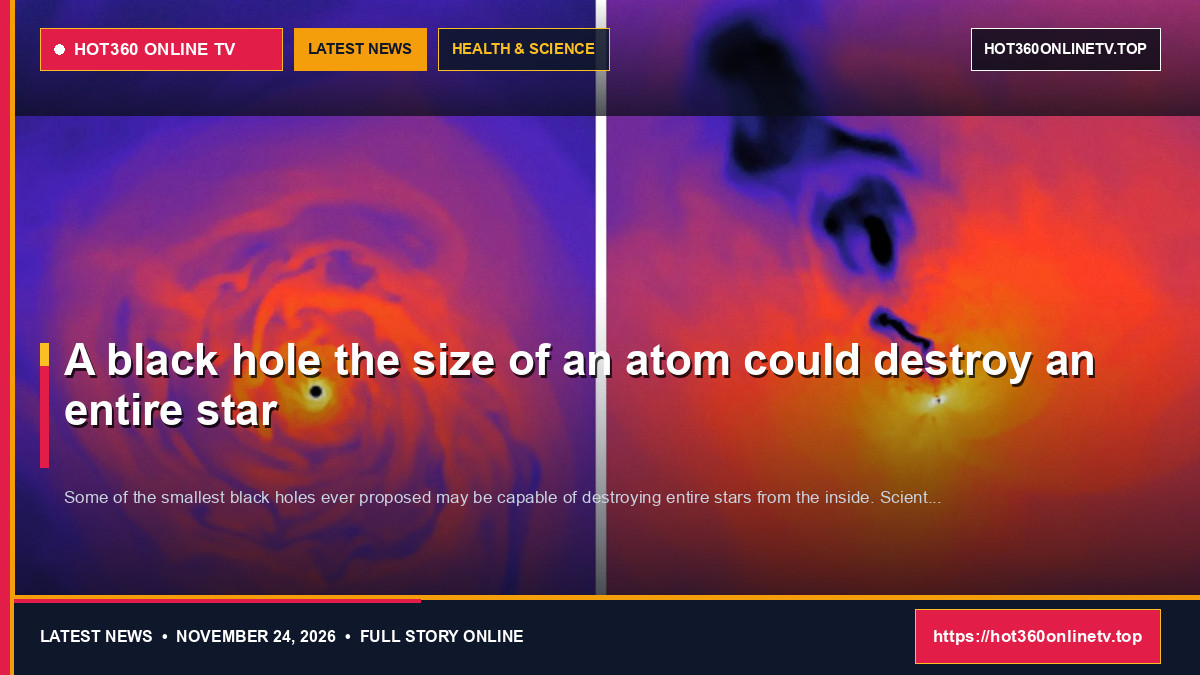
Some of the smallest black holes ever proposed may be capable of destroying entire stars from the inside. Scientists believe these mysterious objects, known as primordial black holes, could have formed during the first fraction of a second after the Big Bang, when extremely dense regions of matter collapsed under their own gravity. If they exist, these ancient remnants could also account for a substantial portion of dark matter, the invisible material that makes up most of the matter in the universe.
Researchers at MIT and other institutions have now identified a possible way to find them. Using theoretical calculations and computer simulations in three dimensions, the team investigated what would happen if a primordial black hole became trapped inside a star similar to our Sun.
Their study, published in The Astrophysical Journal, describes a remarkable possibility. A black hole no larger than an atom, but carrying the mass of an asteroid, could gradually sink toward the center of a star and begin consuming it from within.
If the star rotates rapidly enough, material falling toward the black hole would eventually form a spinning disk around it. That development could set the stage for a catastrophic explosion.
"Once the disk forms, this is essentially a death sentence for the star," says lead author Ore Gottlieb, an assistant professor of physics at MIT.
The interaction between the black hole and the surrounding disk could produce enormous jets of matter that punch through the star and cause it to explode within seconds. Researchers predict that the resulting outburst would emit intense blue and ultraviolet light, along with X-rays and gamma rays, potentially making it visible to telescopes already in operation.
"There is hope for us to probe primordial black holes through interactions with stars," Gottlieb says. "We expect this to be visible, and it's something we should look into."
The research team also included Matteo Cantiello of the Flatiron Institute, Cameron Norton and Matthew Kleban of New York University, and Ken Van Tilburg of Stanford University.
Ancient Black Holes That May Have Survived the Big Bang
Not every primordial black hole formed in the early universe would still exist today. According to a theory developed by physicist Stephen Hawking, black holes gradually lose energy through a quantum process called Hawking radiation. Over immense periods of time, this process causes them to shrink, and the smallest primordial black holes would already have evaporated completely.
Heavier primordial black holes, however, could have survived to the present day. Some might be approximately the size of an atom while containing as much mass as an asteroid (or about a millionth of the mass of the Earth).
These extraordinary objects raise an intriguing question. If they are still scattered throughout the universe, what would happen when one encounters a star? More importantly, could the resulting interaction provide the evidence needed to establish that primordial black holes actually exist?
To investigate, Gottlieb and his colleagues combined mathematical calculations with numerical simulations incorporating general relativity, fluid dynamics, stellar evolution, and particle physics. Their goal was to understand how a primordial black hole could become trapped by a star and what would happen afterward.
How a Tiny Black Hole Could Become Trapped Inside a Star
The researchers found that a star acting alone generally could not capture a primordial black hole passing nearby. Its gravitational attraction would be insufficient to keep the black hole from escaping.
The situation changes when another object is involved. A companion star or planet could alter the gravitational interaction enough to allow the primordial black hole to become trapped.
In this arrangement involving three objects, the black hole could repeatedly travel through the star. Each passage would create friction as it moved through stellar material, gradually draining energy from its orbit and drawing it closer to the star's center.
The process could take thousands or even millions of years. Although that sounds extraordinarily slow, it is relatively brief compared with the age of the universe.
Eventually, the black hole would settle into the star's core, where it could begin feeding on the surrounding material.
"Then, this is where the action begins," Gottlieb says.
A Black Hole Could Slowly Consume a Star From Within
Once the primordial black hole reaches the stellar core, its growth depends partly on what happens to the energy generated as gas falls toward it. Some of that energy can heat the surrounding material, potentially slowing the rate at which additional gas falls inward.
The team's simulations indicate that most of the energy would instead disappear into the black hole. This would allow it to accumulate matter more rapidly than earlier estimates suggested.
Over several million years, the growing black hole could consume approximately 1 percent of the star's total mass. At that stage, its fate would depend heavily on how quickly the star rotates.
If the star spins fast enough, gas would no longer be able to plunge directly into the black hole. Instead, the material would gather into a rotating disk around the black hole, which would by then have grown to several meters in size.
"Inside the star, you have a black hole with a disk," Gottlieb says. "The black hole is also spinning, and it's twisting space and time."
As the disk continues feeding the black hole, the extreme rotation twists the magnetic field threading the surrounding material. This process could generate exceptionally powerful jets that shoot outward from the black hole's poles.
"This twisted magnetic field will power very strong electromagnetic jets from the poles of the black hole," Gottlieb explains. "And these jets will just explode the star, within a few dozen seconds. It's very fast. Once you have a disk, you are done."
What began as a tiny black hole hidden inside an otherwise ordinary star could therefore end in a violent explosion, with the star's destruction unfolding in a matter of seconds once the critical conditions are reached.
Exploding Stars Could Reveal Primordial Black Holes and Dark Matter
The researchers also calculated what these unusual explosions might look like to astronomers, estimating how their brightness and color would change across different wavelengths of light.
Their models predict a recognizable sequence of emissions, beginning with high-energy radiation and progressing through other parts of the electromagnetic spectrum as the explosion evolves. The initial outburst could include intense blue and ultraviolet light, along with gamma rays and X-rays.
"We would initially detect some X-rays and gamma rays, then over time optical and infrared emissions, and later on radio emissions," Gottlieb says. "This is something we could potentially detect, if it's not happening too far from us. It could be many galaxies away, not just in our backyard."
Such signals could be detectable with existing astronomical instruments, potentially allowing researchers to search for primordial black holes far beyond the Milky Way.
However, identifying one would not be straightforward. Other cosmic events can generate similar flashes of radiation, so an unusual explosion alone would not establish that a primordial black hole was responsible.
Astronomers would need to examine additional evidence, including the characteristics of the exploding star. One especially revealing clue would be an explosion involving a star that would not ordinarily be expected to meet such a violent end.
"For instance, if the star is a certain mass that is not supposed to explode, it must be something that is happening inside that is a sort of parasite that is consuming the star from the inside," Gottlieb says. "The broader impact is that we can now place constraints on primordial black holes, and their contributions to dark matter, using observations."
Even if no convincing examples are found, the search could help scientists determine how common primordial black holes might be and how much dark matter they could account for.
For now, primordial black holes remain hypothetical. But the new research offers astronomers a possible observational signature to pursue, connecting the spectacular destruction of stars with objects that may have existed since the universe's earliest moments.
The research received partial support from the U.S. Department of Energy Office of Science Advanced Scientific Computing Research Program and the National Science Foundation.
• RELATED TOPICS Space & Time Space Exploration Black Holes Space Telescopes NASA Astrophysics Dark Matter Asteroids, Comets and Meteors Galaxies
• Space & Time Space Exploration Black Holes Space Telescopes NASA Astrophysics Dark Matter Asteroids, Comets and Meteors Galaxies
• Asteroids, Comets and Meteors
• RELATED TERMS Dark matter Big Bang Galaxy Dark energy Galaxy formation and evolution Big Bang nucleosynthesis Large-scale structure of the cosmos Cosmic microwave background radiation
• Galaxy formation and evolution
• Big Bang nucleosynthesis
• Large-scale structure of the cosmos
• Cosmic microwave background radiation
Materials provided by Massachusetts Institute of Technology. Original written by Jennifer Chu. Note: Content may be edited for style and length.
• Ore Gottlieb, Matteo Cantiello, Cameron Norton, Ken Van Tilburg, Matthew Kleban. The Life and Death of Stars that Capture Primordial Black Holes. The Astrophysical Journal, 2026; 1012 (1): 157 DOI: 10.3847/1538-4357/aeb7e1
Explore More
Researchers Just Sent an Unblockable Message Through a Solid Wall Using Gravity
Your Personality May Be Partly Written in Your DNA, Massive Study of 1 Million People Reveals
A Tiny Region of the Brain Could Hold the Key to Understanding Early Alzheimer’s Symptoms
Two Overlooked “Forever Chemicals” Linked To More Than Double the Risk of Liver Cancer