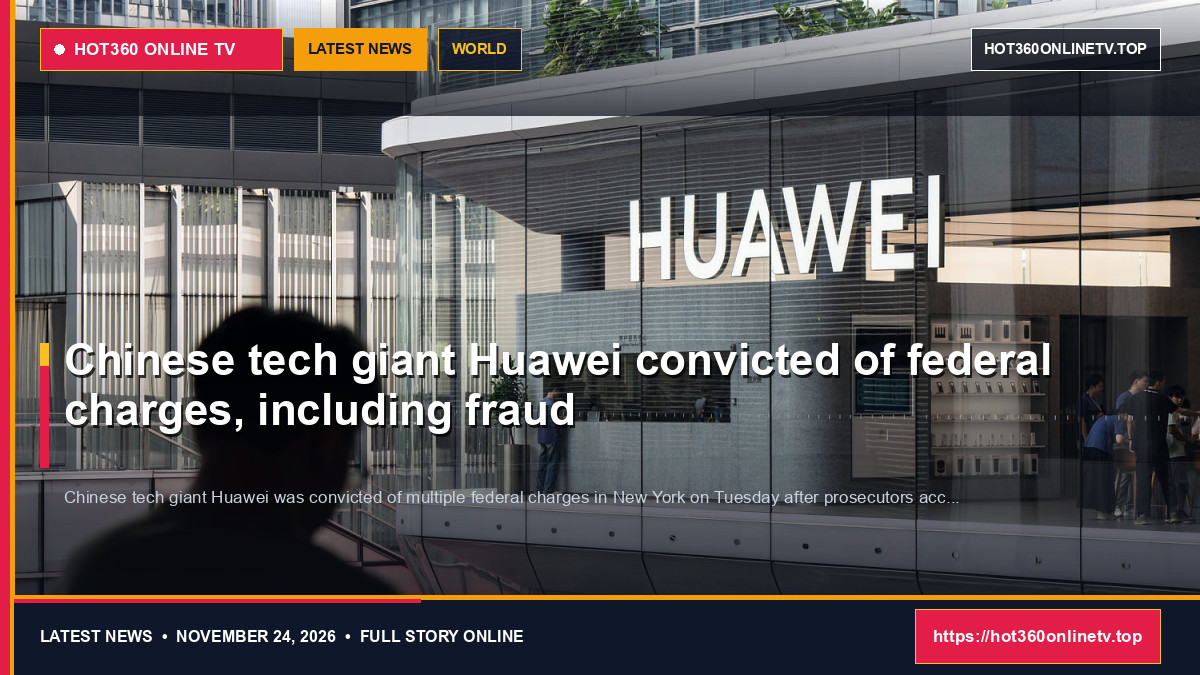
Chinese tech giant Huawei was convicted of multiple federal charges in New York on Tuesday after prosecutors accused the company of stealing technology from U.S. companies, abusing the American financial system and helping Iran spy on its citizens.
A jury in New York’s Eastern District found the company and three of its subsidiaries guilty of seven conspiracy counts that included bank fraud, wire fraud, money laundering, defrauding the United States and conspiracy to steal trade secrets.
In the roughly two-month trial, Huawei was also convicted of bank fraud and wire fraud. Huawei was acquitted of two counts, a racketeering conspiracy and conspiracy to obstruct justice.
“For over two decades, Huawei built its global empire on a foundation of fraud, theft and deception,” Assistant Attorney General Tysen A. Duva said in a statement. “Huawei’s crimes threatened the U.S. financial system, took advantage of American companies that compete honestly in the global telecommunications market, and undermined our national security.”
In a statement, Huawei said the charges are “without legal or factual merit,” and it said it welcomes the racketeering verdict.
“We will thoroughly review the relevant verdicts and take all necessary legal actions to defend our rights and interests,” the company said.
Huawei attorney Brian Heberling said the company plans to appeal. At sentencing, which is scheduled for Sept. 14, Huawei could face fines, forfeiture and restitution.
Prosecutors accused the company, which makes smartphones and has telecom networks around the world, of encouraging its workforce of 200,000 in 170 countries to lie, cheat, and steal “for a competitive advantage to grow and protect its business.”
Huawei was accused of misappropriating intellectual property like source code, user manuals for internet routers, antenna technology and robot testing technology, prosecutors said. T-Mobile, Cisco, Quintel and CNEX were among the companies whose technology was stolen, federal prosecutors said in a news release Tuesday.
For Subscribers
FOR SUBSCRIBERSIowans brace for the Army’s detonation of toxic lead
FOR SUBSCRIBERS‘Definitely possible’ for Democrats to win 60 Senate seats in 2028, campaign chief says
FOR SUBSCRIBERSTrump’s Nvidia intervention could fuel tech oligarchy, experts warn
FOR SUBSCRIBERSNew York governor Kathy Hochul signs AI toy ban into law
FOR SUBSCRIBERS‘I clearly heard the voice of the devil’: Pope Francis’ private diary reveals spiritual crisis
FOR SUBSCRIBERSHow the race to build massive AI data centers is draining global power and water
FOR SUBSCRIBERSTrump administration officials debating targeting Iran’s leaders, sources say
FOR SUBSCRIBERSChina cheers Jensen Huang’s dramatic return, even as political fallout deepens
FOR SUBSCRIBERSDemocrats probing ‘serendipitous timing’ of investments by firm linked to Donald Trump Jr.
FOR SUBSCRIBERSThe Data Dive: A look at some of the cycle’s most unique ballot measures
FOR SUBSCRIBERSDemocrats grumble about the DNC’s plan for the 2028 primary debates
FOR SUBSCRIBERSWhere the redistricting battle could go after the midterms
FOR SUBSCRIBERSHow Trump and Vance came to Jensen Huang’s rescue
FOR SUBSCRIBERSWhat Jensen Huang’s return to Nvidia means for AI chip sales to China
FOR SUBSCRIBERSICE arrests at airports mean ‘huge risk’ for some immigrants traveling, attorneys warn
In Iran, the company assisted the regime with “turnkey” internet services and mobile networks, prosecutors said, and it provided surveillance cameras that allowed officials to monitor protests. Huawei also helped intelligence agents monitor and censor the internet, prosecutors said.
Huawei then lied to banks about the nature of its business in Iran, allowing the company to obtain billions of U.S. dollars and become what prosecutors described as “a sophisticated participant in a global marketplace for telecommunications services.”
In an interview Tuesday, Heberling rejected the government’s allegations, saying prosecutors presented a “caricature-like portrait” of Huawei of as a corrupt organization with company policies that condoned crime.
“That was just profoundly inconsistent with the company that I experienced in my work, but more importantly, [with] the evidence, which really showed a series of isolated events over a 20-year period,” he said. “No company can insure perfection over that period of time.”
Heberling argued that the racketeering acquittal — the most serious charge the company faced — showed a “profound rejection of the narrative the United States pursued in this case.”
Huawei was previously banned from selling equipment to U.S. carriers over fears that it poses a security risk, according to the Associated Press, and it was blacklisted by other Western allies, including Canada and Britain.