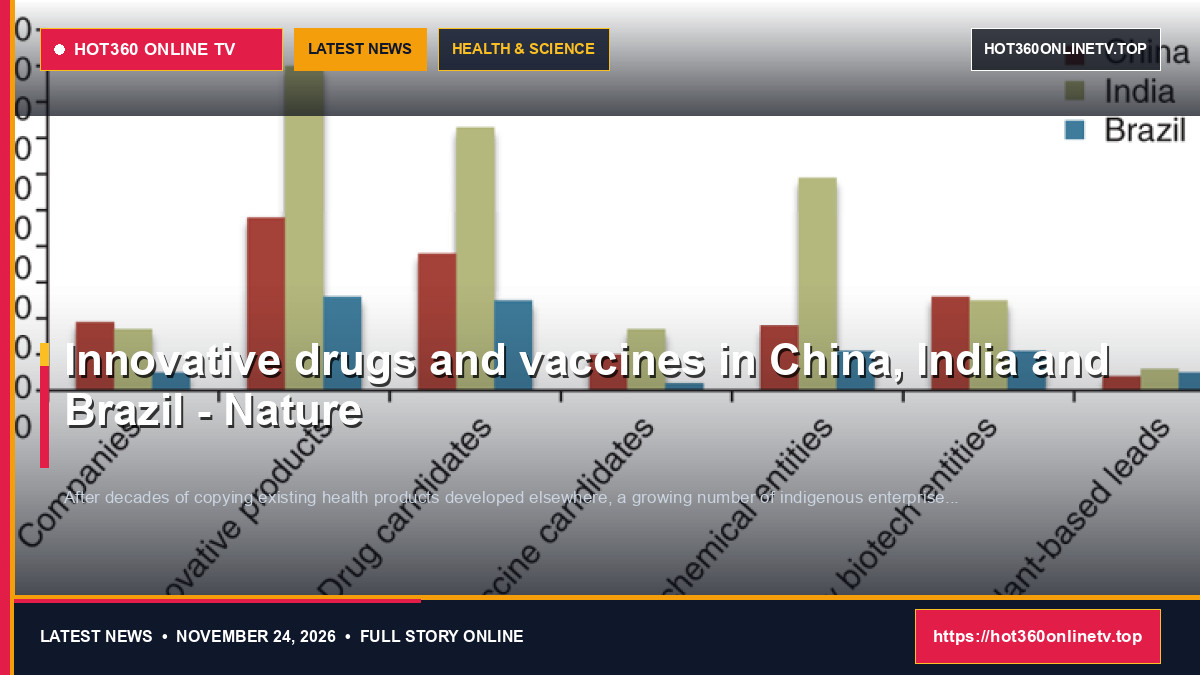
After decades of copying existing health products developed elsewhere, a growing number of indigenous enterprises in China, India and Brazil have begun to develop innovative products of their own. This change has been sparked by these countries' adoption of pharmaceutical product patent regimes—as part of their commitments under the World Trade Organization's Trade-Related Aspects of Intellectual Property Rights (TRIPS) agreement—and enhanced governmental support for innovation. During the past 4 years, we have published a series of articles in this journal discussing health biotech sectors in China, India and Brazil1,2,3. Each of those studies focused on indigenous health biotech enterprises and covered products and services, partnerships, intellectual property portfolios, business models, financial environments, entrepreneurial barriers to innovation and recommendations for advancing health biotech innovation in each country. Here, we build upon and update the aforementioned studies by focusing more directly on innovative vaccines and therapeutics in the pipelines of indigenous enterprises in China, India and Brazil. Specifically, we examine pharmaceutical innovations based on small-molecule drug development involving new chemical entities (NCEs); biotech innovations based on large molecules, nucleic acids, proteins and/or peptides and whole cells (collectively referred to as biotechnological entities); innovations involving traditional medicines, herbal compounds and other biodiversity resources, which we collectively referred to as plant-based medicines; the extent to which the products and/or technologies identified have been in-licensed from foreign sources or out-licensed to them; and how the disease focus of the overall innovation pipelines of Chinese, Indian and Brazilian firms compare with drug and vaccine innovation in the industrialized world, as judged by the US Food and Drug Administration (FDA) approvals over the past 15 years.
This is a preview of subscription content, access via your institution
Access options
Receive 12 print issues and online access
• Purchase on SpringerLink
• Instant access to the full article PDF.
Prices may be subject to local taxes which are calculated during checkout
Explore related subjects
• Intellectual-property rights
• Pharmaceutical Innovation Systems and Market Dynamics
References
• Frew, S.E. et al. Nat. Biotechnol. 26, 37–53 (2008).Article CAS Google Scholar
Frew, S.E. et al. Nat. Biotechnol. 26, 37–53 (2008).
Article CAS Google Scholar
• Frew, S.E. et al. Nat. Biotechnol. 25, 403–417 (2007).Article CAS Google Scholar
Frew, S.E. et al. Nat. Biotechnol. 25, 403–417 (2007).
Article CAS Google Scholar
• Rezaie, R. et al. Nat. Biotechnol. 26, 627–644 (2008).Article CAS Google Scholar
Rezaie, R. et al. Nat. Biotechnol. 26, 627–644 (2008).
Article CAS Google Scholar
• McMahon, D.S., Thorsteinsdóttir, H., Singer, P.A. & Daar, A.S. Regen. Med. 5, 35–44 (2010).Article Google Scholar
McMahon, D.S., Thorsteinsdóttir, H., Singer, P.A. & Daar, A.S. Regen. Med. 5, 35–44 (2010).
• Liang, X. et al. Vaccine 27, 6550–6557 (2009).Article Google Scholar
Liang, X. et al. Vaccine 27, 6550–6557 (2009).
• Perz, J., Armstrong, G.L., Farrington, L.A., Hutin, Y.J.F. & Bell, B.P. J. Hepatol. 45, 529–538 (2006).Article Google Scholar
Perz, J., Armstrong, G.L., Farrington, L.A., Hutin, Y.J.F. & Bell, B.P. J. Hepatol. 45, 529–538 (2006).
• He, J. et al. N. Engl. J. Med. 353, 1124–1134 (2005).Article CAS Google Scholar
He, J. et al. N. Engl. J. Med. 353, 1124–1134 (2005).
Article CAS Google Scholar
• Yu, M. & Yuan, J. Semin. Cancer Biol. 12, 421–429 (2002).Article Google Scholar
Yu, M. & Yuan, J. Semin. Cancer Biol. 12, 421–429 (2002).
• Jia, W. et al. BMC Cancer 6, 178 (2006).Article Google Scholar
Jia, W. et al. BMC Cancer 6, 178 (2006).
• Ramachandran, A. et al. Diabetologia 44, 1094–1101 (2001).Article CAS Google Scholar
Ramachandran, A. et al. Diabetologia 44, 1094–1101 (2001).
Article CAS Google Scholar
• Shaw, J.E., Sicree, R.A., Zimmet, P.Z. Diabetes Res. Clin. Pr. 87, 4–14 (2010).Article CAS Google Scholar
Shaw, J.E., Sicree, R.A., Zimmet, P.Z. Diabetes Res. Clin. Pr. 87, 4–14 (2010).
Article CAS Google Scholar
• Daar, A.S. et al. Nature 450, 494–496 (2007).Article CAS Google Scholar
Daar, A.S. et al. Nature 450, 494–496 (2007).
Article CAS Google Scholar
Acknowledgements
We gratefully acknowledge the comments of J. Clark. We are indebted to the numerous interviewees in Brazil, China and India for sharing their time, experiences and insights with us. This research was funded by Genome Canada through the Ontario Genomics Institute (Toronto), the Ontario Research Fund (Toronto), Rockefeller Foundation (New York) and BioVentures for Global Health (Washington, DC, USA). R.R. was supported by a Doctoral Research Award from the Canadian Institutes of Health Research, and a post-doctoral research fellowship from the University of Toronto's Rotman School of Management and Munk School of Global Affairs, and the Asia Pacific Foundation of Canada (Vancouver). This research was based at the Sandra Rotman Centre (S.R.C.), the University of Toronto and the University Health Network (Toronto). The S.R.C. is financially supported from a variety of sources (http://www.srcglobal.org/).
Author information
Authors and Affiliations
• Rotman School of Management and Munk School of Global Affairs, University of Toronto, Toronto, Ontario, CanadaRahim Rezaie, Anita M McGahan & Peter A Singer
Rotman School of Management and Munk School of Global Affairs, University of Toronto, Toronto, Ontario, Canada
Rahim Rezaie, Anita M McGahan & Peter A Singer
• Asia Pacific Foundation of Canada, Vancouver, British Columbia, CanadaRahim Rezaie
Asia Pacific Foundation of Canada, Vancouver, British Columbia, Canada
• Sandra Rotman Centre, University Health Network and University of Toronto, Toronto, Ontario, CanadaAbdallah S Daar
Sandra Rotman Centre, University Health Network and University of Toronto, Toronto, Ontario, Canada
• Grand Challenges Canada, Toronto, Ontario, CanadaAbdallah S Daar
Grand Challenges Canada, Toronto, Ontario, Canada
• Rahim RezaieView author publicationsSearch author on:PubMed Google Scholar
Search author on:PubMed Google Scholar
• Anita M McGahanView author publicationsSearch author on:PubMed Google Scholar
Search author on:PubMed Google Scholar
• Abdallah S DaarView author publicationsSearch author on:PubMed Google Scholar
Search author on:PubMed Google Scholar
• Peter A SingerView author publicationsSearch author on:PubMed Google Scholar
Search author on:PubMed Google Scholar
Corresponding author
Correspondence to Peter A Singer.
Ethics declarations
Competing interests
P.A.S. is on the scientific advisory board of BioVeda China Fund.
Supplementary information
Supplementary Text and Figures (download PDF )
Supplementary Figures 1–2 and Supplementary Tables 1–4 (PDF 463 kb)
Rights and permissions
About this article
Cite this article
Rezaie, R., McGahan, A., Daar, A. et al. Innovative drugs and vaccines in China, India and Brazil. Nat Biotechnol 30, 923–926 (2012). https://doi.org/10.1038/nbt.2380
• Published: 10 October 2012
Published: 10 October 2012
• Issue date: October 2012
• DOI: https://doi.org/10.1038/nbt.2380
DOI: https://doi.org/10.1038/nbt.2380
Anyone you share the following link with will be able to read this content:
Sorry, a shareable link is not currently available for this article.
Provided by the Springer Nature SharedIt content-sharing initiative