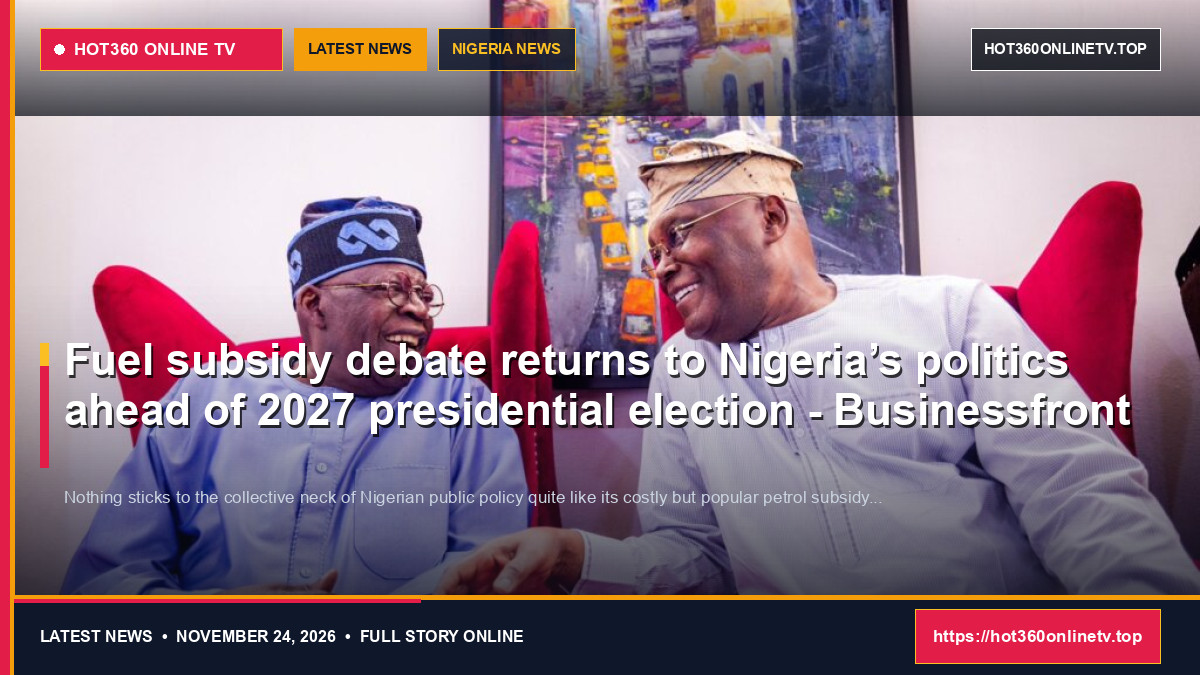
Nothing sticks to the collective neck of Nigerian public policy quite like its costly but popular petrol subsidy.
When Bola Tinubu, the nation’s president, announced its removal in May 2023 and pump prices leapt by more than 250%, chaos followed. Since then Mr Tinubu has kept that chaos mostly at bay by promising better welfare programmes and arguing that the policy, however painful, serves the long-term interest of the average Nigerian. This truce now looks shaky.
Atiku Abubakar, the main opposition leader, said in a widely watched Hausa language interview that he would bring the subsidy back if elected in 2027. The choice of language was telling. Mr Atiku appeared to be speaking directly to his political base, a constituency in the country’s north where the subsidy question has never quite been settled.
Nigeria is a poor country that depends heavily on oil for government revenue and foreign exchange, yet imports most of the fuel its 220 million people burn. This contradiction has shaped four decades of politics. It also explains why a debate about pump prices can still decide the upcoming election.
Mr. Atiku wants to follow every barrel
Mr Atiku’s pitch is more technical than a simple return to the old system. “The principle is simple: the subsidy will follow the barrel,” he said, in what his campaign officials describe as an economic recovery plan. The idea is to shift support “from importation to production, from middlemen to Nigerian refineries, and from unverifiable claims to verifiable barrels.”
Crude allocation, refinery output and domestic deliveries would all be reconciled, he says, so that every subsidised barrel can be tracked from the wellhead to the petrol pump. He insists this is not meant to be permanent.
The goal, he says, is “to use temporary and disciplined support to build a refining industry strong enough eventually not to need subsidy.”
But even a technical approach to subsidy is not in itself always an obtainable solution in a faux system like Nigeria. So many factors will need to be considered for it to be successful.
Who picks up the bill
On its part, the presidency is unconvinced. It argues that the old arrangement was never a harmless discount. It meant the state absorbing the gap between the regulated price and the real cost of supplying petrol, financed through borrowing and other public sector schemes. Millions of barrels of crude were pledged against loans used to keep the scheme afloat.
By 2024 the state oil company, NNPC, owed suppliers billions of dollars. The presidency poses a blunt question. If subsidy returns, who pays for it?
What would the new pump price be? Petrol’s real cost runs to about N1,200 ($0.89) or N1,300 ($0.96) a litre, so somebody has to cover the difference, the presidency said in an official statement.
This burden, it argues, would eventually fall on infrastructure spending, state and local government allocations, or more borrowing and debt.
Reviving the subsidy, a commentator warns, would drag Nigeria back into fiscal habits it has wrestled with for four decades.
In 1986 General Ibrahim Babangida raised petrol prices by 97%, citing the same fiscal pressures, at a time when Nigeria still refined its own fuel domestically.
“When you sell petrol at a price significantly lower than your neighbouring countries, you incentivise smuggling. Even the military, with near absolute control over security, could not stop smuggling,” a commentator says. “The promise to cap what we spend on subsidy is just glib talk. We will soon return to subsidising the West African subregion, and the subsidy bill will keep expanding.”
There is also a revenue case against Mr Atiku’s plan. Since subsidy removal, monthly allocations to the federal, state and local governments have surged.
In July 2026 alone gross federal account revenue reached N5.15 trillion (about $3.8 billion), more than 40% of the total for the whole of 2022. This windfall has allowed governments to fund a doubled minimum wage.
Subsidy returns to campaign trails
Whether voters find the technical version of subsidy more persuasive than the old one remains to be seen. What is clear is that petrol prices, more than growth figures or inflation data, still set the tempo of Nigerian politics.
As 2027 draws closer, both camps are wagering that Nigerians will vote with their fuel gauges rather than their calculators.
Nigeria has been here before. Subsidy has been declared dead and then resurrected more times than most Nigerians care to count, from the partial removals under Olusegun Obasanjo to the reversals under Goodluck Jonathan after the 2012 fuel strikes.
Each time the government of the day insisted the subsidy could not return, and each time politics found a way to put it back on the table. Mr Tinubu’s removal in 2023 was billed as the final word. Mr Atiku’s Hausa interview suggests the word was never quite final.
The trouble for both sides is that voters rarely engage with subsidy the way economists do. A barrel tracked from allocation to refining to delivery is an elegant idea on paper, but it means little to a driver who only wants to know what a litre costs on Monday morning. Numbers convince economists. Petrol prices convince voters.
This is the real contest ahead of 2027. Mr Atiku must persuade Nigerians that a subsidy dressed in spreadsheets and barrel counts will not repeat the sins of the old one. Mr Tinubu’s camp must persuade the same voters that the pain of the last three years has actually bought something durable, rather than merely balanced the books in Abuja.
Whichever argument wins will owe less to petroleum economics than to the oldest currency in politics: trust.