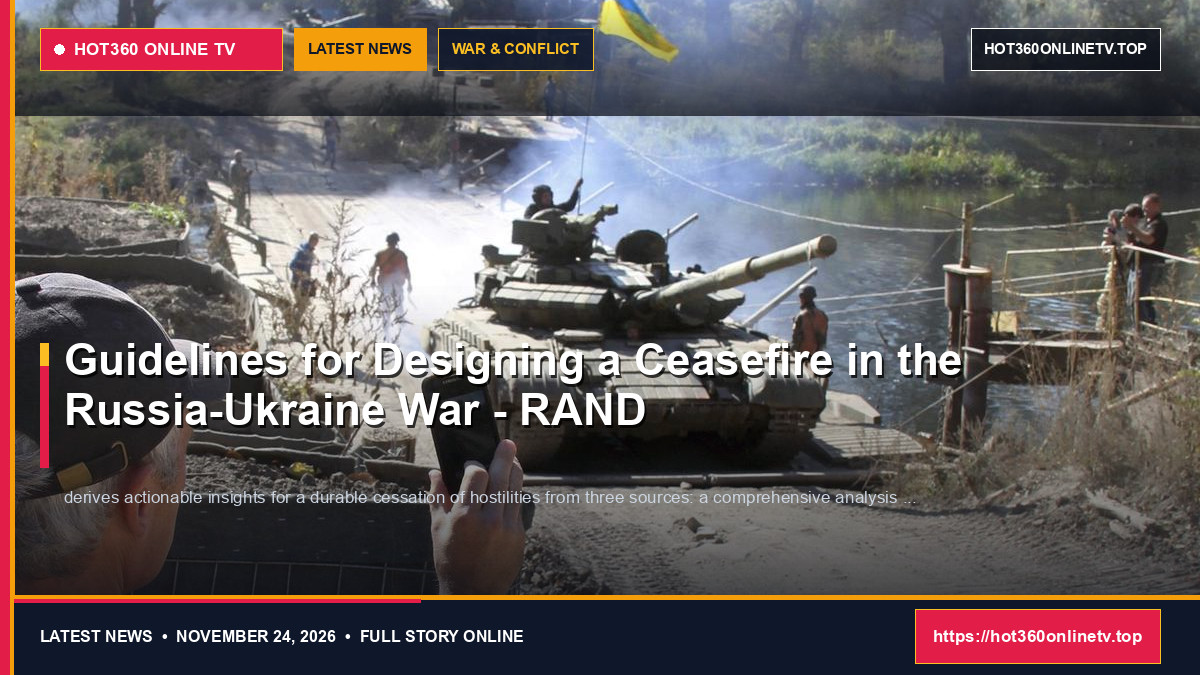
derives actionable insights for a durable cessation of hostilities from three sources: a comprehensive analysis of best practices in establishing and maintaining ceasefires; a review of lessons learned from pre-2022 ceasefire efforts in Ukraine; and an assessment of emerging remote-sensing technologies and how they can enhance ceasefire monitoring.
Best Practices, Lessons Learned, and the Role of Technology
Samuel Charap, Joe Haberman, Katherine Anna Trauger, Benjamin Sakarin, Scott Savitz
ResearchPublished Sep 17, 2025
The Russia-Ukraine war is the largest military conflict in Europe since World War II. A ceasefire—an accord between the belligerents to cease active hostilities and avoid their resumption—will be a key component of any negotiated end to the war. Under any circumstances, designing, agreeing on, and implementing a ceasefire are extremely challenging tasks. The specific circumstances of the Russia-Ukraine war make doing so even more difficult. The conflict line is roughly 3,300 km long, spans land and sea, abuts multiple international borders, and crisscrosses heavily mined areas. The extremely high level of mistrust between the belligerents makes any agreements between them politically fraught. A ceasefire will create military vulnerabilities that both sides will worry could be exploited by the other side for tactical gain. And Russia and Ukraine have had recent experience, with the 2014–2021 Minsk agreements, of a ceasefire that never achieved a sustainable end to the fighting.
This report presents actionable insights for a durable cessation of hostilities derived from three sources: a comprehensive analysis of best practices in establishing and maintaining past ceasefires, particularly after interstate wars; a review of lessons learned from the pre-2022 ceasefire efforts in Ukraine; and an assessment of emerging remote-sensing technologies and how they can enhance ceasefire monitoring. Drawing on this original research, the authors provide recommendations for policymakers and stakeholders working toward a durable peace in Ukraine.
Key Takeaways
• The analysis of past ceasefires shows that certain measures are associated with a more durable peace and, thus, should be included in a future Russia-Ukraine agreement. These include demilitarized zones (DMZs), dispute-resolution mechanisms, and third-party monitoring. In addition, past practice demonstrates the importance of formal agreements over informal ones and of accords that are precise and well elaborated rather than general statements of principle.
• The history of the failure of the Minsk agreements offers important lessons for future ceasefire negotiations, including the need for accountability mechanisms, a separate negotiation track for addressing overarching geopolitical questions, and preparation far in advance of the start of formal talks.
• Remote-sensing technologies will play a critical role in any future third-party monitoring mission in Ukraine given the scale and danger of the conflict line and the otherwise unachievable persistence of monitoring attained through remote sensing. To monitor the conflict line comprehensively, a third-party ceasefire-monitoring mission should deploy a combined and integrated suite of remote-sensing technologies with capabilities and systems tailored to Ukraine’s unique geographic conditions.
Recommendations
• Negotiate overarching geopolitical questions in parallel with, but on a separate track from, ceasefire discussions.
• Start working on the ceasefire design long before negotiations begin.
• Design a formal ceasefire agreement that clearly specifies assigned roles and responsibilities, protocols, and operating procedures.
• Ensure that the agreement includes the following key components: (1) DMZs along the frontline; (2) confidence-building measures, particularly mutual military inspection, on-site verification visits, and aerial surveillance; (3) dispute-resolution mechanisms that involve the conflict parties in joint commissions; (4) an extensive third-party monitoring mechanism; and (5) robust accountability mechanisms to identify, punish, and deter noncompliance.
• Include a robust remote-sensing infrastructure, featuring uncrewed aerial vehicles, aerostats, fixed ground sensors, satellites, buoys, and uncrewed surface vehicles.
• Ensure that the agreement treats interference with remote sensors as a violation.
• Include mechanisms that allow for political-level oversight of implementation and possibly specified conditions that would trigger renegotiation.
• Military Demobilization
• Peacekeeping and Stability Operations
Document Details
• Availability: Web Only
• DOI: https://doi.org/10.7249/RRA3987-1
• Document Number: RR-A3987-1
RAND Style Manual
Chicago Manual of Style
Research conducted by
• RAND National Security Research Division
This research was sponsored by Carnegie Corporation of New York and conducted within the International Security and Defense Policy (ISDP) Program of the RAND National Security Research Division.
This publication is part of the RAND research report series. Research reports present research findings and objective analysis that address the challenges facing the public and private sectors. All RAND research reports undergo rigorous peer review to ensure high standards for research quality and objectivity.
This document and trademark(s) contained herein are protected by law. This representation of RAND intellectual property is provided for noncommercial use only. Unauthorized posting of this publication online is prohibited; linking directly to this product page is encouraged. Permission is required from RAND to reproduce, or reuse in another form, any of its research documents for commercial purposes. For information on reprint and reuse permissions, please visit www.rand.org/pubs/permissions.
RAND is a nonprofit institution that helps improve policy and decisionmaking through research and analysis. RAND's publications do not necessarily reflect the opinions of its research clients and sponsors.