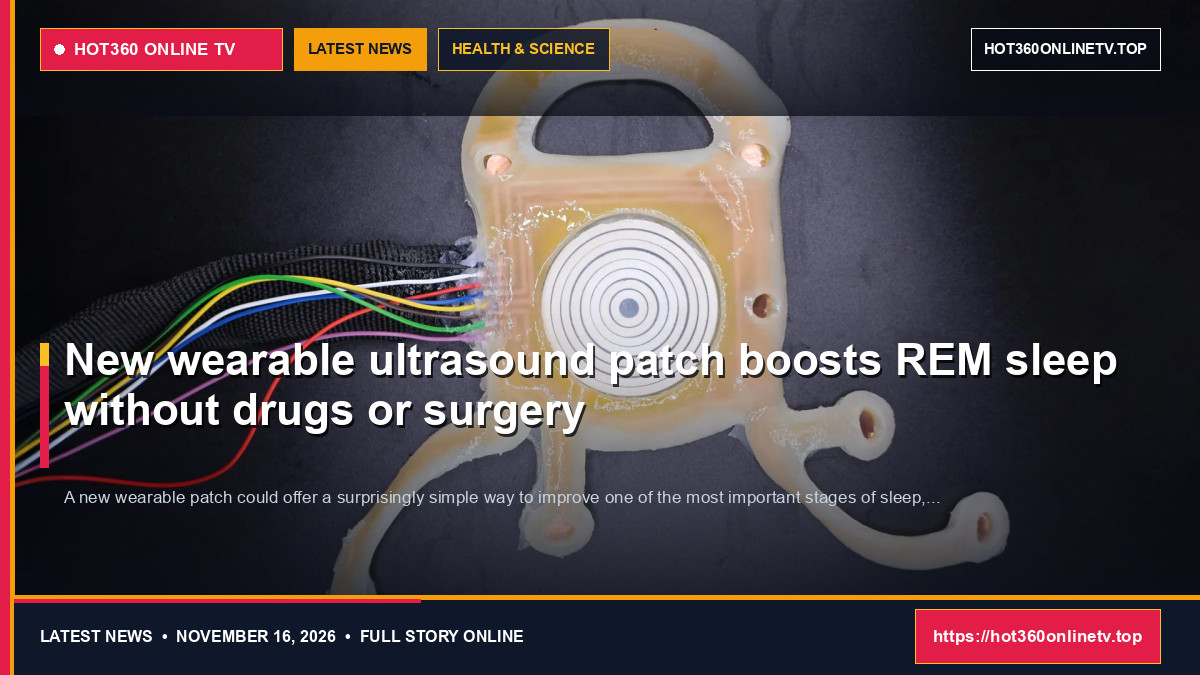
A new wearable patch could offer a surprisingly simple way to improve one of the most important stages of sleep, without relying on medication or surgery. Developed by researchers led by the University of Texas at Austin, the device uses gentle ultrasound waves to stimulate regions deep inside the brain, helping people enter REM sleep sooner and spend more time in this restorative stage.
Known as NEUSLeeP, the soft patch attaches to the skin and combines ultrasound stimulation with electrodes that monitor brain activity in real time. This allows researchers to influence brain regions involved in sleep while simultaneously tracking how the brain responds.
REM sleep, short for rapid eye movement sleep, is the stage when most vivid dreaming occurs. It also plays an important role in processing emotions, consolidating memories, and adapting to stress. Disturbances in this stage of sleep have been associated with several mental health conditions, making it an important target for new treatments.
"This is the first time we've been able to noninvasively target deep brain regions involved in REM sleep, while simultaneously monitoring brain activity," said Kai Wing "Kevin" Tang, a recent UT biomedical engineering Ph.D. graduate who led the research effort.
"Our skin-attached NEUSLeeP patch opens up new possibilities for understanding sleep and treating sleep disorders in home settings," added Huiliang "Evan" Wang, assistant professor in the Cockrell School of Engineering's Department of Biomedical Engineering. Wang supervised Tang's research and served as the principal investigator (PI) overseeing the project.
Sleep Patch Helps People Reach REM Sleep 43 Minutes Faster
The early results suggest that the technology can make a measurable difference in how people experience REM sleep.
In a study involving 28 participants, published in Nature Communications, people using the patch entered REM sleep an average of 43 minutes sooner and spent approximately 16 additional minutes in that stage.
These improvements were observed in both healthy sleepers and participants experiencing certain sleep difficulties. The volunteers also reported that the patch was comfortable to wear, with minimal adverse effects.
Unlike medications that affect the body more broadly, NEUSLeeP is designed to deliver stimulation to specific brain regions involved in sleep regulation. It uses ultrasound, a form of sound energy with frequencies beyond human hearing, to reach areas beneath the surface of the brain without requiring an invasive procedure.
The findings are encouraging, although the relatively small study means that larger trials will be needed to determine how consistently the technology works and whether its benefits persist over time.
Potential Benefits for Stress and Emotional Health
The researchers also found evidence that the patch's effects may extend beyond increasing REM sleep.
Among healthy participants, ultrasound stimulation improved heart rate variability, a measure of the natural differences in time between consecutive heartbeats. This measurement provides insight into how the body's nervous system responds to stress and adjusts to changing conditions.
Brain imaging revealed changes in neural circuits involved in emotional processing. Together, these findings suggest that improving REM sleep through targeted stimulation could potentially support emotional regulation and the ability to cope with stress.
"REM sleep is not just about dreaming -- it's about emotional reset and stress adaptation," explained Gregory Fonzo, assistant professor in the Dell Medical School's Department of Psychiatry and Behavioral Sciences and one of the project's co-PIs. "By enhancing REM, we may help people better cope with stress and improve their overall well-being."
These possibilities are especially interesting because REM sleep disturbances have been linked to depression, anxiety, and post-traumatic stress disorder (PTSD).
Current approaches to sleep problems often involve medication or behavioral therapy. Although these treatments can be effective, medications may produce unwanted side effects, and existing approaches do not always directly address the biological processes responsible for disrupted REM sleep.
A device capable of influencing those processes without drugs or surgery could therefore offer an additional treatment option. However, the researchers have not yet established whether NEUSLeeP can improve symptoms of mental health disorders.
A New Direction for Treating Insomnia and PTSD
Building on the initial findings, the research team plans to conduct larger clinical trials to confirm the patch's effects and investigate its potential use in people with PTSD, depression, and chronic insomnia.
Beyond treating sleep disorders, the technology could eventually support sleep monitoring at home and provide scientists with a new way to study how deep brain regions influence sleep. Researchers also envision personalized therapies that could be adjusted to individual sleep patterns and needs.
"Our vision is a future where patients with mental health disorders can optimize their sleep with a noninvasive and safe treatment," said Vincent Mysliwiec, M.D., a professor at UT Health San Antonio, a leading expert in sleep disorders, and another co-PI on the project. "This technology could help millions of people get the restorative sleep they need."
The team is already taking steps toward making NEUSLeeP available beyond the research setting. Working with the university's commercialization unit, Discovery to Impact, the researchers are exploring how to bring the device to market and have filed a patent application covering the technology.
If future studies confirm the early results, this wearable ultrasound patch could become a valuable new tool for improving REM sleep and potentially addressing conditions associated with poor sleep.
Other members of the research team include William D. Moscoso-Barrera, Mengxia Yu, Mengmeng Yao, Jinmo Jeong, Ilya Pyatnitskiy, Anakaren Romero Lozano, Jiachen Wang, Ju-Chun Hsieh, Tony Sungjin Chae, Daniel Song, Julieta Garcia, Rithvik Mittapalli, and Adam Bush of the Department of Biomedical Engineering; Benjamin Baird of the College of Natural Sciences' Department of Psychology; and Wynn Legon of Virginia Tech's Fralin Biomedical Research Institute.
• RELATED TOPICS Health & Medicine Eye Care Personalized Medicine Mental Health Research Heart Disease Mind & Brain Mental Health Depression Perception Memory
• Health & Medicine Eye Care Personalized Medicine Mental Health Research Heart Disease
• Personalized Medicine
• Mental Health Research
• Mind & Brain Mental Health Depression Perception Memory
• RELATED TERMS Sleep Central nervous system Sleep apnea Obstructive sleep apnea Limbic system Sleep disorder Emotion Circadian rhythm sleep disorder
• Central nervous system
• Obstructive sleep apnea
• Circadian rhythm sleep disorder
Materials provided by University of Texas at Austin. Note: Content may be edited for style and length.
• Kai Wing Kevin Tang, Benjamin Baird, William D. Moscoso-Barrera, Mengxia Yu, Mengmeng Yao, Jinmo Jeong, Ilya Pyatnitskiy, Anakaren Romero Lozano, Jiachen Wang, Ju-Chun Hsieh, Tony Sungjin Chae, Daniel Song, Julieta Garcia, Rithvik Mittapalli, Adam Bush, Wynn Legon, Vincent Mysliwiec, Gregory A. Fonzo, Huiliang Wang. Skin-attached bioadhesive patch enabling ultrasound deep brain stimulation and real-time electrophysiological monitoring for REM sleep enhancement. Nature Communications, 2026; 17 (1) DOI: 10.1038/s41467-026-73787-6
Explore More
Scientists Just Challenged a 50-Year-Old Theory About How Evolution Work
“A Magnetar Is Born”: Supercomputer Simulates One of the Universe’s Most Violent Collisions
Powerful New Weight-Loss Drug Could Change How Millions Treat Painful Knee Arthritis
A 3-Million-Year-Old Fossil Is Turning the Story of Human Evolution Upside Down