Story Breakdown & Key Highlights
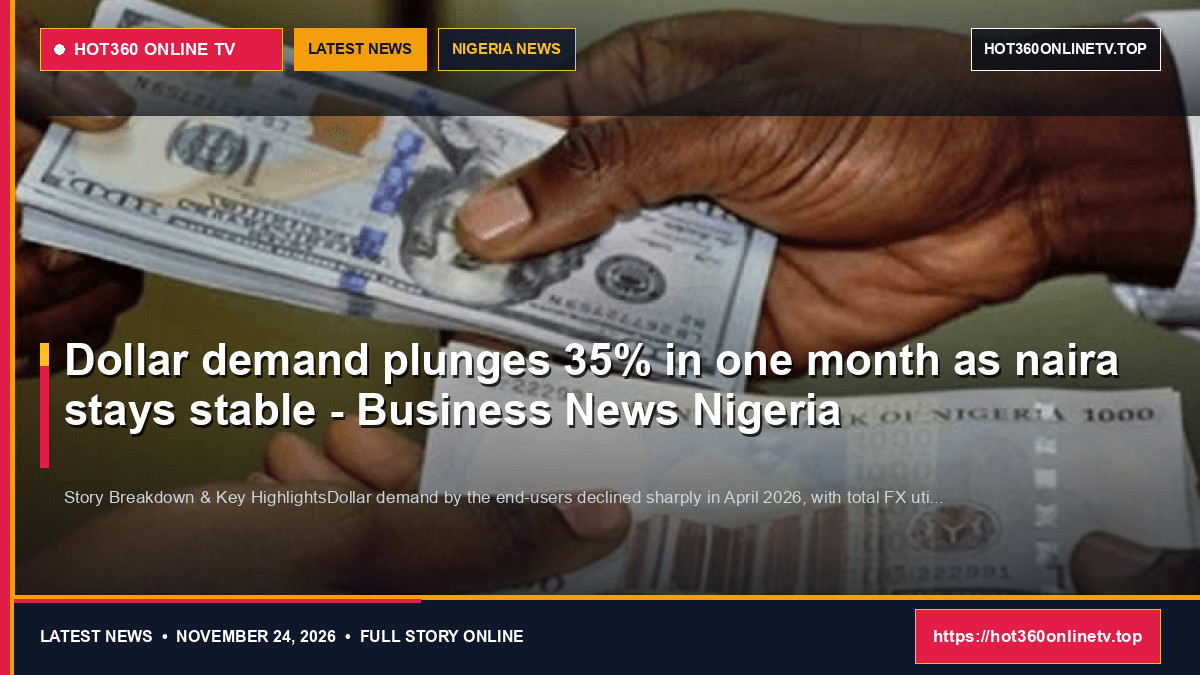
- Dollar demand by the end-users declined sharply in April 2026, with total FX utilisation by sectors falling by 35.23 percent to $3.42 billion, as the nNaira rises after CBN...
- Data showed that visible imports accounted for 41.92 percent of total FX utilisation, while invisible imports accounted for the larger share of 58.08 percent.
Full Report
Dollar demand by the end-users declined sharply in April 2026, with total FX utilisation by sectors falling by 35.23 percent to $3.42 billion, as the nNaira rises after CBN removes FX, securities restrictions on discount windowaira maintained relative stability in the official foreign exchange market, according to the monthly economic report published by the Central Bank of Nigeria (CBN).
Data showed that visible imports accounted for 41.92 percent of total FX utilisation, while invisible imports accounted for the larger share of 58.08 percent.
Within visible imports, the industrial sector was the largest user of foreign exchange, accounting for 37.44 percent of total utilisation. This was followed by manufactured products with 21.85 percent, oil imports with 20.11 percent and food products with 14.47 percent.
The transport sector accounted for 3.54 percent of visible import-related FX utilisation, while minerals and agriculture accounted for 1.47 percent and 1.12 percent respectively.
Read also: CBN’s discount window rules drive Naira to five-month high
For invisible imports, financial services dominated FX utilisation, accounting for 91.51 percent of the total. Business services followed with 4.37 percent, transport services with 2.58 percent and communication services with 0.84 percent, while other service categories accounted for the balance.
The decline in FX demand came as the naira appreciated against the dollar at the Nigerian Foreign Exchange Market (NFEM) during the month.
The monthly average exchange rate strengthened by 1.38 percent to N1,361.22/$ in April from N1,379.98/$ in March. At the end of the period, the NFEM rate closed at N1,374.94/$, compared with N1,386.72/$ in the preceding month.
However, average foreign exchange turnover at the NFEM declined by 26.97 percent to $442.54 million in April from $605.93 million in March, reflecting lower market activity during the period.
Read also: Naira cools as daily FX market activity declines
Meanwhile, Nigeria recorded a stronger net foreign exchange inflow in April, with FX flows through the economy resulting in a net inflow of $5.85 billion, compared with $4.16 billion in the preceding month.
Aggregate foreign exchange inflow declined to $8.71 billion from $9.70 billion, while aggregate outflow fell much more sharply to $2.86 billion from $5.54 billion.
Foreign exchange inflow through the banking system and autonomous sources fell to $1.83 billion and $6.88 billion respectively, from $2.47 billion and $7.24 billion in March.
On the outflow side, flows through banks fell to $2.00 billion from $4.12 billion, while autonomous outflows declined to $0.86 billion from $1.42 billion.
Consequently, the banking system recorded a lower net outflow of $0.18 billion, compared with $1.66 billion in the preceding month, while autonomous sources recorded a higher net inflow of $6.02 billion, compared with $5.82 billion in March.
The country’s external reserves remained adequate and above the international benchmark of three months of import cover. At the end of April 2026, external reserves stood at $48.32 billion, compared with $48.35 billion at the end of March 2026.
The reserves position was sufficient to cover 10.01 months of imports of goods and services, providing a substantial buffer against external payment pressures.
• Nigeria’s shifting rice policies leave farmers flying blind
• CBN doubles down on single-digit inflation target, vows policy consistency
• APC 11-year reign narrows $2.3trn road infrastructure gap
Hope Moses-Ashike is an Associate Editor, Banking and Finance, with more than a decade of experience reporting on Nigeria’s financial system and broader economy. She closely tracks market movements, monetary policy decisions, company disclosures, regulatory actions, economic indicators, and global developments, and interprets what they mean for businesses, investors, policymakers, and households. Her reporting helps readers understand complex issues such as inflation trends, foreign exchange market dynamics, interest rate decisions, bank performance, and investment risks. She also covers major international events and periodically travels to Washington, D.C., to report on the World Bank/IMF Spring and Annual Meetings. Her dedication to financial journalism has earned her multiple recognitions and invitations to high-level professional development programmes. She is an alumna of the International Visitors Leadership Programme (IVLP) in the United States and holds an Advanced Financial Journalism Certificate from the Press Association Training in London, UK. Her other notable achievements include completing the Lagos Business School CMC Programme, the Bloomberg Media Africa Initiative Programme, and a Master Class in Journalism at Rhodes University in South Africa.