Story Breakdown & Key Highlights
- Interim results of healthcare challenges, sparked by questions like “What if we could mass-produce vaccines in a mobile truck?” and “What if we could predict and manage diseases...
- The K-Health Future Promotion Team of the Korea Health Industry Development Institute (KHIDI) held a showcase to present the interim results of the ’Korean ARPA-H (Advanced...
Full Report
Interim results of healthcare challenges, sparked by questions like “What if we could mass-produce vaccines in a mobile truck?” and “What if we could predict and manage diseases in our daily lives?”, have been shared. These are game-changing technologies that could revolutionize the medical paradigm if they lead to final success.
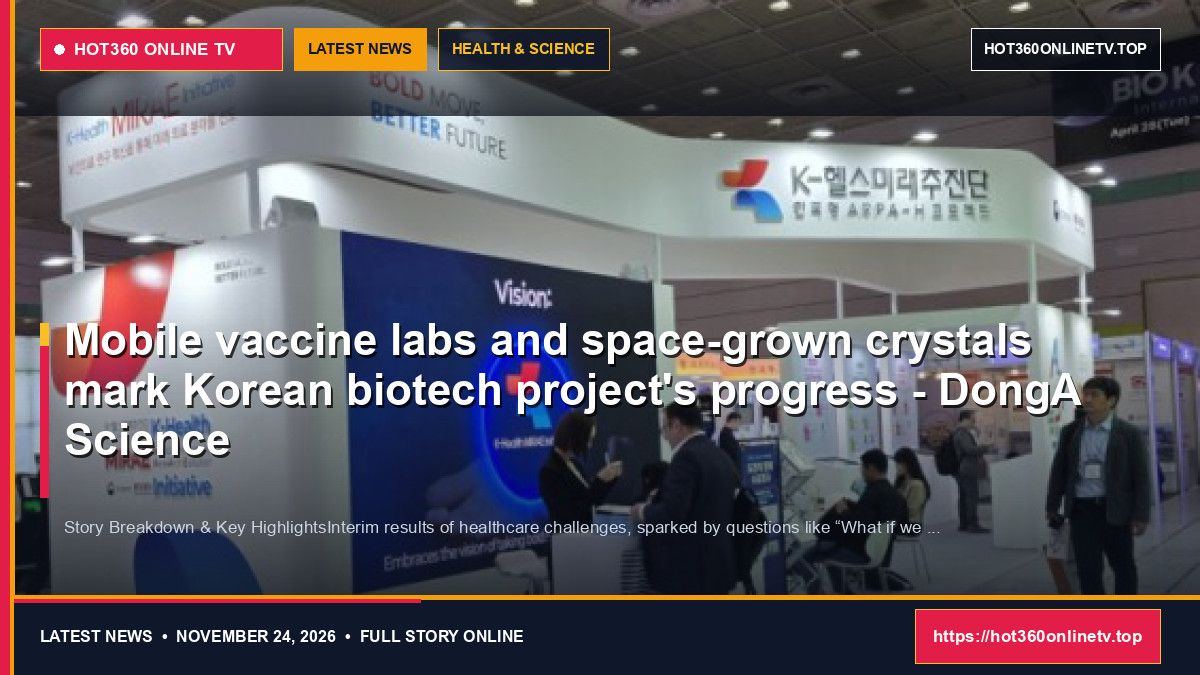
The K-Health Future Promotion Team of the Korea Health Industry Development Institute (KHIDI) held a showcase to present the interim results of the ’Korean ARPA-H (Advanced Research Projects Agency for Health) Project’ at ‘Bio Korea 2026’, which takes place at COEX in Seoul from the 28th to the 30th.
The Korean ARPA-H Project supports high-risk, high-return research in the healthcare sector that, if successful, could fundamentally improve the nation's health and welfare. This showcase presents the achievements from the two years since the promotion team was launched in March 2024.
Among the projects aimed at responding to infectious diseases and securing vaccine and therapeutic sovereignty, research on developing a modular production system for rapid vaccine manufacturing was introduced. This research, led by the International Vaccine Institute (IVI), began with the ambitious question, “What if we could mass-produce vaccines directly in a mobile truck?”
Currently, when a new infectious disease emerges, vaccine production relies on a centralized system in large, fixed factories. If issues like delays in vaccine manufacturing and logistics supply occur, it becomes difficult to respond immediately during a pandemic.
The research team aims to design small-scale, mobile modular equipment to develop a decentralized vaccine production device and system. It is a vaccine production platform that can be operated on-site where an infectious disease outbreak occurs. The team is currently developing a system that manufactures vaccines from the drug substance without bottlenecks using microfluidic chips and fluid control technology. The manufacturing system can be mounted on a container for mobility.
A researcher participating in this study explained, “The goal is to produce 1 million doses (one dose is for one vaccination) within 100 days,” and added, “This is a facility that can respond to infectious diseases in remote areas like Africa, where it is difficult to build vaccine factories.” He also explained that while the current research focuses on manufacturing messenger RNA (mRNA) vaccines, it could evolve into a module for responding to cancer or rare diseases in the future.
Stemming from the question, “What if we could predict and manage diseases in our daily lives?”, a device for preventing, managing, and detecting the exacerbation of chronic kidney disease was introduced.
Lee Sang-heon, a researcher at CGBIO participating in this study, said, “Once kidney disease worsens, it can enter an irreversible stage, so we are developing a platform that monitors indicators of kidney function like creatinine and potassium ions and delivers the information to patients and doctors. Such platforms exist for some chronic diseases like diabetes, but not for kidney disease.”
At this stage of interim results, the biggest challenge in reaching the final product is implementing a sensor within a microneedle that can detect kidney disease biomarkers. The next task is to convert the signals obtained from the biomarkers into an algorithm to provide to the patient.
If the research is successfully completed, the smartphone-based chronic kidney disease service is expected to be effective in detecting and preventing high-risk situations for patients in advance.
For new drug development, a challenging project involving protein crystallization in space microgravity was introduced. An official from Spacelintech, a participating company, said, “Crystallizing high-purity protein is crucial for developing new drugs. When protein crystallization experiments are conducted on Earth, the success rate is less than 10% due to the influence of gravity.”
The official added, “In a microgravity environment, the probability of extracting high-purity protein crystals increases. We launched an experimental module to the International Space Station (ISS) in August of last year for verification and retrieved it this February to check the experimental results.” If it is proven that high-quality protein crystals can be created in space, the precision of new drug development could be elevated to a new level.
In addition, other projects were introduced, including the development of a personalized innovative treatment platform for pediatric rare disease patients, the development of technology simulating human immune functions for drug safety assessment, and the development of an AI-based real-time management platform for intensive care patients.
An official from KHIDI stated, “The K-Health Future Promotion Team is supporting challenging and creative projects to solve global problems. If these research projects are applied in clinical settings and commercialized, they will bring about a change in the medical paradigm, create new industrial sectors, and strengthen the status of K-Bio.”