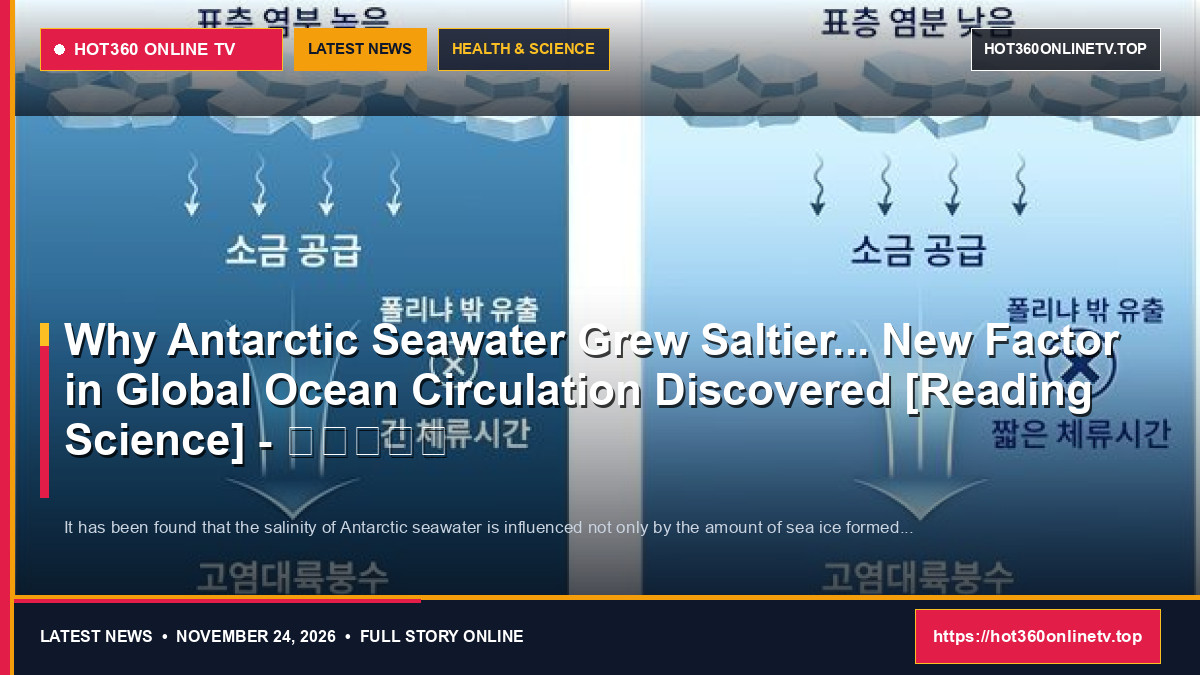
It has been found that the salinity of Antarctic seawater is influenced not only by the amount of sea ice formed in winter, but also by summer sea-ice conditions and ocean currents. The findings are expected to improve understanding of how cold, dense Antarctic seawater sinks into the deep ocean and circulates around the world, helping to improve the accuracy of climate change predictions.
The Korea Polar Research Institute said Tuesday that a joint research team led by Lee Wonsang, principal research scientist at the institute, and Professor Yoon Seungtae of Kyungpook National University had identified two previously unrecognized factors that influence changes in seawater salinity after analyzing nine years of observations from Terra Nova Bay, off the coast of Korea's Jang Bogo Station in Antarctica. The findings, with Choi Hyuna, a doctoral student at Kyungpook National University, as first author, were published this month in the international journal Geophysical Research Letters.
Schematic of two factors that regulate the salinity of High-Salinity Shelf Water. Even when the amount of salt released as ice forms in winter is the same, summer salinity is higher if surface salinity is high before freezing and the salty water (High-Salinity Shelf Water) remains in the bay longer (Case A). Salinity is lower if surface salinity is low and the salty water flows out quickly (Case B). Darker colors indicate higher salinity. Provided by the research team.
In Antarctica, as the sea freezes in winter, salt dissolved in the seawater is released into the surrounding ocean. This process creates high-salinity, high-density water known as high-salinity shelf water. This cold, dense water sinks to the seafloor and is a major source of Antarctic Bottom Water, which circulates throughout the world's deep oceans.
Antarctic Bottom Water supplies oxygen to the deep ocean and stores heat and carbon dioxide. Changes in the salinity of seawater around Antarctica can therefore affect global ocean circulation and climate change, extending beyond a local phenomenon. Terra Nova Bay, off the coast of Jang Bogo Station, is a major area where this high-salinity shelf water forms.
The research team analyzed data collected from 2014 to 2022 by the icebreaking research vessel Araon and long-term moored observation instruments, in collaboration with researchers from Jeju National University and institutions in New Zealand and the United States.
The findings showed that summer salinity in Terra Nova Bay began rising again after 2015 and reached a record high in 2022. In 2017 in particular, summer salinity rose sharply even though less sea ice had formed the previous winter, reducing the amount of salt supplied to the water. The phenomenon was difficult to explain based solely on the amount of sea ice formed in winter.
Using an ocean numerical model, the team identified two additional factors. The first is the condition of the ocean surface during the preceding summer. When ice melts early in summer and ice-free conditions persist for a long time, large amounts of freshwater enter the surface layer, lowering its salinity. In that case, even when salt is released as the sea freezes the following winter, its ability to raise salinity throughout the water column is limited.
A conductivity-temperature-depth (CTD) instrument is recovered aboard the icebreaking research vessel Araon after completing seawater observations. Photo courtesy of the Korea Polar Research Institute.
The second factor is how long seawater remains in the area. When deep currents strengthen, high-salinity seawater moves out of the bay more quickly, leaving less time for salt to accumulate inside it. This means that even when the same amount of ice forms, the salinity of the seawater can vary depending on the flow of ocean currents.
The study shows that understanding how Antarctic Bottom Water forms requires a comprehensive look not only at the amount of sea ice formed in winter, but also at summer ocean conditions and changes in currents.
Yoon Seungtae, a professor at Kyungpook National University and the paper's corresponding author, said, "Summer seawater salinity is influenced not only by the amount of sea ice formed in winter, but also by conditions in the ocean the previous summer and the seawater's residence time. Year-round observations are important for understanding changes in Antarctic Bottom Water."
Hot Picks Today
• The Era of Getting 200 Million Won After 30 Years Is Over... A Japanese Bank's "Perpetual Department Head" Who Just Clocked In Cries Out
• Spain Hit by Its Worst Tragedy... Lee Kangin, Moreno and Real Madrid Join Soccer World in Mourning
• They Said, “Make It Your Home for Life” - Then Suddenly Kicked 200 Passengers Off... What Happened to the Around-the-World Cruise?
• "130 Rice Bowls Sold Out in a Day"... 'Unfiltered Face' Adds 8 Million Won to Night Market Sales: China's Bungeunwoo
Lee Wonsang, a principal research scientist at the Korea Polar Research Institute, said, "More than a decade of long-term observations provided the foundation for this study. We will expand our year-round observation network and improve the accuracy of predictions of changes in Antarctic Bottom Water."