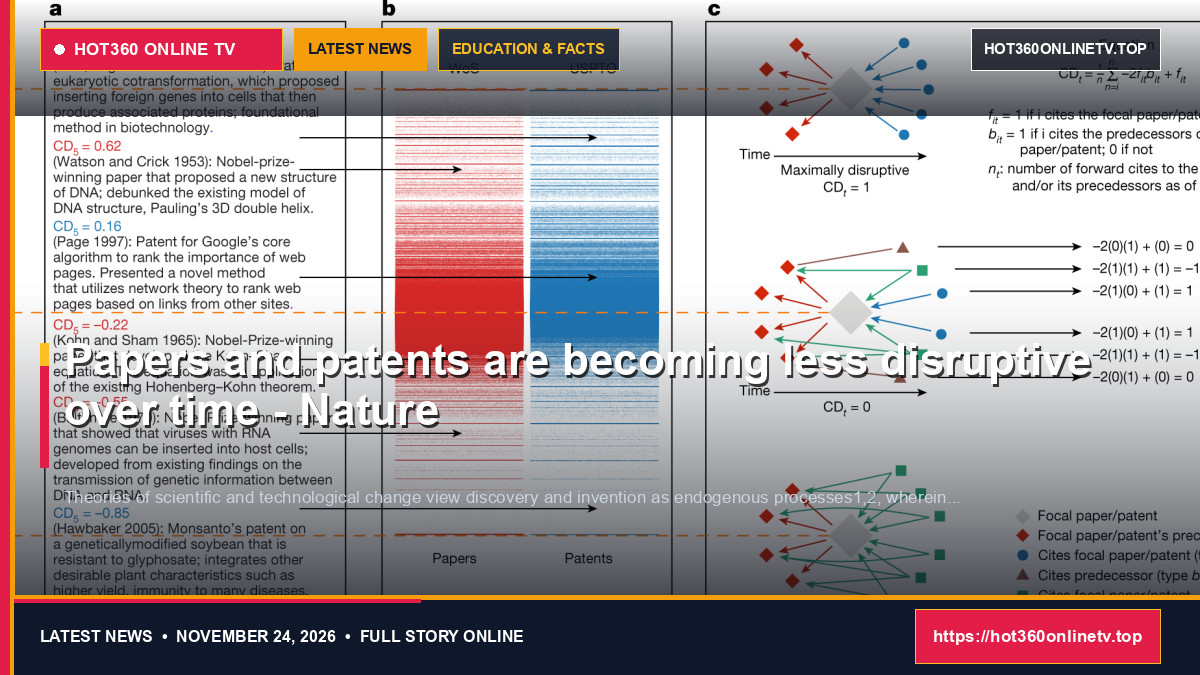
Theories of scientific and technological change view discovery and invention as endogenous processes1,2, wherein previous accumulated knowledge enables future progress by allowing researchers to, in Newton’s words, ‘stand on the shoulders of giants’3,4,5,6,7. Recent decades have witnessed exponential growth in the volume of new scientific and technological knowledge, thereby creating conditions that should be ripe for major advances8,9. Yet contrary to this view, studies suggest that progress is slowing in several major fields10,11. Here, we analyse these claims at scale across six decades, using data on 45 million papers and 3.9 million patents from six large-scale datasets, together with a new quantitative metric—the CD index12—that characterizes how papers and patents change networks of citations in science and technology. We find that papers and patents are increasingly less likely to break with the past in ways that push science and technology in new directions. This pattern holds universally across fields and is robust across multiple different citation- and text-based metrics1,13,14,15,16,17. Subsequently, we link this decline in disruptiveness to a narrowing in the use of previous knowledge, allowing us to reconcile the patterns we observe with the ‘shoulders of giants’ view. We find that the observed declines are unlikely to be driven by changes in the quality of published science, citation practices or field-specific factors. Overall, our results suggest that slowing rates of disruption may reflect a fundamental shift in the nature of science and technology.
This is a preview of subscription content, access via your institution
Access options
Access Nature and 54 other Nature Portfolio journals
Get Nature+, our best-value online-access subscription
Receive 51 print issues and online access
• Purchase on SpringerLink
• Instant access to the full article PDF.
Prices may be subject to local taxes which are calculated during checkout
Surprising combinations of research contents and contexts are related to impact and emerge with scientific outsiders from distant disciplines
The critical role of persistent disruption in advancing science
Community-centric modeling of citation dynamics explains collective citation patterns across different knowledge systems
Explore related subjects
• Technological Innovation and Economic Growth
Data availability
Data associated with this study are freely available in a public repository at https://doi.org/10.5281/zenodo.7258379. Our study draws on data from six sources: the American Physical Society, JSTOR, Microsoft Academic Graph, Patents View, PubMed and WoS. Data from Microsoft Academic Graph, Patents View and PubMed are publicly available, and our repository includes complete data for analyses from these sources. Data from the American Physical Society, JSTOR and WoS are not publicly available, and were used under licence from their respective publishers. To facilitate replication, our repository includes limited versions of the data from these sources, which will enable calculation of basic descriptive statistics. The authors will make full versions of these data available upon request and with permission from their respective publishers. Source data are provided with this paper.
Code availability
Open-source code related to this study is available at https://doi.org/10.5281/zenodo.7258379 and http://www.cdindex.info. We used Python v.3.10.6 (pandas v.1.4.3, numpy v.1.23.1, matplotlib v.3.5.2, seaborn v.0.11.2, spacy v.2.2, jupyterlab v.3.4.4) to wrangle, analyse and visualize data and to conduct statistical analyses. We used MariaDB v.10.6.4 to wrangle data. We used R v.4.2.1 (ggplot2 v.3.36, ggrepel v.0.9.0) to visualize data. We used StataMP v.17.0 (reghdfe v.5.7.3) to conduct statistical analyses.
References
• Fleming, L. Recombinant uncertainty in technological search. Manage. Sci. 47, 117–132 (2001).Article Google Scholar
Fleming, L. Recombinant uncertainty in technological search. Manage. Sci. 47, 117–132 (2001).
• Schumpeter, J. Capitalism, Socialism and Democracy (Perennial, 1942).
Schumpeter, J. Capitalism, Socialism and Democracy (Perennial, 1942).
• Koyré, A. An unpublished letter of Robert Hooke to Isaac Newton. ISIS 43, 312–337 (1952).Article MathSciNet PubMed Google Scholar
Koyré, A. An unpublished letter of Robert Hooke to Isaac Newton. ISIS 43, 312–337 (1952).
Article MathSciNet PubMed Google Scholar
• Popper, K. Conjectures and Refutations: The Growth of Scientific Knowledge (Routledge, 2014).
Popper, K. Conjectures and Refutations: The Growth of Scientific Knowledge (Routledge, 2014).
• Fleck, L. Genesis and Development of a Scientific Fact (Univ. Chicago Press, 2012).
Fleck, L. Genesis and Development of a Scientific Fact (Univ. Chicago Press, 2012).
• Acemoglu, D., Akcigit, U. & Kerr, W. R. Innovation network. Proc. Natl Acad. Sci. USA 113, 11483–11488 (2016).Article ADS CAS PubMed PubMed Central Google Scholar
Acemoglu, D., Akcigit, U. & Kerr, W. R. Innovation network. Proc. Natl Acad. Sci. USA 113, 11483–11488 (2016).
Article ADS CAS PubMed PubMed Central Google Scholar
• Weitzman, M. L. Recombinant growth. Q. J. Econ. 113, 331–360 (1998).Article MathSciNet Google Scholar
Weitzman, M. L. Recombinant growth. Q. J. Econ. 113, 331–360 (1998).
Article MathSciNet Google Scholar
• Tria, F., Loreto, V., Servedio, V. D. P. & Strogatz, S. H. The dynamics of correlated novelties. Sci. Rep. 4, 1–8 (2014).Article Google Scholar
Tria, F., Loreto, V., Servedio, V. D. P. & Strogatz, S. H. The dynamics of correlated novelties. Sci. Rep. 4, 1–8 (2014).
• Fink, T. M. A., Reeves, M., Palma, R. & Farr, R. S. Serendipity and strategy in rapid innovation. Nat. Commun. 8, 1–9 (2017).Article CAS Google Scholar
Fink, T. M. A., Reeves, M., Palma, R. & Farr, R. S. Serendipity and strategy in rapid innovation. Nat. Commun. 8, 1–9 (2017).
Article CAS Google Scholar
• Pammolli, F., Magazzini, L. & Riccaboni, M. The productivity crisis in pharmaceutical R&D. Nat. Rev. Drug Discov. 10, 428–438 (2011).Article CAS PubMed Google Scholar
Pammolli, F., Magazzini, L. & Riccaboni, M. The productivity crisis in pharmaceutical R&D. Nat. Rev. Drug Discov. 10, 428–438 (2011).
Article CAS PubMed Google Scholar
• Bloom, N., Jones, C. I., Van Reenen, J. & Webb, M. Are ideas getting harder to find? Am. Econ. Rev. 110, 1104–1144 (2020).Article Google Scholar
Bloom, N., Jones, C. I., Van Reenen, J. & Webb, M. Are ideas getting harder to find? Am. Econ. Rev. 110, 1104–1144 (2020).
• Funk, R. J. & Owen-Smith, J. A dynamic network measure of technological change. Manage. Sci. 63, 791–817 (2017).Article Google Scholar
Funk, R. J. & Owen-Smith, J. A dynamic network measure of technological change. Manage. Sci. 63, 791–817 (2017).
• Bornmann, L., Devarakonda, S., Tekles, A. & Chacko, G. Are disruption index indicators convergently valid? The comparison of several indicator variants with assessments by peers. Quant. Sci. Stud. 1, 1242–1259 (2020).Article Google Scholar
Bornmann, L., Devarakonda, S., Tekles, A. & Chacko, G. Are disruption index indicators convergently valid? The comparison of several indicator variants with assessments by peers. Quant. Sci. Stud. 1, 1242–1259 (2020).
• Uzzi, B., Mukherjee, S., Stringer, M. & Jones, B. Atypical combinations and scientific impact. Science 342, 468–472 (2013).Article ADS CAS PubMed Google Scholar
Uzzi, B., Mukherjee, S., Stringer, M. & Jones, B. Atypical combinations and scientific impact. Science 342, 468–472 (2013).
Article ADS CAS PubMed Google Scholar
• Leydesdorff, L., Tekles, A. & Bornmann, L. A proposal to revise the disruption index. Prof. Inf. 30, e300121 (2021).
Leydesdorff, L., Tekles, A. & Bornmann, L. A proposal to revise the disruption index. Prof. Inf. 30, e300121 (2021).
• Lu, C. et al. Analyzing linguistic complexity and scientific impact. J. Informetr. 13, 817–829 (2019).Article Google Scholar
Lu, C. et al. Analyzing linguistic complexity and scientific impact. J. Informetr. 13, 817–829 (2019).
• Hofstra, B. et al. The diversity–innovation paradox in science. Proc. Natl Acad. Sci. USA 117, 9284–9291 (2020).Article ADS CAS PubMed PubMed Central Google Scholar
Hofstra, B. et al. The diversity–innovation paradox in science. Proc. Natl Acad. Sci. USA 117, 9284–9291 (2020).
Article ADS CAS PubMed PubMed Central Google Scholar
• Jones, B. F. The burden of knowledge and the ‘death of the renaissance man’: is innovation getting harder? Rev. Econ. Stud. 76, 283–317 (2009).Article Google Scholar
Jones, B. F. The burden of knowledge and the ‘death of the renaissance man’: is innovation getting harder? Rev. Econ. Stud. 76, 283–317 (2009).
• Gordon, R. J. The Rise and Fall of American Growth (Princeton Univ. Press, 2016).
Gordon, R. J. The Rise and Fall of American Growth (Princeton Univ. Press, 2016).
• Chu, J. S. G. & Evans, J. A. Slowed canonical progress in large fields of science. Proc. Natl Acad. Sci. USA 118, e2021636118 (2021).Article CAS PubMed PubMed Central Google Scholar
Chu, J. S. G. & Evans, J. A. Slowed canonical progress in large fields of science. Proc. Natl Acad. Sci. USA 118, e2021636118 (2021).
Article CAS PubMed PubMed Central Google Scholar
• Packalen, M. & Bhattacharya, J. NIH funding and the pursuit of edge science. Proc. Natl Acad. Sci. USA 117, 12011–12016 (2020).Article ADS CAS PubMed PubMed Central Google Scholar
Packalen, M. & Bhattacharya, J. NIH funding and the pursuit of edge science. Proc. Natl Acad. Sci. USA 117, 12011–12016 (2020).
Article ADS CAS PubMed PubMed Central Google Scholar
• Jaffe, A. B. & Lerner, J. Innovation and its Discontents: How Our Broken Patent System Is Endangering Innovation and Progress, and What To Do About It (Princeton Univ. Press, 2011).
Jaffe, A. B. & Lerner, J. Innovation and its Discontents: How Our Broken Patent System Is Endangering Innovation and Progress, and What To Do About It (Princeton Univ. Press, 2011).
• Horgan, J. The End of Science: Facing the Limits of Knowledge in the Twilight of the Scientific Age (Basic Books, 2015).
Horgan, J. The End of Science: Facing the Limits of Knowledge in the Twilight of the Scientific Age (Basic Books, 2015).
• Collison, P. & Nielsen, M. Science Is Getting Less Bang for its Buck (Atlantic, 2018).
Collison, P. & Nielsen, M. Science Is Getting Less Bang for its Buck (Atlantic, 2018).
• Nolan, A. Artificial intelligence and the future of science. oecd.ai, https://oecd.ai/en/wonk/ai-future-of-science (25 October 2021).
Nolan, A. Artificial intelligence and the future of science. oecd.ai, https://oecd.ai/en/wonk/ai-future-of-science (25 October 2021).
• Effective Policies to Foster High-risk/High-reward Research. OECD Science, Technology, and Industry Policy Papers (OECD, 2021).
Effective Policies to Foster High-risk/High-reward Research. OECD Science, Technology, and Industry Policy Papers (OECD, 2021).
• Cowen, T. The Great Stagnation: How America Ate All the Low-Hanging Fruit of Modern History, Got Sick, and Will (Eventually) Feel Better (Penguin, 2011).
Cowen, T. The Great Stagnation: How America Ate All the Low-Hanging Fruit of Modern History, Got Sick, and Will (Eventually) Feel Better (Penguin, 2011).
• Einstein, A. The World As I See It (Citadel Press, 1949).
Einstein, A. The World As I See It (Citadel Press, 1949).
• Arthur, W. B. The structure of invention. Res. Policy 36, 274–287 (2007).Article Google Scholar
Arthur, W. B. The structure of invention. Res. Policy 36, 274–287 (2007).
• Tushman, M. L. & Anderson, P. Technological discontinuities and organizational environments. Adm. Sci. Q. 31, 439–465 (1986).Article Google Scholar
Tushman, M. L. & Anderson, P. Technological discontinuities and organizational environments. Adm. Sci. Q. 31, 439–465 (1986).
• Kohn, W. & Sham, L. J. Self-consistent equations including exchange and correlation effects. Phys. Rev. 140, A1133 (1965).Article ADS MathSciNet Google Scholar
Kohn, W. & Sham, L. J. Self-consistent equations including exchange and correlation effects. Phys. Rev. 140, A1133 (1965).
Article ADS MathSciNet Google Scholar
• Watson, J. D. & Crick, F. H. C. Molecular structure of nucleic acids: a structure for deoxyribose nucleic acid. Nature 171, 737–738 (1953).Article ADS CAS PubMed Google Scholar
Watson, J. D. & Crick, F. H. C. Molecular structure of nucleic acids: a structure for deoxyribose nucleic acid. Nature 171, 737–738 (1953).
Article ADS CAS PubMed Google Scholar
• Bornmann, L. & Tekles, A. Disruption index depends on length of citation window. Prof. Inf. 28, e280207 (2019).
Bornmann, L. & Tekles, A. Disruption index depends on length of citation window. Prof. Inf. 28, e280207 (2019).
• Wu, L., Wang, D. & Evans, J. A. Large teams develop and small teams disrupt science and technology. Nature 566, 378–382 (2019).Article ADS CAS PubMed Google Scholar
Wu, L., Wang, D. & Evans, J. A. Large teams develop and small teams disrupt science and technology. Nature 566, 378–382 (2019).
Article ADS CAS PubMed Google Scholar
• Kuhn, T. S. The Structure of Scientific Revolutions (Univ. Chicago Press, 1962).
Kuhn, T. S. The Structure of Scientific Revolutions (Univ. Chicago Press, 1962).
• Brad Wray, K. Kuhn and the discovery of paradigms. Philos. Soc. Sci. 41, 380–397 (2011).Article Google Scholar
Brad Wray, K. Kuhn and the discovery of paradigms. Philos. Soc. Sci. 41, 380–397 (2011).
• Ioannidis, J. P. A. Why most published research findings are false. PLoS Med. 2, e124 (2005).Article PubMed PubMed Central Google Scholar
Ioannidis, J. P. A. Why most published research findings are false. PLoS Med. 2, e124 (2005).
Article PubMed PubMed Central Google Scholar
• Li, J., Yin, Y., Fortunato, S. & Wang, D. A dataset of publication records for Nobel laureates. Sci. Data 6, 1–10 (2019).Article Google Scholar
Li, J., Yin, Y., Fortunato, S. & Wang, D. A dataset of publication records for Nobel laureates. Sci. Data 6, 1–10 (2019).
• Bornmann, L. & Marx, W. Methods for the generation of normalized citation impact scores in bibliometrics: which method best reflects the judgements of experts? J. Informetr. 9, 408–418 (2015).Article Google Scholar
Bornmann, L. & Marx, W. Methods for the generation of normalized citation impact scores in bibliometrics: which method best reflects the judgements of experts? J. Informetr. 9, 408–418 (2015).
• Waltman, L. A review of the literature on citation impact indicators. J. Informetr. 10, 365–391 (2016).Article Google Scholar
Waltman, L. A review of the literature on citation impact indicators. J. Informetr. 10, 365–391 (2016).
• Waltman, L. & van Eck, N. J. in Springer Handbook of Science and Technology Indicators (eds. Glänzel, W. et al.) 281–300 (Springer, 2019).
Waltman, L. & van Eck, N. J. in Springer Handbook of Science and Technology Indicators (eds. Glänzel, W. et al.) 281–300 (Springer, 2019).
• Bornmann, L. How can citation impact in bibliometrics be normalized? A new approach combining citing-side normalization and citation percentiles. Quant. Sci. Stud. 1, 1553–1569 (2020).Article Google Scholar
Bornmann, L. How can citation impact in bibliometrics be normalized? A new approach combining citing-side normalization and citation percentiles. Quant. Sci. Stud. 1, 1553–1569 (2020).
• Petersen, A. M., Pan, R. K., Pammolli, F. & Fortunato, S. Methods to account for citation inflation in research evaluation. Res. Policy 48, 1855–1865 (2019).Article Google Scholar
Petersen, A. M., Pan, R. K., Pammolli, F. & Fortunato, S. Methods to account for citation inflation in research evaluation. Res. Policy 48, 1855–1865 (2019).
• Bornmann, L. & Mutz, R. Growth rates of modern science: a bibliometric analysis based on the number of publications and cited references. J. Assoc. Inf. Sci. Technol. 66, 2215–2222 (2015).Article CAS Google Scholar
Bornmann, L. & Mutz, R. Growth rates of modern science: a bibliometric analysis based on the number of publications and cited references. J. Assoc. Inf. Sci. Technol. 66, 2215–2222 (2015).
Article CAS Google Scholar
• Bornmann, L., Haunschild, R. & Mutz, R. Growth rates of modern science: a latent piecewise growth curve approach to model publication numbers from established and new literature databases. Humanit. Soc. Sci. Commun. 8, 1–15 (2021).Article Google Scholar
Bornmann, L., Haunschild, R. & Mutz, R. Growth rates of modern science: a latent piecewise growth curve approach to model publication numbers from established and new literature databases. Humanit. Soc. Sci. Commun. 8, 1–15 (2021).
• Jones, B. F. & Weinberg, B. A. Age dynamics in scientific creativity. Proc. Natl Acad. Sci. USA 108, 18910–18914 (2011).Article ADS CAS PubMed PubMed Central Google Scholar
Jones, B. F. & Weinberg, B. A. Age dynamics in scientific creativity. Proc. Natl Acad. Sci. USA 108, 18910–18914 (2011).
Article ADS CAS PubMed PubMed Central Google Scholar
• Bonzi, S. & Snyder, H. Motivations for citation: a comparison of self citation and citation to others. Scientometrics 21, 245–254 (1991).Article Google Scholar
Bonzi, S. & Snyder, H. Motivations for citation: a comparison of self citation and citation to others. Scientometrics 21, 245–254 (1991).
• Fowler, J. & Aksnes, D. Does self-citation pay? Scientometrics 72, 427–437 (2007).Article Google Scholar
Fowler, J. & Aksnes, D. Does self-citation pay? Scientometrics 72, 427–437 (2007).
• King, M. M., Bergstrom, C. T., Correll, S. J., Jacquet, J. & West, J. D. Men set their own cites high: gender and self-citation across fields and over time. Socius 3, 2378023117738903 (2017).Article Google Scholar
King, M. M., Bergstrom, C. T., Correll, S. J., Jacquet, J. & West, J. D. Men set their own cites high: gender and self-citation across fields and over time. Socius 3, 2378023117738903 (2017).
• Mukherjee, S., Romero, D. M., Jones, B. & Uzzi, B. The nearly universal link between the age of past knowledge and tomorrow’s breakthroughs in science and technology: the hotspot. Sci. Adv. 3, e1601315 (2017).Article ADS PubMed PubMed Central Google Scholar
Mukherjee, S., Romero, D. M., Jones, B. & Uzzi, B. The nearly universal link between the age of past knowledge and tomorrow’s breakthroughs in science and technology: the hotspot. Sci. Adv. 3, e1601315 (2017).
Article ADS PubMed PubMed Central Google Scholar
• Merton, R. K. Singletons and multiples in scientific discovery: a chapter in the sociology of science. Proc. Am. Philos. Soc. 105, 470–486 (1961). Google Scholar
Merton, R. K. Singletons and multiples in scientific discovery: a chapter in the sociology of science. Proc. Am. Philos. Soc. 105, 470–486 (1961).
• Wang, D., Song, C. & Barabási, A.-L. Quantifying long-term scientific impact. Science 342, 127–132 (2013).Article ADS CAS PubMed Google Scholar
Wang, D., Song, C. & Barabási, A.-L. Quantifying long-term scientific impact. Science 342, 127–132 (2013).
Article ADS CAS PubMed Google Scholar
• Leahey, E. Not by productivity alone: how visibility and specialization contribute to academic earnings. Am. Sociol. Rev. 72, 533–561 (2007).Article Google Scholar
Leahey, E. Not by productivity alone: how visibility and specialization contribute to academic earnings. Am. Sociol. Rev. 72, 533–561 (2007).
• Tahamtan, I. & Bornmann, L. Core elements in the process of citing publications: conceptual overview of the literature. J. Informetr. 12, 203–216 (2018).Article Google Scholar
Tahamtan, I. & Bornmann, L. Core elements in the process of citing publications: conceptual overview of the literature. J. Informetr. 12, 203–216 (2018).
• Tahamtan, I. & Bornmann, L. What do citation counts measure? An updated review of studies on citations in scientific documents published between 2006 and 2018. Scientometrics 121, 1635–1684 (2019).Article Google Scholar
Tahamtan, I. & Bornmann, L. What do citation counts measure? An updated review of studies on citations in scientific documents published between 2006 and 2018. Scientometrics 121, 1635–1684 (2019).
• Bhattacharya, J. & Packalen, M. Stagnation and Scientific Incentives (Working Paper 26752), https://www.nber.org/papers/w26752 (2020).
Bhattacharya, J. & Packalen, M. Stagnation and Scientific Incentives (Working Paper 26752), https://www.nber.org/papers/w26752 (2020).
• Azoulay, P., Graff Zivin, J. S. & Manso, G. Incentives and creativity: evidence from the academic life sciences. RAND J. Econ. 42, 527–554 (2011).Article Google Scholar
Azoulay, P., Graff Zivin, J. S. & Manso, G. Incentives and creativity: evidence from the academic life sciences. RAND J. Econ. 42, 527–554 (2011).
• Baltimore, D. Viral RNA-dependent DNA polymerase: RNA-dependent DNA polymerase in virions of RNA tumour viruses. Nature 226, 1209–1211 (1970).Article ADS CAS PubMed Google Scholar
Baltimore, D. Viral RNA-dependent DNA polymerase: RNA-dependent DNA polymerase in virions of RNA tumour viruses. Nature 226, 1209–1211 (1970).
Article ADS CAS PubMed Google Scholar
• Page, L. Method for node ranking in a linked database. US patent 6,285,999 (2001).
Page, L. Method for node ranking in a linked database. US patent 6,285,999 (2001).
• Axel, R., Wigler, M. H. & Silverstein, S. J. Processes for inserting DNA into eucaryotic cells and for producing proteinaceous materials. US patent 4,634,665 (1983).
Axel, R., Wigler, M. H. & Silverstein, S. J. Processes for inserting DNA into eucaryotic cells and for producing proteinaceous materials. US patent 4,634,665 (1983).
• Hawbaker, M. S. Soybean variety SE90346. US patent 6,958,436 (2005).
Hawbaker, M. S. Soybean variety SE90346. US patent 6,958,436 (2005).
• Katsuki, T. & Sharpless, K. B. The first practical method for asymmetric epoxidation. J. Am. Chem. Soc. 102, 5974–5976 (1980).
Katsuki, T. & Sharpless, K. B. The first practical method for asymmetric epoxidation. J. Am. Chem. Soc. 102, 5974–5976 (1980).
• Riess, A. G., et al. Observational evidence from supernovae for an accelerating universe and a cosmological constant. Astron. J. 116, 1009 (1998).
Riess, A. G., et al. Observational evidence from supernovae for an accelerating universe and a cosmological constant. Astron. J. 116, 1009 (1998).
• Dirac, P. A. M. The quantum theory of the electron. Proc. R. Soc. Lond. A Math. Phys. Sci. 117, 610–624 (1928).ADS Google Scholar
Dirac, P. A. M. The quantum theory of the electron. Proc. R. Soc. Lond. A Math. Phys. Sci. 117, 610–624 (1928).
• Sanger, F., Nicklen, S. & Coulson, A. R. DNA sequencing with chain-terminating inhibitors. Proc. Natl Acad. Sci. USA 74, 5463–5467 (1977).Article ADS CAS PubMed PubMed Central Google Scholar
Sanger, F., Nicklen, S. & Coulson, A. R. DNA sequencing with chain-terminating inhibitors. Proc. Natl Acad. Sci. USA 74, 5463–5467 (1977).
Article ADS CAS PubMed PubMed Central Google Scholar
• Bednorz, J. G. & Müller, K. A. Possible high Tc superconductivity in the Ba-La-Cu-O system. Z. Phys. B Condens. Matter 64, 189–193 (1986).
Bednorz, J. G. & Müller, K. A. Possible high Tc superconductivity in the Ba-La-Cu-O system. Z. Phys. B Condens. Matter 64, 189–193 (1986).
• Wuchty, S., Jones, B. F. & Uzzi, B. The increasing dominance of teams in production of knowledge. Science 316, 1036–1039 (2007).Article ADS CAS PubMed Google Scholar
Wuchty, S., Jones, B. F. & Uzzi, B. The increasing dominance of teams in production of knowledge. Science 316, 1036–1039 (2007).
Article ADS CAS PubMed Google Scholar
• Guimera, R., Uzzi, B., Spiro, J. & Amaral, L. A. N. Team assembly mechanisms determine collaboration network structure and team performance. Science 308, 697–702 (2005).Article ADS CAS PubMed PubMed Central Google Scholar
Guimera, R., Uzzi, B., Spiro, J. & Amaral, L. A. N. Team assembly mechanisms determine collaboration network structure and team performance. Science 308, 697–702 (2005).
Article ADS CAS PubMed PubMed Central Google Scholar
• Jones, B. F., Wuchty, S. & Uzzi, B. Multi-university research teams: shifting impact, geography, and stratification in science. Science 322, 1259–1262 (2008).Article ADS CAS PubMed Google Scholar
Jones, B. F., Wuchty, S. & Uzzi, B. Multi-university research teams: shifting impact, geography, and stratification in science. Science 322, 1259–1262 (2008).
Article ADS CAS PubMed Google Scholar
• Grömping, U. Estimators of relative importance in linear regression based on variance decomposition. Am. Stat. 61, 139–147 (2007).Article MathSciNet Google Scholar
Grömping, U. Estimators of relative importance in linear regression based on variance decomposition. Am. Stat. 61, 139–147 (2007).
Article MathSciNet Google Scholar
• Mukherjee, S., Uzzi, B., Jones, B. & Stringer, M. A new method for identifying recombinations of existing knowledge associated with high-impact innovation. J. Prod. Innov. Manage. 33, 224–236 (2016).Article Google Scholar
Mukherjee, S., Uzzi, B., Jones, B. & Stringer, M. A new method for identifying recombinations of existing knowledge associated with high-impact innovation. J. Prod. Innov. Manage. 33, 224–236 (2016).
• Christianson, N. H., Sizemore Blevins, A. & Bassett, D. S. Architecture and evolution of semantic networks in mathematics texts. Proc. R. Soc. A 476, 20190741 (2020).Article ADS MathSciNet PubMed PubMed Central Google Scholar
Christianson, N. H., Sizemore Blevins, A. & Bassett, D. S. Architecture and evolution of semantic networks in mathematics texts. Proc. R. Soc. A 476, 20190741 (2020).
Article ADS MathSciNet PubMed PubMed Central Google Scholar
• Newman, M. E. J. The structure of scientific collaboration networks. Proc. Natl Acad. Sci. USA 98, 404–409 (2001).Article ADS MathSciNet CAS PubMed PubMed Central Google Scholar
Newman, M. E. J. The structure of scientific collaboration networks. Proc. Natl Acad. Sci. USA 98, 404–409 (2001).
Article ADS MathSciNet CAS PubMed PubMed Central Google Scholar
• Newman, M. E. J. Scientific collaboration networks. I. Network construction and fundamental results. Phys. Rev. E 64, 016131 (2001).Article ADS CAS Google Scholar
Newman, M. E. J. Scientific collaboration networks. I. Network construction and fundamental results. Phys. Rev. E 64, 016131 (2001).
Article ADS CAS Google Scholar
• Uzzi, B. & Spiro, J. Collaboration and creativity: the small world problem. Am. J. Sociol. 111, 447–504 (2005).Article Google Scholar
Uzzi, B. & Spiro, J. Collaboration and creativity: the small world problem. Am. J. Sociol. 111, 447–504 (2005).
• Funk, R. J. Making the most of where you are: geography, networks, and innovation in organizations. Acad. Manage. J. 57, 193–222 (2014).Article Google Scholar
Funk, R. J. Making the most of where you are: geography, networks, and innovation in organizations. Acad. Manage. J. 57, 193–222 (2014).
• Barabási, A.-L. Network Science (Cambridge Univ. Press, 2016).
Barabási, A.-L. Network Science (Cambridge Univ. Press, 2016).
• Blau, D. M. & Weinberg, B. A. Why the US science and engineering workforce is aging rapidly. Proc. Natl Acad. Sci. USA 114, 3879–3884 (2017).Article ADS CAS PubMed PubMed Central Google Scholar
Blau, D. M. & Weinberg, B. A. Why the US science and engineering workforce is aging rapidly. Proc. Natl Acad. Sci. USA 114, 3879–3884 (2017).
Article ADS CAS PubMed PubMed Central Google Scholar
• Cui, H., Wu, L. & Evans, J. A. Aging scientists and slowed advance. Preprint at https://doi.org/10.48550/arXiv.2202.04044 (2022).
Cui, H., Wu, L. & Evans, J. A. Aging scientists and slowed advance. Preprint at https://doi.org/10.48550/arXiv.2202.04044 (2022).
• Azoulay, P., Fons-Rosen, C. & Graff Zivin, J. S. Does science advance one funeral at a time? Am. Econ. Rev. 109, 2889–2920 (2019).Article PubMed PubMed Central Google Scholar
Azoulay, P., Fons-Rosen, C. & Graff Zivin, J. S. Does science advance one funeral at a time? Am. Econ. Rev. 109, 2889–2920 (2019).
Article PubMed PubMed Central Google Scholar
Acknowledgements
This study was supported by the National Science Foundation (grant Nos. 1829168, 1932596 and 1829302).
Author information
Authors and Affiliations
• Carlson School of Management, University of Minnesota, Minneapolis, MN, USAMichael Park & Russell J. Funk
Carlson School of Management, University of Minnesota, Minneapolis, MN, USA
Michael Park & Russell J. Funk
• School of Sociology, University of Arizona, Tucson, AZ, USAErin Leahey
School of Sociology, University of Arizona, Tucson, AZ, USA
• Michael ParkView author publicationsSearch author on:PubMed Google Scholar
Search author on:PubMed Google Scholar
• Erin LeaheyView author publicationsSearch author on:PubMed Google Scholar
Search author on:PubMed Google Scholar
• Russell J. FunkView author publicationsSearch author on:PubMed Google Scholar
Search author on:PubMed Google Scholar
Contributions
R.J.F. and E.L. collaboratively contributed to the conception and design of the study. R.J.F. and M.P. collaboratively contributed to the acquisition, analysis and interpretation of the data. R.J.F. created software used in the study. R.J.F., E.L. and M.P. collaboratively drafted and revised the manuscript.
Corresponding author
Correspondence to Russell J. Funk.
Ethics declarations
Competing interests
The authors declare no competing interests.
Peer review
Peer review information
Nature thanks Diana Hicks and the other, anonymous, reviewer(s) for their contribution to the peer review of this work. Peer reviewer reports are available.
Additional information
Publisher’s note Springer Nature remains neutral with regard to jurisdictional claims in published maps and institutional affiliations.
Extended data figures and tables
Extended Data Fig. 1 Distribution of CD5.
This figure gives an overview of the distribution of CD5 for papers (n = 24,659,076) and patents (n = 3,912,353). Panels a and c show counts of papers and patents over discrete intervals of CD5. Panels b and d show the distribution of CD5 over time, within 10 (papers) and 5 (patents) year intervals, using letter-value plots. These plots are similar to boxplots, but generally provide more reliable summaries for large datasets. They are drawn by identifying the median of the underlying distribution and then recursively drawing boxes outward from there in either direction that encompass half of the remaining data.
Extended Data Fig. 2 CD index measured using alternative forward citation windows.
This figure evaluates the sensitivity of our results to the use of different forward citation windows when computing the CD index for papers (n = 24,659,076) and patents (n = 3,912,353). In the main text, the index is computed based on citations made to papers and patents and their backward references as of 5 years after the year of publication. a and c plot the CD index using a longer, 10 year forward window, for papers and patents, respectively. b and d plot the CD index using all forward citations made to sample papers and patents as of the year 2017. Shaded bands correspond to 95% confidence intervals. Overall, the results mirror those reported in the main text, although the decline is somewhat steeper using longer forward citation windows, suggesting our primary results may represent a more conservative estimate.
Extended Data Fig. 3 Diversity of language use in science and technology over time.
This figure shows changes in the ratio of unique to total words (also known as the type-token ratio) over time based on data from the abstracts of papers (a, n = 76 WoS research area × year observations) and patents (b, n = 229 NBER technology category × year observations). For papers, lines correspond to WoS research areas; for patents, lines correspond to NBER technology categories. For paper abstracts, lines begin in 1992 because WoS does not reliably record abstracts for papers published prior to the early 1990s. The ratio of unique to total words is computed separately by field (i.e., the uniqueness of words and total word counts are determined within WoS research areas and NBER technology categories). If disruption is decreasing, we may plausibly expect to see a decrease in the diversity of words used by scientists and inventors, as discoveries and inventions will be less likely to create departures from the status quo, and will therefore be less likely to need to introduce new terminology. For both papers and patents, we observe declining diversity in word use over time, which is consistent with this expectation and corroborates our findings using the CD index.
Extended Data Fig. 4 Declining combinatorial novelty.
This figure shows changing patterns in the combinatorial novelty/conventionality of papers (a, n = 24,659,076) and patents (b, n = 3,912,353), using a previously proposed measure of “atypical combinations”14. The measure quantifies the degree to which the prior work cited by a paper or patent would be expected by chance. For papers, we follow prior work14 and consider combinations of cited journals. If a paper made three citations to prior work, and that work was published in three different journals—Nature, Cell, and Science—then there are three combinations—Nature × Cell, Nature × Science, and Science × Cell. To determine the degree to which each combination would be expected by chance, the frequency of observed pairings is compared to those in 10 “rewired” copies of the overall citation network, using a z-score. For patents, there is no natural analogue to journals, and therefore we consider pairings of primary United States Patent Classification (USPC) system codes. We present the results of this analysis following the approach of prior work14, which plots the cumulative distribution function of the measure. In general, there is a rightward shift in the cumulative distributions over time, suggesting that for both papers and patents, combinations are more conventional than would be expected by chance, consistent with what we would anticipate based on our results using the CD index. For patents, there is also a smaller shift in the opposite direction on the left side of the distribution, suggesting that novel patents in recent decades are somewhat more novel than novel patents in earlier decades. Overall, however, the bulk of the distribution is moving rightward, indicating greater conventionality.
Extended Data Fig. 5 Contribution of field, year, and author effects.
This figure shows the relative contribution of field, year, and author fixed effects to the adjusted R2 in regression models predicting CD5. The top bar shows the results for papers (n = 80,607,091 paper × author observations); the bottom bar shows the results for patents (n = 8,319,826 patent × inventor observations). The results suggest that for both papers and patents, stable characteristics of authors contribute significantly to patterns of disruptiveness. Moreover, relatively little of the variation is accounted for by field-specific factors.
Extended Data Fig. 6 CD index over time across data sources.
This figure shows changes in CD5 over time across four additional data sources (the WoS [n = 24,659,076] and Patents View [n = 3,912,353] lines are included for reference): JSTOR (n = 1,703,353), the American Physical Society corpus (n = 478,373), Microsoft Academic Graph (n = 1,000,000), and PubMed (n = 16,774,282). Colours indicate the six different data sources. Shaded bands correspond to 95% confidence intervals. The figure indicates that the decline in disruption is unlikely to be driven by our sample choice of WoS papers and Patents View patents.
Extended Data Fig. 7 Alternative measures of disruption.
This figure shows the decline in the disruption of papers (a, n = 100,000) and patents (b, n = 100,000) based on two alternative measures of disruption. The blue lines calculate disruption using a measure proposed in Bornmann et al.13, \({{DI}}_{l}^{{nok}}\) where l = 5, which makes the measure more resilient to marginal changes in the number of papers or patents that only cite the focal work’s references. The orange lines calculate disruption using a measure proposed in Leydesdorff et al.15, DI*, which makes the measure less sensitive to small changes in the forward citation patterns of papers or patents that make no backward citations. Shaded bands correspond to 95% confidence intervals. With both alternative measures, we observe decreases in disruption for papers and patents, suggesting that the decline is not an artefact of our operationalization of disruption.
Extended Data Fig. 8 Robustness to changes in publication, citation, and authorship practices.
This figure evaluates whether declines in disruptiveness may be attributable to changes in publication, citation, and authorship practices for papers (n = 24,659,076) and patents (n = 3,912,353). Panels a and d adjust for these changes using a normalization approach. We present two alternative versions of the CD index, both of which account for the tendency for papers and patents to cite more prior work over time. Blue lines indicate normalization at the paper level (accounting for the number of citations made by the focal paper/patent). Orange lines indicate normalization at the field and year level (accounting for the mean number of citations made by papers/patents in the focal field and year). Panels b (papers) and e (patents) adjust for changes in publication, citation, and authorship practices using a regression approach. The panels show predicted values of CD5 based on regressions reported in Models 4 (papers) and 8 (patents) of Supplementary Table 1, which adjust for field × year—Number of new papers/patents, Mean number of papers/patents cited, Mean number of authors/inventors per paper/patent—and paper/patent-level—Number of papers/patents cited, Number of unlinked references—characteristics. Predictions are made separately for each year indicator included in the models; we then connect these separate predictions with lines to aid interpretation. Finally, Panels c (papers) and f (patents) adjust for changes in publication, citation, and authorship practices using a simulation approach. The panels plot z-scores that compare values of CD5 obtained from the observed citation networks to those obtained from randomly rewired copies of the observed networks. Across all six panels, shaded bands correspond to 95% confidence intervals.
Extended Data Fig. 9 Growth of scientific and technological knowledge.
This figure shows the number of papers (n = 24,659,076) published (a) and patents (n = 3,912,353) granted (b) over time. For papers, lines correspond to WoS research areas; for patents, lines correspond to NBER technology categories.
Supplementary information
Supplementary Information (download PDF )
Supplementary Sections 1–3, Tables 1–3 and References.
Reporting summary (download PDF )
Peer Review File (download PDF )
Source data
Source Data Fig. 2. (download XLSX )
Source Data Fig. 3. (download XLSX )
Source Data Fig. 4. (download XLSX )
Source Data Fig. 5. (download XLSX )
Source Data Fig. 6. (download XLSX )
Source Data Extended Data Fig. 1. (download XLSX )
Source Data Extended Data Fig. 2. (download XLSX )
Source Data Extended Data Fig. 3. (download XLSX )
Source Data Extended Data Fig. 5. (download XLSX )
Source Data Extended Data Fig. 6. (download XLSX )
Source Data Extended Data Fig. 7. (download XLSX )
Source Data Extended Data Fig. 8. (download XLSX )
Source Data Extended Data Fig. 9. (download XLSX )
Rights and permissions
Springer Nature or its licensor (e.g. a society or other partner) holds exclusive rights to this article under a publishing agreement with the author(s) or other rightsholder(s); author self-archiving of the accepted manuscript version of this article is solely governed by the terms of such publishing agreement and applicable law.
About this article
Cite this article
Park, M., Leahey, E. & Funk, R.J. Papers and patents are becoming less disruptive over time. Nature 613, 138–144 (2023). https://doi.org/10.1038/s41586-022-05543-x
• Received: 14 February 2022
Received: 14 February 2022
• Accepted: 08 November 2022
Accepted: 08 November 2022
• Published: 04 January 2023
Published: 04 January 2023
• Version of record: 04 January 2023
Version of record: 04 January 2023
• Issue date: 05 January 2023
Issue date: 05 January 2023
• DOI: https://doi.org/10.1038/s41586-022-05543-x
DOI: https://doi.org/10.1038/s41586-022-05543-x
Anyone you share the following link with will be able to read this content:
Sorry, a shareable link is not currently available for this article.
Provided by the Springer Nature SharedIt content-sharing initiative
Commenting on this article is now closed.
• Nagarjuna Asam 5 January 2023, 05:34 By the paper's definition, a change in CD could simply have been due to a change in the way people think about citations, or due to the searching bring simplified in the recent now.Their awesomely complex simulation accounts for "Structural changes in citation networks" but not for the more simple explanations like "people cite more of the existing papers even after they become irrelevant (to please all potential reviewers, for example)."Although a lot of effort seems to have gone into this research, attenuating the effect of increase in Nk does not account for all kids of behavioral changes in the way people cite. The statement "decline in CD5 is unlikely to be driven by changing publication, citation or authorship practices" is unsubstantiated and the conclusion "discovery and invention tends to be less disruptive" seems far-fetched.When it comes to alternate explanations, one should not ignore the simplest ones, for they are the ones most likely to be true. Occam's razor, people!That said, I do appreciate the authors for putting effort into 'alternate explanations'.
Nagarjuna Asam 5 January 2023, 05:34
By the paper's definition, a change in CD could simply have been due to a change in the way people think about citations, or due to the searching bring simplified in the recent now.Their awesomely complex simulation accounts for "Structural changes in citation networks" but not for the more simple explanations like "people cite more of the existing papers even after they become irrelevant (to please all potential reviewers, for example)."
Although a lot of effort seems to have gone into this research, attenuating the effect of increase in Nk does not account for all kids of behavioral changes in the way people cite. The statement "decline in CD5 is unlikely to be driven by changing publication, citation or authorship practices" is unsubstantiated and the conclusion "discovery and invention tends to be less disruptive" seems far-fetched.
When it comes to alternate explanations, one should not ignore the simplest ones, for they are the ones most likely to be true. Occam's razor, people!
That said, I do appreciate the authors for putting effort into 'alternate explanations'.
• Peter Quennell Replied to Nagarjuna Asam 8 January 2023, 16:40 Quote: "When it comes to alternate explanations, one should not ignore the simplest ones, for they are the ones most likely to be true. Occam's razor, people!"Sorry, absolutely not the case here. There is a complex problem wordwide, and complex explanations and solutions should be applied. Don't belittle them.
Peter Quennell Replied to Nagarjuna Asam 8 January 2023, 16:40
Quote: "When it comes to alternate explanations, one should not ignore the simplest ones, for they are the ones most likely to be true. Occam's razor, people!"
Sorry, absolutely not the case here. There is a complex problem wordwide, and complex explanations and solutions should be applied. Don't belittle them.
• Jose de la Fuente 5 January 2023, 07:50 The peer review process currently used by scientific journals may also slow rates of disruption in science. Most papers are reviewed by scientists working on the same or close related areas and even cited in the submitted paper. It may be considered the possibility of asking scientists from different areas to review papers to raise novel and challenging questions that will contribute to new viewpoints and disruptive science.
Jose de la Fuente 5 January 2023, 07:50
The peer review process currently used by scientific journals may also slow rates of disruption in science. Most papers are reviewed by scientists working on the same or close related areas and even cited in the submitted paper. It may be considered the possibility of asking scientists from different areas to review papers to raise novel and challenging questions that will contribute to new viewpoints and disruptive science.
• Peter Quennell Replied to Jose de la Fuente 8 January 2023, 09:27 Or is it even the scientific community itself that must say what notion is disruptive? I don't fault it, it's the demand function that is falling short.
Peter Quennell Replied to Jose de la Fuente 8 January 2023, 09:27
Or is it even the scientific community itself that must say what notion is disruptive? I don't fault it, it's the demand function that is falling short.
• FelixZD 5 January 2023, 12:26 It seems like this paper says many, many times there's a drop in disruptive papers and patents over a long time.And also says the number of disruptive papers and patents has stayed constant over that time.Interesting.Perhaps some use of the word, "percentage", might clarify things.
FelixZD 5 January 2023, 12:26
It seems like this paper says many, many times there's a drop in disruptive papers and patents over a long time.
And also says the number of disruptive papers and patents has stayed constant over that time.
Perhaps some use of the word, "percentage", might clarify things.
• Arturo Tozzi cns 6 January 2023, 17:24 I do not trust this research. If you look at the new papers published in Nature or Science, you almost every week find a ground breaking paper, with fully novel methods and revolutionary results.
Arturo Tozzi cns 6 January 2023, 17:24
I do not trust this research. If you look at the new papers published in Nature or Science, you almost every week find a ground breaking paper, with fully novel methods and revolutionary results.
• Peter Quennell Replied to Arturo Tozzi cns 8 January 2023, 08:12 Very few are really disruptive in terms of new S curves. More's the pity. It's mostly the demand function that is falling short. It's a vast problem worldwide - in part, deliberately caused.
Peter Quennell Replied to Arturo Tozzi cns 8 January 2023, 08:12
Very few are really disruptive in terms of new S curves. More's the pity. It's mostly the demand function that is falling short. It's a vast problem worldwide - in part, deliberately caused.
• Andrea Saltelli 7 January 2023, 11:05 Perhaps the authors could usefully consider the dramatic changes intervened in the political economy of science. Surprising that the reproducibilitycrisis is never mentioned, and that 'publish and perish' is only mentioned inthe end-sentence of the piece. The present crisis was predicted half a centuryago by Derek de Solla Price [1] in relation to the concept of‘senility’, and more in detail Jerome R. Ravetz [2] in terms of mutatedsociological characteristic of the scientific enterprise. Philip Mirowski andmany others have written extensively about the commodification of research,e.g. [3], [4]. Some of this material is reviewed in [5] – apologies for the self-citation.Although the term ‘philosophers’ is mentioned several times in the text it doesnot seems that the reading from sociology and philosophy of science is properlynoted.[1] D. J. de Solla Price, Little science, big science.Columbia University Press, 1963. [Online]. Available:https://books.google.es/boo...[2] J. R. Ravetz, Scientific knowledgeand its social problems. Oxford University Press, 1971.[3] P. Mirowski, Science-Mart,Privatizing American Science. Harvard University Press, 2011.[4] P. Mirowski, “Democracy, Expertise andthe Post-Truth Era: An Inquiry into the Contemporary Politics of STS,” Academia.eu,vol. April, 2020, [Online]. Available: https://www.academia.edu/42...[5] A. Saltelli and S. Funtowicz, “What isscience’s crisis really about?,” Futures, vol. 91, pp. 5–11, 2017.
Andrea Saltelli 7 January 2023, 11:05
Perhaps the authors could usefully consider the dramatic changes intervened in the political economy of science. Surprising that the reproducibilitycrisis is never mentioned, and that 'publish and perish' is only mentioned inthe end-sentence of the piece. The present crisis was predicted half a centuryago by Derek de Solla Price [1] in relation to the concept of‘senility’, and more in detail Jerome R. Ravetz [2] in terms of mutatedsociological characteristic of the scientific enterprise. Philip Mirowski andmany others have written extensively about the commodification of research,e.g. [3], [4]. Some of this material is reviewed in [5] – apologies for the self-citation.Although the term ‘philosophers’ is mentioned several times in the text it doesnot seems that the reading from sociology and philosophy of science is properlynoted.
[1] D. J. de Solla Price, Little science, big science.Columbia University Press, 1963. [Online]. Available:https://books.google.es/boo...
[2] J. R. Ravetz, Scientific knowledgeand its social problems. Oxford University Press, 1971.
[3] P. Mirowski, Science-Mart,Privatizing American Science. Harvard University Press, 2011.
[4] P. Mirowski, “Democracy, Expertise andthe Post-Truth Era: An Inquiry into the Contemporary Politics of STS,” Academia.eu,vol. April, 2020, [Online]. Available: https://www.academia.edu/42...
[5] A. Saltelli and S. Funtowicz, “What isscience’s crisis really about?,” Futures, vol. 91, pp. 5–11, 2017.
• Peter Quennell Replied to Andrea Saltelli 8 January 2023, 08:17 I found and recommend paper [5]. This very well describes one major problem area, though not the only one. Your paper would be operationally even more useful if the cites are related to the bottom or top of the S-curve. You can tell when a new S curve has begun by whether there is group-group-group behavior and blink-of-an-eye system change cuts in. This is way too rare in sharp-elbowed lone-warrior academia, where the urge is to lead the parade with economists the worst. (Your "publish and perish" made me laugh; that must dampen things!)
Peter Quennell Replied to Andrea Saltelli 8 January 2023, 08:17
I found and recommend paper [5]. This very well describes one major problem area, though not the only one. Your paper would be operationally even more useful if the cites are related to the bottom or top of the S-curve. You can tell when a new S curve has begun by whether there is group-group-group behavior and blink-of-an-eye system change cuts in. This is way too rare in sharp-elbowed lone-warrior academia, where the urge is to lead the parade with economists the worst. (Your "publish and perish" made me laugh; that must dampen things!)
• Peter Quennell 8 January 2023, 08:06 Excellent - and strongly confirmed from a global development point of view (I worked on growth & development globally in a career with the UN). It's precisely why growth is slowing worldwide (ask China). I'd suggest a Version II of the paper locating papers and patents sampled in terms of the S-curve. ALL high value creation aka fast sustained growth is down the BOTTOM (in the early days) of the S-curve. But mature corporations with scorched earth IP behavior and corrupted governments and muddled universities and vulture capitalism are making sure almost all investment goes to the TOP of the S-curve ("must keep those jobs"). Plus global diffusion is terrible: the language barrier is huge, and the US and its dopey neoliberalism caused immense harm to the UN and thus diffusion worldwide. The Innovator's Dilemma by the late Clayton Christensen of Harvard, also Geoffrey Moore's Crossing The Chasm, and Slywotzky's Value Migration, are absolutely vital reads. If writers wish to be in touch I can explain more (with Powerpoints!). (peterquennell@gmail.com New York.)
Peter Quennell 8 January 2023, 08:06
Excellent - and strongly confirmed from a global development point of view (I worked on growth & development globally in a career with the UN). It's precisely why growth is slowing worldwide (ask China). I'd suggest a Version II of the paper locating papers and patents sampled in terms of the S-curve. ALL high value creation aka fast sustained growth is down the BOTTOM (in the early days) of the S-curve. But mature corporations with scorched earth IP behavior and corrupted governments and muddled universities and vulture capitalism are making sure almost all investment goes to the TOP of the S-curve ("must keep those jobs"). Plus global diffusion is terrible: the language barrier is huge, and the US and its dopey neoliberalism caused immense harm to the UN and thus diffusion worldwide. The Innovator's Dilemma by the late Clayton Christensen of Harvard, also Geoffrey Moore's Crossing The Chasm, and Slywotzky's Value Migration, are absolutely vital reads. If writers wish to be in touch I can explain more (with Powerpoints!). (peterquennell@gmail.com New York.)
• Richard McGowan 8 January 2023, 17:45 It seems obvious to me that one needs to submit grant applications that are not too speculative. Also, to play it safe for academic tenure, one needs numbers of publications, so it is best to publish incremental research than to try speculative things that may not pan-out quickly enough. The academy is inherently conservative, and, often, it is unsafe to buck the old masters in a field.
Richard McGowan 8 January 2023, 17:45
It seems obvious to me that one needs to submit grant applications that are not too speculative. Also, to play it safe for academic tenure, one needs numbers of publications, so it is best to publish incremental research than to try speculative things that may not pan-out quickly enough. The academy is inherently conservative, and, often, it is unsafe to buck the old masters in a field.
• January 17 January 2023, 17:05 And how about the following explanation: maybe the problem is that we split the research into more papers, not even because we need more publications, but also because we are doing more experiments, describing methods in more detail, so what used to be a single paper with a few experiments in the 50's is now a series of papers each with dozens of experiments. By definition, the CD score would fail to notice groups of papers being "disruptors".Regarding the impact of the change in citation practice: while the authors claim that "the observed declines are unlikely to be driven by changes in the quality of published science, citation practices or field-specific factors.", I don't see good foundation for this sentence in the paper. For example, in Fig. 6, they show the mean number of self-citations. However, given the rise in the mean number of cited papers, maybe the mean *fraction* of self-citations remained the same?
January 17 January 2023, 17:05
And how about the following explanation: maybe the problem is that we split the research into more papers, not even because we need more publications, but also because we are doing more experiments, describing methods in more detail, so what used to be a single paper with a few experiments in the 50's is now a series of papers each with dozens of experiments. By definition, the CD score would fail to notice groups of papers being "disruptors".
Regarding the impact of the change in citation practice: while the authors claim that "the observed declines are unlikely to be driven by changes in the quality of published science, citation practices or field-specific factors.", I don't see good foundation for this sentence in the paper. For example, in Fig. 6, they show the mean number of self-citations. However, given the rise in the mean number of cited papers, maybe the mean *fraction* of self-citations remained the same?
• disqus_wWuWjZUwSZ 21 January 2023, 14:54 You are absolutely correct, from an individual perspective, (career) safety seems prudent - focus on incremental scholarly advances and sustainable personal career track-record. However from a collective long-term (societal) point of view, this "low-hanging-fruit" and "short-term gain" approach stifles innovation, incents "game-the-system" behaviors, and promotes waste (of limited human, $, and environmental resources), which results in the observed decrease of "return on investment".In scientific terms, this debate is about the tradeoffs (balance) between bias (risk) and precision (variability). Clearly funding agencies and R&D organizations (including academic institutions) need to push for high-risk innovation, with the expectation that we need to also support many (majority?) of the projects/investigators that are bound to fail. The alternative is a steady progression towards sterile, predictable, and steady-state of minimalistic scholarly productivity that favor presentation-eloquence and low-risk of sidetracking individual careers; all at the expense of pursuits of genuine breakthroughs that lead to new knowledge and improve all human experiences.
disqus_wWuWjZUwSZ 21 January 2023, 14:54
You are absolutely correct, from an individual perspective, (career) safety seems prudent - focus on incremental scholarly advances and sustainable personal career track-record. However from a collective long-term (societal) point of view, this "low-hanging-fruit" and "short-term gain" approach stifles innovation, incents "game-the-system" behaviors, and promotes waste (of limited human, $, and environmental resources), which results in the observed decrease of "return on investment".
In scientific terms, this debate is about the tradeoffs (balance) between bias (risk) and precision (variability). Clearly funding agencies and R&D organizations (including academic institutions) need to push for high-risk innovation, with the expectation that we need to also support many (majority?) of the projects/investigators that are bound to fail. The alternative is a steady progression towards sterile, predictable, and steady-state of minimalistic scholarly productivity that favor presentation-eloquence and low-risk of sidetracking individual careers; all at the expense of pursuits of genuine breakthroughs that lead to new knowledge and improve all human experiences.
• Matthew Wolfwood 8 April 2023, 06:45 Censorship , agenda and nepotism stifle innovation. More that than anything. How much true innovation has been shelved ?
Matthew Wolfwood 8 April 2023, 06:45
Censorship , agenda and nepotism stifle innovation. More that than anything. How much true innovation has been shelved ?