Story Breakdown & Key Highlights
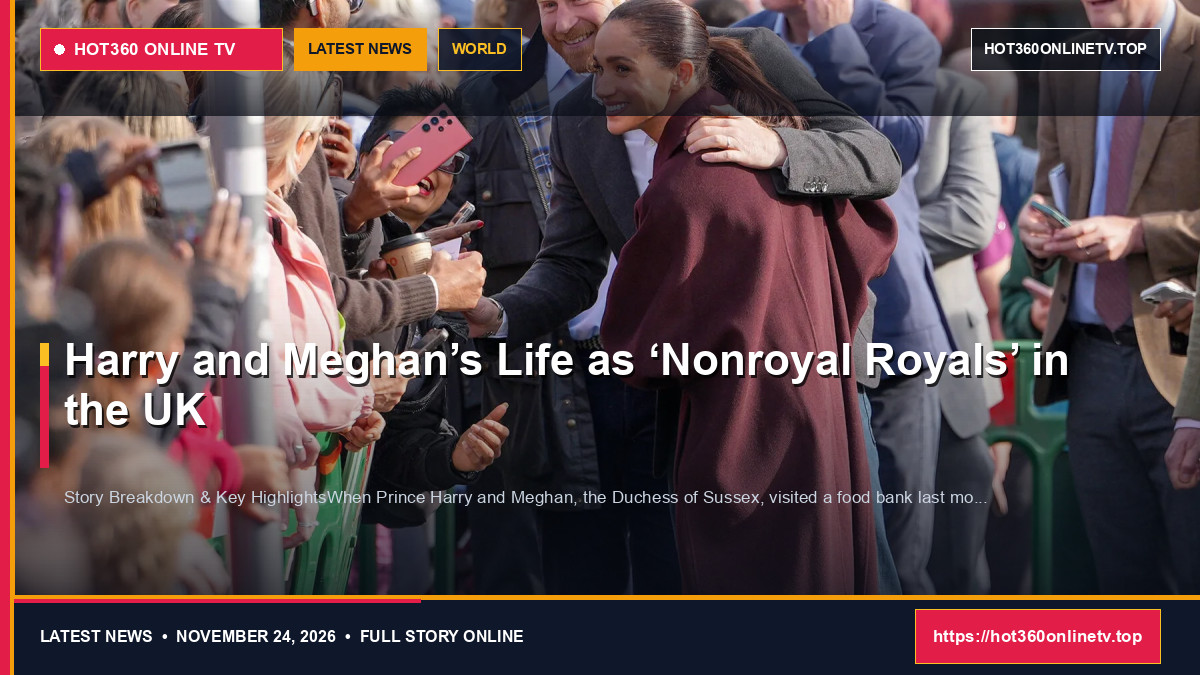
- When Prince Harry and Meghan, the Duchess of Sussex, visited a food bank last month in Nottingham, England, they had a request. No formal etiquette. No need for the bows or...
- The co-founder of the charity, Sajid Mohammed, obliged with an ordinary handshake. But around him, people curtsied, some volunteers wept with emotion, and six parents tried to...
Full Report
When Prince Harry and Meghan, the Duchess of Sussex, visited a food bank last month in Nottingham, England, they had a request. No formal etiquette. No need for the bows or curtsies that are traditional for members of the royal family. They could be greeted simply as “Harry and Meghan.”
The co-founder of the charity, Sajid Mohammed, obliged with an ordinary handshake. But around him, people curtsied, some volunteers wept with emotion, and six parents tried to bring their babies forward.
Even royals who have stepped back from official duties still inspire reflexive ceremony in some parts of the British public, it turns out.
“It’s very much like Harry’s mother, the late Princess Diana,” Mr. Mohammed said in an interview afterward. “There’s an aura around the couple. It’s beyond normal celebrity.”
The rapturous response they received in Nottingham underlines the challenge, and potential benefit, that the newly repatriated Sussexes offer to Britain’s monarchy, six years after they left the country and their royal duties. Queen Elizabeth II reluctantly blessed their self-imposed exile in 2020 but said that they must give up state funding and could no longer be considered full working royals.
Their return to Britain, which Harry said in a recent GQ interview was to pursue “opportunities for the family” and to school their children, has resurfaced questions about their status. They appear intent on carving out a specific profile, managing public appearances on their own terms and tightly controlling what they share, including where in England they have chosen to live, a fact that remains undisclosed. Their careful image management partly reflects the couple’s fraught relationship with the British media and its often hostile coverage in the past, which they previously said had contributed to their departure from Britain.
Meghan and Harry decorating cupcakes at Epic Partners in Nottingham last month.Credit...Pool photo by Joe Giddens
For now, their popularity in opinion polls remains low, particularly compared with Harry’s older brother, Prince William, and his wife Catherine, Princess of Wales. But can a pair armed with Hollywood glamour and global celebrity operate on their own terms without eclipsing the traditional working royals they left behind? Could their return, if managed well, inject energy into the institution as King Charles III enters his twilight years?
Charles has attempted to hold the line his mother drew. After Harry and Meghan’s return to Britain in late August, a letter was sent on the king’s behalf to government officials, stiffly reminding them that the Sussexes were “private citizens” who must not be addressed as “His and Her Royal Highness.”
The difficulty for Buckingham Palace is that, while it could strip away their official status, it cannot strip away their star power.
On the day the Sussexes swept through Nottingham, the king was in Cardiff opening the Senedd, the Welsh Parliament. While the BBC covered both events, ITV’s evening bulletin only found room for Harry and Meghan. The following day, Peter Hunt, a former BBC royal correspondent, highlighted the newspaper front pages smothered in Sussex coverage, writing on social media: “The palace spin is failing on contact with reality. Harry and Meghan are royals. End of.”
King Charles and Queen Camilla at the opening ceremony of the Welsh Parliament in Cardiff, last month.Credit...Pool photo by Alastair Grant
The daily grind of the British crown is not, by design, thrilling. It’s built on unglamorous routine — bronze plaques unveiled at rain-swept civic centers and ribbon-cuttings at community clinics — the stoic pattern perfected by Princess Anne, Charles’s sister.
“One of the biggest risks of Harry and Meghan coming back is that they take attention away from the core work of the monarchy, which is slightly dull at times,” said Craig Prescott, a constitutional scholar and author.
That dynamic is particularly delicate around major overseas excursions, when palace orthodoxy holds that royals should not compete with royals on big tours. When Charles toured the Caribbean this month, the Sussexes avoided rival public appearances.