Story Breakdown & Key Highlights
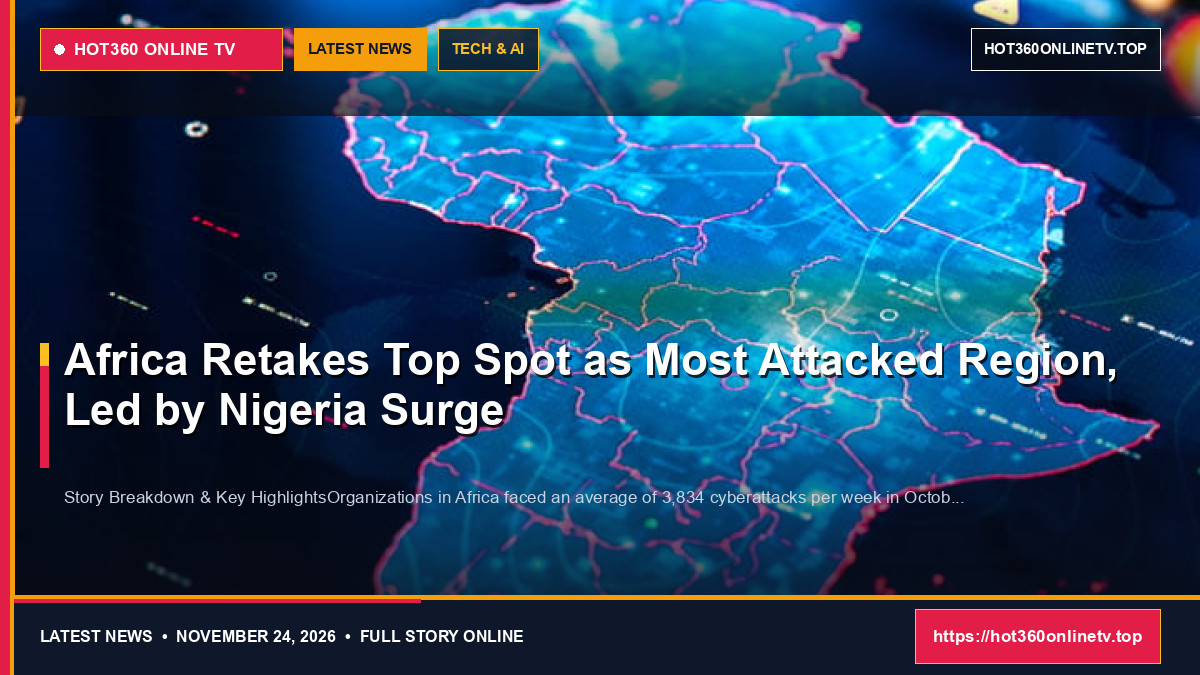
- Organizations in Africa faced an average of 3,834 cyberattacks per week in October, a jump of 38% from a year earlier, making the continent the most-attacked region for the first...
- Nigeria, Angola, and Kenya were among the top-five most targeted countries, with Nigeria topping the list with nearly 6,700 attacks targeting organizations in the country every...
Full Report
Organizations in Africa faced an average of 3,834 cyberattacks per week in October, a jump of 38% from a year earlier, making the continent the most-attacked region for the first time in more than a year.
Nigeria, Angola, and Kenya were among the top-five most targeted countries, with Nigeria topping the list with nearly 6,700 attacks targeting organizations in the country every week; that marks a 140% increase over October 2025, according to data published by Check Point Research earlier this month. The nations are among those rapidly pushing technological transformation of their infrastructure, expanding connectivity, investing in digital services, and putting sensitive data in network-connected applications and storage.
The fast transformation is exposing more opportunities for attackers, says Shayimamba Conco, chief technology officer and security evangelist in the Office of the CTO at Check Point Software.
Related:Chinese AI Project Scouts Spies in Taiwan Chip Industry
"All this rapid digital expansion is now happening within the region, but then, at the same time, this [expansion] is outpacing improvements in security maturity," he says, adding that security improvements are uneven across the continent. "Yes, some areas — let's say for example, South Africa — it's adopting cybersecurity at a much quicker rate than the rest of the Africa region, but there will be those regions which are still lagging behind a bit."
The significant increase in average weekly attacks pushed African organizations past those in Latin America as the favored targets of cyberattackers. In the first quarter of 2026, Latin America averaged more than 3,000 attacks per week, surpassing the approximate 2,700 attacks targeting African organizations. In September, the two regions essentially tied in terms of attacks, with Africa once again becoming the most popular target in October.
Globally, organizations experienced an average of 2,550 weekly cyberattacks in October, down 9% from September but up a third from the previous year. While Africa encountered the most weekly attacks, both Latin America and Asia-Pacific regions saw a greater-than-average number — 3,483 and 3,436, respectively.
Globally, cyberattacks focused heavily on the education sector, with the average academic institution suffering more than 5,900 attacks per week, up a third from the same month in 2025. The education sector has topped the global list of popular targets every month, with organizations made attractive to attackers because of their large data sets and reliance on legacy systems, says Conco.
Related:Malicious Linux Implants Mimic Asian Mail Security Products
"There is a lack of budget when it comes to not just IT, but specifically cybersecurity," he says. "A junior IT engineer has to manage these vast environments, which are hard to lock down by nature, because you've got all these students who need access to all these applications and resources."
In Africa, however, cyberattackers most often targeted financial services, government agencies, and the energy sector, according to Check Point's data.
The countries are racing to improve their cybersecurity postures and address persistent threats. Nigeria's National Information Technology Development Agency (NITDA) continues to work on the details of the nation's cybersecurity and cloud-sovereignty policies. Last month, Operation Serengeti 3.0 — a joint task force between Interpol and 20 African countries — led to the arrest of more than 1,500 suspects and the recovery of $105 million in stolen funds. In August, Operation Jackal IV targeted West African crime syndicates, leading to more than 200 arrests.
Check Point also flagged the use of AI in companies as a potential weak point, finding that about 2.9% of prompts to generative AI and large language models (LLMs) posed a high risk of leaking sensitive information. The risk is steadily increasing over time, from 2.3% in August to 2.5% in September.
Related:UAE, Saudi Arabia Face Onslaught of Increasingly Complex Cyberattacks
For privacy-breaking prompts, Latin American organizations shouldered the highest risk, with 3.8% of prompts posing leak risks.