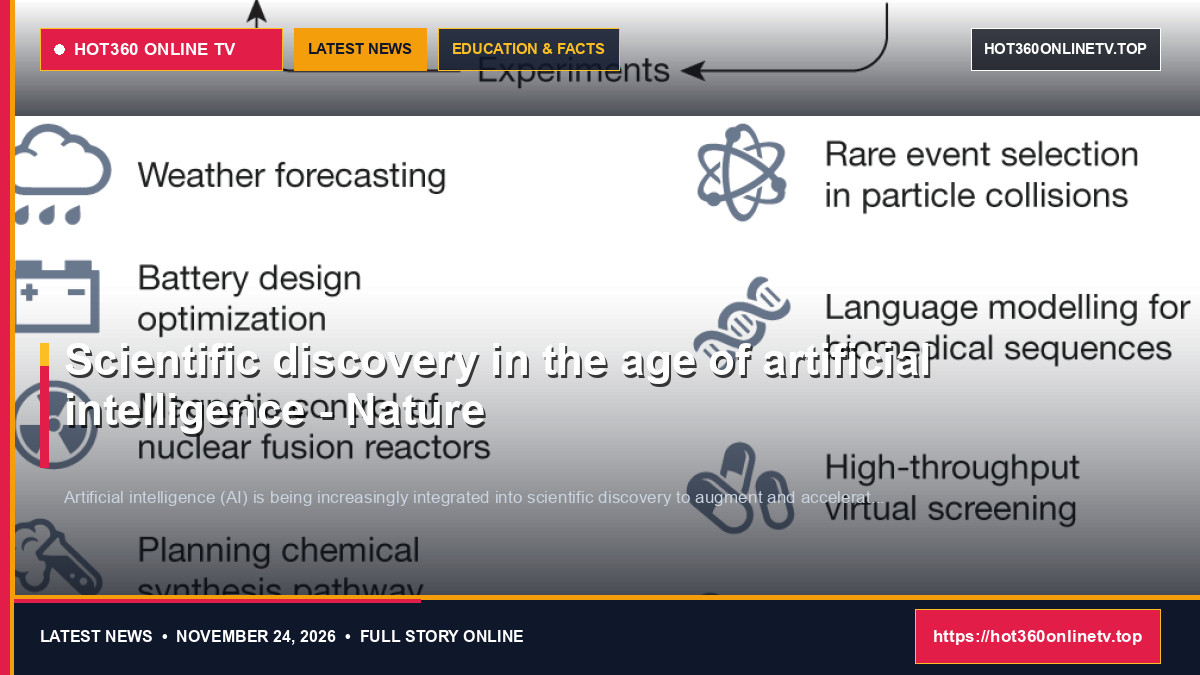
Artificial intelligence (AI) is being increasingly integrated into scientific discovery to augment and accelerate research, helping scientists to generate hypotheses, design experiments, collect and interpret large datasets, and gain insights that might not have been possible using traditional scientific methods alone. Here we examine breakthroughs over the past decade that include self-supervised learning, which allows models to be trained on vast amounts of unlabelled data, and geometric deep learning, which leverages knowledge about the structure of scientific data to enhance model accuracy and efficiency. Generative AI methods can create designs, such as small-molecule drugs and proteins, by analysing diverse data modalities, including images and sequences. We discuss how these methods can help scientists throughout the scientific process and the central issues that remain despite such advances. Both developers and users of AI tools need a better understanding of when such approaches need improvement, and challenges posed by poor data quality and stewardship remain. These issues cut across scientific disciplines and require developing foundational algorithmic approaches that can contribute to scientific understanding or acquire it autonomously, making them critical areas of focus for AI innovation.
This is a preview of subscription content, access via your institution
Access options
Access Nature and 54 other Nature Portfolio journals
Get Nature+, our best-value online-access subscription
Receive 51 print issues and online access
• Purchase on SpringerLink
• Instant access to the full article PDF.
Prices may be subject to local taxes which are calculated during checkout
Quantifying the use and potential benefits of artificial intelligence in scientific research
On scientific understanding with artificial intelligence
Artificial intelligence and illusions of understanding in scientific research
Explore related subjects
• Artificial Intelligence Applications in Healthcare Decision Support
Change history
• 30 August 2023A Correction to this paper has been published: https://doi.org/10.1038/s41586-023-06559-7
30 August 2023
A Correction to this paper has been published: https://doi.org/10.1038/s41586-023-06559-7
References
• LeCun, Y., Bengio, Y. & Hinton, G. Deep learning. Nature 521, 436–444 (2015). This survey summarizes key elements of deep learning and its development in speech recognition, computer vision and and natural language processing.Article ADS CAS PubMed Google Scholar
LeCun, Y., Bengio, Y. & Hinton, G. Deep learning. Nature 521, 436–444 (2015). This survey summarizes key elements of deep learning and its development in speech recognition, computer vision and and natural language processing.
Article ADS CAS PubMed Google Scholar
• de Regt, H. W. Understanding, values, and the aims of science. Phil. Sci. 87, 921–932 (2020).Article MathSciNet Google Scholar
de Regt, H. W. Understanding, values, and the aims of science. Phil. Sci. 87, 921–932 (2020).
Article MathSciNet Google Scholar
• Pickstone, J. V. Ways of Knowing: A New History of Science, Technology, and Medicine (Univ. Chicago Press, 2001).
Pickstone, J. V. Ways of Knowing: A New History of Science, Technology, and Medicine (Univ. Chicago Press, 2001).
• Han, J. et al. Deep potential: a general representation of a many-body potential energy surface. Commun. Comput. Phys. 23, 629–639 (2018). This paper introduced a deep neural network architecture that learns the potential energy surface of many-body systems while respecting the underlying symmetries of the system by incorporating group theory.
Han, J. et al. Deep potential: a general representation of a many-body potential energy surface. Commun. Comput. Phys. 23, 629–639 (2018). This paper introduced a deep neural network architecture that learns the potential energy surface of many-body systems while respecting the underlying symmetries of the system by incorporating group theory.
• Akiyama, K. et al. First M87 Event Horizon Telescope results. IV. Imaging the central supermassive black hole. Astrophys. J. Lett. 875, L4 (2019).Article ADS CAS Google Scholar
Akiyama, K. et al. First M87 Event Horizon Telescope results. IV. Imaging the central supermassive black hole. Astrophys. J. Lett. 875, L4 (2019).
Article ADS CAS Google Scholar
• Wagner, A. Z. Constructions in combinatorics via neural networks. Preprint at https://arxiv.org/abs/2104.14516 (2021).
Wagner, A. Z. Constructions in combinatorics via neural networks. Preprint at https://arxiv.org/abs/2104.14516 (2021).
• Coley, C. W. et al. A robotic platform for flow synthesis of organic compounds informed by AI planning. Science 365, eaax1566 (2019).Article CAS PubMed Google Scholar
Coley, C. W. et al. A robotic platform for flow synthesis of organic compounds informed by AI planning. Science 365, eaax1566 (2019).
Article CAS PubMed Google Scholar
• Bommasani, R. et al. On the opportunities and risks of foundation models. Preprint at https://arxiv.org/abs/2108.07258 (2021).
Bommasani, R. et al. On the opportunities and risks of foundation models. Preprint at https://arxiv.org/abs/2108.07258 (2021).
• Davies, A. et al. Advancing mathematics by guiding human intuition with AI. Nature 600, 70–74 (2021). This paper explores how AI can aid the development of pure mathematics by guiding mathematical intuition.Article ADS CAS PubMed PubMed Central MATH Google Scholar
Davies, A. et al. Advancing mathematics by guiding human intuition with AI. Nature 600, 70–74 (2021). This paper explores how AI can aid the development of pure mathematics by guiding mathematical intuition.
Article ADS CAS PubMed PubMed Central MATH Google Scholar
• Jumper, J. et al. Highly accurate protein structure prediction with AlphaFold. Nature 596, 583–589 (2021).This study was the first to demonstrate the ability to predict protein folding structures using AI methods with a high degree of accuracy, achieving results that are at or near the experimental resolution. This accomplishment is particularly noteworthy, as predicting protein folding has been a grand challenge in the field of molecular biology for over 50 years.Article ADS CAS PubMed PubMed Central Google Scholar
Jumper, J. et al. Highly accurate protein structure prediction with AlphaFold. Nature 596, 583–589 (2021).This study was the first to demonstrate the ability to predict protein folding structures using AI methods with a high degree of accuracy, achieving results that are at or near the experimental resolution. This accomplishment is particularly noteworthy, as predicting protein folding has been a grand challenge in the field of molecular biology for over 50 years.
Article ADS CAS PubMed PubMed Central Google Scholar
• Stokes, J. M. et al. A deep learning approach to antibiotic discovery. Cell 180, 688–702 (2020).Article CAS PubMed PubMed Central Google Scholar
Stokes, J. M. et al. A deep learning approach to antibiotic discovery. Cell 180, 688–702 (2020).
Article CAS PubMed PubMed Central Google Scholar
• Bohacek, R. S., McMartin, C. & Guida, W. C. The art and practice of structure-based drug design: a molecular modeling perspective. Med. Res. Rev. 16, 3–50 (1996).Article CAS PubMed Google Scholar
Bohacek, R. S., McMartin, C. & Guida, W. C. The art and practice of structure-based drug design: a molecular modeling perspective. Med. Res. Rev. 16, 3–50 (1996).
Article CAS PubMed Google Scholar
• Bileschi, M. L. et al. Using deep learning to annotate the protein universe. Nat. Biotechnol. 40, 932–937 (2022).
Bileschi, M. L. et al. Using deep learning to annotate the protein universe. Nat. Biotechnol. 40, 932–937 (2022).
• Bellemare, M. G. et al. Autonomous navigation of stratospheric balloons using reinforcement learning. Nature 588, 77–82 (2020). This paper describes a reinforcement-learning algorithm for navigating a super-pressure balloon in the stratosphere, making real-time decisions in the changing environment.Article ADS CAS PubMed Google Scholar
Bellemare, M. G. et al. Autonomous navigation of stratospheric balloons using reinforcement learning. Nature 588, 77–82 (2020). This paper describes a reinforcement-learning algorithm for navigating a super-pressure balloon in the stratosphere, making real-time decisions in the changing environment.
Article ADS CAS PubMed Google Scholar
• Tshitoyan, V. et al. Unsupervised word embeddings capture latent knowledge from materials science literature. Nature 571, 95–98 (2019).Article ADS CAS PubMed Google Scholar
Tshitoyan, V. et al. Unsupervised word embeddings capture latent knowledge from materials science literature. Nature 571, 95–98 (2019).
Article ADS CAS PubMed Google Scholar
• Zhang, L. et al. Deep potential molecular dynamics: a scalable model with the accuracy of quantum mechanics. Phys. Rev. Lett. 120, 143001 (2018).Article ADS CAS PubMed Google Scholar
Zhang, L. et al. Deep potential molecular dynamics: a scalable model with the accuracy of quantum mechanics. Phys. Rev. Lett. 120, 143001 (2018).
Article ADS CAS PubMed Google Scholar
• Deiana, A. M. et al. Applications and techniques for fast machine learning in science. Front. Big Data 5, 787421 (2022).
Deiana, A. M. et al. Applications and techniques for fast machine learning in science. Front. Big Data 5, 787421 (2022).
• Karagiorgi, G. et al. Machine learning in the search for new fundamental physics. Nat. Rev. Phys. 4, 399–412 (2022).
Karagiorgi, G. et al. Machine learning in the search for new fundamental physics. Nat. Rev. Phys. 4, 399–412 (2022).
• Zhou, C. & Paffenroth, R. C. Anomaly detection with robust deep autoencoders. In ACM SIGKDD International Conference on Knowledge Discovery and Data Mining 665–674 (2017).
Zhou, C. & Paffenroth, R. C. Anomaly detection with robust deep autoencoders. In ACM SIGKDD International Conference on Knowledge Discovery and Data Mining 665–674 (2017).
• Hinton, G. E. & Salakhutdinov, R. R. Reducing the dimensionality of data with neural networks. Science 313, 504–507 (2006).Article ADS MathSciNet CAS PubMed MATH Google Scholar
Hinton, G. E. & Salakhutdinov, R. R. Reducing the dimensionality of data with neural networks. Science 313, 504–507 (2006).
Article ADS MathSciNet CAS PubMed MATH Google Scholar
• Kasieczka, G. et al. The LHC Olympics 2020 a community challenge for anomaly detection in high energy physics. Rep. Prog. Phys. 84, 124201 (2021).Article ADS CAS Google Scholar
Kasieczka, G. et al. The LHC Olympics 2020 a community challenge for anomaly detection in high energy physics. Rep. Prog. Phys. 84, 124201 (2021).
Article ADS CAS Google Scholar
• Govorkova, E. et al. Autoencoders on field-programmable gate arrays for real-time, unsupervised new physics detection at 40 MHz at the Large Hadron Collider. Nat. Mach. Intell. 4, 154–161 (2022).Article Google Scholar
Govorkova, E. et al. Autoencoders on field-programmable gate arrays for real-time, unsupervised new physics detection at 40 MHz at the Large Hadron Collider. Nat. Mach. Intell. 4, 154–161 (2022).
• Chamberland, M. et al. Detecting microstructural deviations in individuals with deep diffusion MRI tractometry. Nat. Comput. Sci. 1, 598–606 (2021).Article PubMed PubMed Central Google Scholar
Chamberland, M. et al. Detecting microstructural deviations in individuals with deep diffusion MRI tractometry. Nat. Comput. Sci. 1, 598–606 (2021).
Article PubMed PubMed Central Google Scholar
• Rafique, M. et al. Delegated regressor, a robust approach for automated anomaly detection in the soil radon time series data. Sci. Rep. 10, 3004 (2020).Article ADS CAS PubMed PubMed Central Google Scholar
Rafique, M. et al. Delegated regressor, a robust approach for automated anomaly detection in the soil radon time series data. Sci. Rep. 10, 3004 (2020).
Article ADS CAS PubMed PubMed Central Google Scholar
• Pastore, V. P. et al. Annotation-free learning of plankton for classification and anomaly detection. Sci. Rep. 10, 12142 (2020).Article ADS CAS PubMed PubMed Central Google Scholar
Pastore, V. P. et al. Annotation-free learning of plankton for classification and anomaly detection. Sci. Rep. 10, 12142 (2020).
Article ADS CAS PubMed PubMed Central Google Scholar
• Naul, B. et al. A recurrent neural network for classification of unevenly sampled variable stars. Nat. Astron. 2, 151–155 (2018).Article ADS Google Scholar
Naul, B. et al. A recurrent neural network for classification of unevenly sampled variable stars. Nat. Astron. 2, 151–155 (2018).
Article ADS Google Scholar
• Lee, D.-H. et al. Pseudo-label: the simple and efficient semi-supervised learning method for deep neural networks. In ICML Workshop on Challenges in Representation Learning (2013).
Lee, D.-H. et al. Pseudo-label: the simple and efficient semi-supervised learning method for deep neural networks. In ICML Workshop on Challenges in Representation Learning (2013).
• Zhou, D. et al. Learning with local and global consistency. In Advances in Neural Information Processing Systems 16, 321–328 (2003).
Zhou, D. et al. Learning with local and global consistency. In Advances in Neural Information Processing Systems 16, 321–328 (2003).
• Radivojac, P. et al. A large-scale evaluation of computational protein function prediction. Nat. Methods 10, 221–227 (2013).Article CAS PubMed PubMed Central Google Scholar
Radivojac, P. et al. A large-scale evaluation of computational protein function prediction. Nat. Methods 10, 221–227 (2013).
Article CAS PubMed PubMed Central Google Scholar
• Barkas, N. et al. Joint analysis of heterogeneous single-cell RNA-seq dataset collections. Nat. Methods 16, 695–698 (2019).Article CAS PubMed PubMed Central Google Scholar
Barkas, N. et al. Joint analysis of heterogeneous single-cell RNA-seq dataset collections. Nat. Methods 16, 695–698 (2019).
Article CAS PubMed PubMed Central Google Scholar
• Tran, K. & Ulissi, Z. W. Active learning across intermetallics to guide discovery of electrocatalysts for CO2 reduction and H2 evolution. Nat. Catal. 1, 696–703 (2018).Article CAS Google Scholar
Tran, K. & Ulissi, Z. W. Active learning across intermetallics to guide discovery of electrocatalysts for CO2 reduction and H2 evolution. Nat. Catal. 1, 696–703 (2018).
Article CAS Google Scholar
• Jablonka, K. M. et al. Bias free multiobjective active learning for materials design and discovery. Nat. Commun. 12, 2312 (2021).Article ADS CAS PubMed PubMed Central Google Scholar
Jablonka, K. M. et al. Bias free multiobjective active learning for materials design and discovery. Nat. Commun. 12, 2312 (2021).
Article ADS CAS PubMed PubMed Central Google Scholar
• Roussel, R. et al. Turn-key constrained parameter space exploration for particle accelerators using Bayesian active learning. Nat. Commun. 12, 5612 (2021).Article ADS CAS PubMed PubMed Central Google Scholar
Roussel, R. et al. Turn-key constrained parameter space exploration for particle accelerators using Bayesian active learning. Nat. Commun. 12, 5612 (2021).
Article ADS CAS PubMed PubMed Central Google Scholar
• Ratner, A. J. et al. Data programming: creating large training sets, quickly. In Advances in Neural Information Processing Systems 29, 3567–3575 (2016).
Ratner, A. J. et al. Data programming: creating large training sets, quickly. In Advances in Neural Information Processing Systems 29, 3567–3575 (2016).
• Ratner, A. et al. Snorkel: rapid training data creation with weak supervision. In International Conference on Very Large Data Bases 11, 269–282 (2017). This paper presents a weakly-supervised AI system designed to annotate massive amounts of data using labeling functions.
Ratner, A. et al. Snorkel: rapid training data creation with weak supervision. In International Conference on Very Large Data Bases 11, 269–282 (2017). This paper presents a weakly-supervised AI system designed to annotate massive amounts of data using labeling functions.
• Butter, A. et al. GANplifying event samples. SciPost Phys. 10, 139 (2021).Article ADS Google Scholar
Butter, A. et al. GANplifying event samples. SciPost Phys. 10, 139 (2021).
Article ADS Google Scholar
• Brown, T. et al. Language models are few-shot learners. In Advances in Neural Information Processing Systems 33, 1877–1901 (2020).
Brown, T. et al. Language models are few-shot learners. In Advances in Neural Information Processing Systems 33, 1877–1901 (2020).
• Ramesh, A. et al. Zero-shot text-to-image generation. In International Conference on Machine Learning 139, 8821–8831 (2021).
Ramesh, A. et al. Zero-shot text-to-image generation. In International Conference on Machine Learning 139, 8821–8831 (2021).
• Littman, M. L. Reinforcement learning improves behaviour from evaluative feedback. Nature 521, 445–451 (2015).Article ADS CAS PubMed Google Scholar
Littman, M. L. Reinforcement learning improves behaviour from evaluative feedback. Nature 521, 445–451 (2015).
Article ADS CAS PubMed Google Scholar
• Cubuk, E. D. et al. Autoaugment: learning augmentation strategies from data. In IEEE Conference on Computer Vision and Pattern Recognition 113–123 (2019).
Cubuk, E. D. et al. Autoaugment: learning augmentation strategies from data. In IEEE Conference on Computer Vision and Pattern Recognition 113–123 (2019).
• Reed, C. J. et al. Selfaugment: automatic augmentation policies for self-supervised learning. In IEEE Conference on Computer Vision and Pattern Recognition 2674–2683 (2021).
Reed, C. J. et al. Selfaugment: automatic augmentation policies for self-supervised learning. In IEEE Conference on Computer Vision and Pattern Recognition 2674–2683 (2021).
• ATLAS Collaboration et al. Deep generative models for fast photon shower simulation in ATLAS. Preprint at https://arxiv.org/abs/2210.06204 (2022).
ATLAS Collaboration et al. Deep generative models for fast photon shower simulation in ATLAS. Preprint at https://arxiv.org/abs/2210.06204 (2022).
• Mahmood, F. et al. Deep adversarial training for multi-organ nuclei segmentation in histopathology images. IEEE Trans. Med. Imaging 39, 3257–3267 (2019).Article Google Scholar
Mahmood, F. et al. Deep adversarial training for multi-organ nuclei segmentation in histopathology images. IEEE Trans. Med. Imaging 39, 3257–3267 (2019).
• Teixeira, B. et al. Generating synthetic X-ray images of a person from the surface geometry. In IEEE Conference on Computer Vision and Pattern Recognition 9059–9067 (2018).
Teixeira, B. et al. Generating synthetic X-ray images of a person from the surface geometry. In IEEE Conference on Computer Vision and Pattern Recognition 9059–9067 (2018).
• Lee, D., Moon, W.-J. & Ye, J. C. Assessing the importance of magnetic resonance contrasts using collaborative generative adversarial networks. Nat. Mach. Intell. 2, 34–42 (2020).Article Google Scholar
Lee, D., Moon, W.-J. & Ye, J. C. Assessing the importance of magnetic resonance contrasts using collaborative generative adversarial networks. Nat. Mach. Intell. 2, 34–42 (2020).
• Kench, S. & Cooper, S. J. Generating three-dimensional structures from a two-dimensional slice with generative adversarial network-based dimensionality expansion. Nat. Mach. Intell. 3, 299–305 (2021).Article Google Scholar
Kench, S. & Cooper, S. J. Generating three-dimensional structures from a two-dimensional slice with generative adversarial network-based dimensionality expansion. Nat. Mach. Intell. 3, 299–305 (2021).
• Wan, C. & Jones, D. T. Protein function prediction is improved by creating synthetic feature samples with generative adversarial networks. Nat. Mach. Intell. 2, 540–550 (2020).Article Google Scholar
Wan, C. & Jones, D. T. Protein function prediction is improved by creating synthetic feature samples with generative adversarial networks. Nat. Mach. Intell. 2, 540–550 (2020).
• Repecka, D. et al. Expanding functional protein sequence spaces using generative adversarial networks. Nat. Mach. Intell. 3, 324–333 (2021).Article Google Scholar
Repecka, D. et al. Expanding functional protein sequence spaces using generative adversarial networks. Nat. Mach. Intell. 3, 324–333 (2021).
• Marouf, M. et al. Realistic in silico generation and augmentation of single-cell RNA-seq data using generative adversarial networks. Nat. Commun. 11, 166 (2020).Article ADS CAS PubMed PubMed Central Google Scholar
Marouf, M. et al. Realistic in silico generation and augmentation of single-cell RNA-seq data using generative adversarial networks. Nat. Commun. 11, 166 (2020).
Article ADS CAS PubMed PubMed Central Google Scholar
• Ghahramani, Z. Probabilistic machine learning and artificial intelligence. Nature 521, 452–459 (2015).This survey provides an introduction to probabilistic machine learning, which involves the representation and manipulation of uncertainty in models and predictions, playing a central role in scientific data analysis.Article ADS CAS PubMed Google Scholar
Ghahramani, Z. Probabilistic machine learning and artificial intelligence. Nature 521, 452–459 (2015).This survey provides an introduction to probabilistic machine learning, which involves the representation and manipulation of uncertainty in models and predictions, playing a central role in scientific data analysis.
Article ADS CAS PubMed Google Scholar
• Cogan, J. et al. Jet-images: computer vision inspired techniques for jet tagging. J. High Energy Phys. 2015, 118 (2015).Article Google Scholar
Cogan, J. et al. Jet-images: computer vision inspired techniques for jet tagging. J. High Energy Phys. 2015, 118 (2015).
• Zhao, W. et al. Sparse deconvolution improves the resolution of live-cell super-resolution fluorescence microscopy. Nat. Biotechnol. 40, 606–617 (2022).Article CAS PubMed Google Scholar
Zhao, W. et al. Sparse deconvolution improves the resolution of live-cell super-resolution fluorescence microscopy. Nat. Biotechnol. 40, 606–617 (2022).
Article CAS PubMed Google Scholar
• Brbić, M. et al. MARS: discovering novel cell types across heterogeneous single-cell experiments. Nat. Methods 17, 1200–1206 (2020).Article PubMed Google Scholar
Brbić, M. et al. MARS: discovering novel cell types across heterogeneous single-cell experiments. Nat. Methods 17, 1200–1206 (2020).
Article PubMed Google Scholar
• Qiao, C. et al. Evaluation and development of deep neural networks for image super-resolution in optical microscopy. Nat. Methods 18, 194–202 (2021).Article CAS PubMed Google Scholar
Qiao, C. et al. Evaluation and development of deep neural networks for image super-resolution in optical microscopy. Nat. Methods 18, 194–202 (2021).
Article CAS PubMed Google Scholar
• Andreassen, A. et al. OmniFold: a method to simultaneously unfold all observables. Phys. Rev. Lett. 124, 182001 (2020).Article ADS CAS PubMed Google Scholar
Andreassen, A. et al. OmniFold: a method to simultaneously unfold all observables. Phys. Rev. Lett. 124, 182001 (2020).
Article ADS CAS PubMed Google Scholar
• Bergenstråhle, L. et al. Super-resolved spatial transcriptomics by deep data fusion. Nat. Biotechnol. 40, 476–479 (2021).
Bergenstråhle, L. et al. Super-resolved spatial transcriptomics by deep data fusion. Nat. Biotechnol. 40, 476–479 (2021).
• Vincent, P. et al. Extracting and composing robust features with denoising autoencoders. In International Conference on Machine Learning 1096–1103 (2008).
Vincent, P. et al. Extracting and composing robust features with denoising autoencoders. In International Conference on Machine Learning 1096–1103 (2008).
• Kingma, D. P. & Welling, M. Auto-encoding variational Bayes. In International Conference on Learning Representations (2014).
Kingma, D. P. & Welling, M. Auto-encoding variational Bayes. In International Conference on Learning Representations (2014).
• Eraslan, G. et al. Single-cell RNA-seq denoising using a deep count autoencoder. Nat. Commun. 10, 390 (2019).Article ADS CAS PubMed PubMed Central Google Scholar
Eraslan, G. et al. Single-cell RNA-seq denoising using a deep count autoencoder. Nat. Commun. 10, 390 (2019).
Article ADS CAS PubMed PubMed Central Google Scholar
• Goodfellow, I., Bengio, Y. & Courville, A. Deep Learning (MIT Press, 2016).
Goodfellow, I., Bengio, Y. & Courville, A. Deep Learning (MIT Press, 2016).
• Olshausen, B. A. & Field, D. J. Emergence of simple-cell receptive field properties by learning a sparse code for natural images. Nature 381, 607–609 (1996).Article ADS CAS PubMed Google Scholar
Olshausen, B. A. & Field, D. J. Emergence of simple-cell receptive field properties by learning a sparse code for natural images. Nature 381, 607–609 (1996).
Article ADS CAS PubMed Google Scholar
• Bengio, Y. Deep learning of representations for unsupervised and transfer learning. In ICML Workshop on Unsupervised and Transfer Learning (2012).
Bengio, Y. Deep learning of representations for unsupervised and transfer learning. In ICML Workshop on Unsupervised and Transfer Learning (2012).
• Detlefsen, N. S., Hauberg, S. & Boomsma, W. Learning meaningful representations of protein sequences. Nat. Commun. 13, 1914 (2022).Article ADS CAS PubMed PubMed Central Google Scholar
Detlefsen, N. S., Hauberg, S. & Boomsma, W. Learning meaningful representations of protein sequences. Nat. Commun. 13, 1914 (2022).
Article ADS CAS PubMed PubMed Central Google Scholar
• Becht, E. et al. Dimensionality reduction for visualizing single-cell data using UMAP. Nat. Biotechnol. 37, 38–44 (2019).Article CAS Google Scholar
Becht, E. et al. Dimensionality reduction for visualizing single-cell data using UMAP. Nat. Biotechnol. 37, 38–44 (2019).
Article CAS Google Scholar
• Bronstein, M. M. et al. Geometric deep learning: going beyond euclidean data. IEEE Signal Process Mag. 34, 18–42 (2017).Article ADS Google Scholar
Bronstein, M. M. et al. Geometric deep learning: going beyond euclidean data. IEEE Signal Process Mag. 34, 18–42 (2017).
Article ADS Google Scholar
• Anderson, P. W. More is different: broken symmetry and the nature of the hierarchical structure of science. Science 177, 393–396 (1972).Article ADS CAS PubMed Google Scholar
Anderson, P. W. More is different: broken symmetry and the nature of the hierarchical structure of science. Science 177, 393–396 (1972).
Article ADS CAS PubMed Google Scholar
• Qiao, Z. et al. Informing geometric deep learning with electronic interactions to accelerate quantum chemistry. Proc. Natl Acad. Sci. USA 119, e2205221119 (2022).
Qiao, Z. et al. Informing geometric deep learning with electronic interactions to accelerate quantum chemistry. Proc. Natl Acad. Sci. USA 119, e2205221119 (2022).
• Bogatskiy, A. et al. Symmetry group equivariant architectures for physics. Preprint at https://arxiv.org/abs/2203.06153 (2022).
Bogatskiy, A. et al. Symmetry group equivariant architectures for physics. Preprint at https://arxiv.org/abs/2203.06153 (2022).
• Bronstein, M. M. et al. Geometric deep learning: grids, groups, graphs, geodesics, and gauges. Preprint at https://arxiv.org/abs/2104.13478 (2021).
Bronstein, M. M. et al. Geometric deep learning: grids, groups, graphs, geodesics, and gauges. Preprint at https://arxiv.org/abs/2104.13478 (2021).
• Townshend, R. J. L. et al. Geometric deep learning of RNA structure. Science 373, 1047–1051 (2021).Article ADS CAS PubMed PubMed Central Google Scholar
Townshend, R. J. L. et al. Geometric deep learning of RNA structure. Science 373, 1047–1051 (2021).
Article ADS CAS PubMed PubMed Central Google Scholar
• Wicky, B. I. M. et al. Hallucinating symmetric protein assemblies. Science 378, 56–61 (2022).
Wicky, B. I. M. et al. Hallucinating symmetric protein assemblies. Science 378, 56–61 (2022).
• Kipf, T. N. & Welling, M. Semi-supervised classification with graph convolutional networks. In International Conference on Learning Representations (2017).
Kipf, T. N. & Welling, M. Semi-supervised classification with graph convolutional networks. In International Conference on Learning Representations (2017).
• Veličković, P. et al. Graph attention networks. In International Conference on Learning Representations (2018).
Veličković, P. et al. Graph attention networks. In International Conference on Learning Representations (2018).
• Hamilton, W. L., Ying, Z. & Leskovec, J. Inductive representation learning on large graphs. In Advances in Neural Information Processing Systems 30, 1024–1034 (2017).
Hamilton, W. L., Ying, Z. & Leskovec, J. Inductive representation learning on large graphs. In Advances in Neural Information Processing Systems 30, 1024–1034 (2017).
• Gilmer, J. et al. Neural message passing for quantum chemistry. In International Conference on Machine Learning 1263–1272 (2017).
Gilmer, J. et al. Neural message passing for quantum chemistry. In International Conference on Machine Learning 1263–1272 (2017).
• Li, M. M., Huang, K. & Zitnik, M. Graph representation learning in biomedicine and healthcare. Nat. Biomed. Eng. 6, 1353–1369 (2022).
Li, M. M., Huang, K. & Zitnik, M. Graph representation learning in biomedicine and healthcare. Nat. Biomed. Eng. 6, 1353–1369 (2022).
• Satorras, V. G., Hoogeboom, E. & Welling, M. E(n) equivariant graph neural networks. In International Conference on Machine Learning 9323–9332 (2021). This study incorporates principles of physics into the design of neural models, advancing the field of equivariant machine learning.
Satorras, V. G., Hoogeboom, E. & Welling, M. E(n) equivariant graph neural networks. In International Conference on Machine Learning 9323–9332 (2021). This study incorporates principles of physics into the design of neural models, advancing the field of equivariant machine learning.
• Thomas, N. et al. Tensor field networks: rotation-and translation-equivariant neural networks for 3D point clouds. Preprint at https://arxiv.org/abs/1802.08219 (2018).
Thomas, N. et al. Tensor field networks: rotation-and translation-equivariant neural networks for 3D point clouds. Preprint at https://arxiv.org/abs/1802.08219 (2018).
• Finzi, M. et al. Generalizing convolutional neural networks for equivariance to lie groups on arbitrary continuous data. In International Conference on Machine Learning 3165–3176 (2020).
Finzi, M. et al. Generalizing convolutional neural networks for equivariance to lie groups on arbitrary continuous data. In International Conference on Machine Learning 3165–3176 (2020).
• Fuchs, F. et al. SE(3)-transformers: 3D roto-translation equivariant attention networks. In Advances in Neural Information Processing Systems 33, 1970-1981 (2020).
Fuchs, F. et al. SE(3)-transformers: 3D roto-translation equivariant attention networks. In Advances in Neural Information Processing Systems 33, 1970-1981 (2020).
• Zaheer, M. et al. Deep sets. In Advances in Neural Information Processing Systems 30, 3391–3401 (2017). This paper is an early study that explores the use of deep neural architectures on set data, which consists of an unordered list of elements.
Zaheer, M. et al. Deep sets. In Advances in Neural Information Processing Systems 30, 3391–3401 (2017). This paper is an early study that explores the use of deep neural architectures on set data, which consists of an unordered list of elements.
• Cohen, T. S. et al. Spherical CNNs. In International Conference on Learning Representations (2018).
Cohen, T. S. et al. Spherical CNNs. In International Conference on Learning Representations (2018).
• Gordon, J. et al. Permutation equivariant models for compositional generalization in language. In International Conference on Learning Representations (2019).
Gordon, J. et al. Permutation equivariant models for compositional generalization in language. In International Conference on Learning Representations (2019).
• Finzi, M., Welling, M. & Wilson, A. G. A practical method for constructing equivariant multilayer perceptrons for arbitrary matrix groups. In International Conference on Machine Learning 3318–3328 (2021).
Finzi, M., Welling, M. & Wilson, A. G. A practical method for constructing equivariant multilayer perceptrons for arbitrary matrix groups. In International Conference on Machine Learning 3318–3328 (2021).
• Dijk, D. V. et al. Recovering gene interactions from single-cell data using data diffusion. Cell 174, 716–729 (2018).Article PubMed PubMed Central Google Scholar
Dijk, D. V. et al. Recovering gene interactions from single-cell data using data diffusion. Cell 174, 716–729 (2018).
Article PubMed PubMed Central Google Scholar
• Gainza, P. et al. Deciphering interaction fingerprints from protein molecular surfaces using geometric deep learning. Nat. Methods 17, 184–192 (2020).Article CAS PubMed Google Scholar
Gainza, P. et al. Deciphering interaction fingerprints from protein molecular surfaces using geometric deep learning. Nat. Methods 17, 184–192 (2020).
Article CAS PubMed Google Scholar
• Hatfield, P. W. et al. The data-driven future of high-energy-density physics. Nature 593, 351–361 (2021).Article ADS CAS PubMed Google Scholar
Hatfield, P. W. et al. The data-driven future of high-energy-density physics. Nature 593, 351–361 (2021).
Article ADS CAS PubMed Google Scholar
• Bapst, V. et al. Unveiling the predictive power of static structure in glassy systems. Nat. Phys. 16, 448–454 (2020).Article CAS Google Scholar
Bapst, V. et al. Unveiling the predictive power of static structure in glassy systems. Nat. Phys. 16, 448–454 (2020).
Article CAS Google Scholar
• Zhang, R., Zhou, T. & Ma, J. Multiscale and integrative single-cell Hi-C analysis with Higashi. Nat. Biotechnol. 40, 254–261 (2022).Article CAS PubMed Google Scholar
Zhang, R., Zhou, T. & Ma, J. Multiscale and integrative single-cell Hi-C analysis with Higashi. Nat. Biotechnol. 40, 254–261 (2022).
Article CAS PubMed Google Scholar
• Sammut, S.-J. et al. Multi-omic machine learning predictor of breast cancer therapy response. Nature 601, 623–629 (2022).Article ADS CAS PubMed Google Scholar
Sammut, S.-J. et al. Multi-omic machine learning predictor of breast cancer therapy response. Nature 601, 623–629 (2022).
Article ADS CAS PubMed Google Scholar
• DeZoort, G. et al. Graph neural networks at the Large Hadron Collider. Nat. Rev. Phys. 5, 281–303 (2023).
DeZoort, G. et al. Graph neural networks at the Large Hadron Collider. Nat. Rev. Phys. 5, 281–303 (2023).
• Liu, S. et al. Pre-training molecular graph representation with 3D geometry. In International Conference on Learning Representations (2022).
Liu, S. et al. Pre-training molecular graph representation with 3D geometry. In International Conference on Learning Representations (2022).
• The LIGO Scientific Collaboration. et al. A gravitational-wave standard siren measurement of the Hubble constant. Nature 551, 85–88 (2017).Article Google Scholar
The LIGO Scientific Collaboration. et al. A gravitational-wave standard siren measurement of the Hubble constant. Nature 551, 85–88 (2017).
• Reichstein, M. et al. Deep learning and process understanding for data-driven Earth system science. Nature 566, 195–204 (2019).Article ADS CAS PubMed Google Scholar
Reichstein, M. et al. Deep learning and process understanding for data-driven Earth system science. Nature 566, 195–204 (2019).
Article ADS CAS PubMed Google Scholar
• Goenka, S. D. et al. Accelerated identification of disease-causing variants with ultra-rapid nanopore genome sequencing. Nat. Biotechnol. 40, 1035–1041 (2022).
Goenka, S. D. et al. Accelerated identification of disease-causing variants with ultra-rapid nanopore genome sequencing. Nat. Biotechnol. 40, 1035–1041 (2022).
• Bengio, Y. et al. Greedy layer-wise training of deep networks. In Advances in Neural Information Processing Systems 19, 153–160 (2006).
Bengio, Y. et al. Greedy layer-wise training of deep networks. In Advances in Neural Information Processing Systems 19, 153–160 (2006).
• Hinton, G. E., Osindero, S. & Teh, Y.-W. A fast learning algorithm for deep belief nets. Neural Comput. 18, 1527–1554 (2006).Article MathSciNet PubMed MATH Google Scholar
Hinton, G. E., Osindero, S. & Teh, Y.-W. A fast learning algorithm for deep belief nets. Neural Comput. 18, 1527–1554 (2006).
Article MathSciNet PubMed MATH Google Scholar
• Jordan, M. I. & Mitchell, T. M. Machine learning: trends, perspectives, and prospects. Science 349, 255–260 (2015).Article ADS MathSciNet CAS PubMed MATH Google Scholar
Jordan, M. I. & Mitchell, T. M. Machine learning: trends, perspectives, and prospects. Science 349, 255–260 (2015).
Article ADS MathSciNet CAS PubMed MATH Google Scholar
• Devlin, J. et al. BERT: pre-training of deep bidirectional transformers for language understanding. In North American Chapter of the Association for Computational Linguistics 4171–4186 (2019).
Devlin, J. et al. BERT: pre-training of deep bidirectional transformers for language understanding. In North American Chapter of the Association for Computational Linguistics 4171–4186 (2019).
• Rives, A. et al. Biological structure and function emerge from scaling unsupervised learning to 250 million protein sequences. Proc. Natl Acad. Sci. USA 118, e2016239118 (2021).
Rives, A. et al. Biological structure and function emerge from scaling unsupervised learning to 250 million protein sequences. Proc. Natl Acad. Sci. USA 118, e2016239118 (2021).
• Elnaggar, A. et al. ProtTrans: rowards cracking the language of lifes code through self-supervised deep learning and high performance computing. In IEEE Transactions on Pattern Analysis and Machine Intelligence (2021).
Elnaggar, A. et al. ProtTrans: rowards cracking the language of lifes code through self-supervised deep learning and high performance computing. In IEEE Transactions on Pattern Analysis and Machine Intelligence (2021).
• Hie, B. et al. Learning the language of viral evolution and escape. Science 371, 284–288 (2021).This paper modeled viral escape with machine learning algorithms originally developed for human natural language.Article ADS MathSciNet CAS PubMed MATH Google Scholar
Hie, B. et al. Learning the language of viral evolution and escape. Science 371, 284–288 (2021).This paper modeled viral escape with machine learning algorithms originally developed for human natural language.
Article ADS MathSciNet CAS PubMed MATH Google Scholar
• Biswas, S. et al. Low-N protein engineering with data-efficient deep learning. Nat. Methods 18, 389–396 (2021).Article CAS PubMed Google Scholar
Biswas, S. et al. Low-N protein engineering with data-efficient deep learning. Nat. Methods 18, 389–396 (2021).
Article CAS PubMed Google Scholar
• Ferruz, N. & Höcker, B. Controllable protein design with language models. Nat. Mach. Intell. 4, 521–532 (2022).
Ferruz, N. & Höcker, B. Controllable protein design with language models. Nat. Mach. Intell. 4, 521–532 (2022).
• Hsu, C. et al. Learning inverse folding from millions of predicted structures. In International Conference on Machine Learning 8946–8970 (2022).
Hsu, C. et al. Learning inverse folding from millions of predicted structures. In International Conference on Machine Learning 8946–8970 (2022).
• Baek, M. et al. Accurate prediction of protein structures and interactions using a three-track neural network. Science 373, 871–876 (2021). Inspired by AlphaFold2, this study reported RoseTTAFold, a novel three-track neural module capable of simultaneously processing protein’s sequence, distance and coordinates.Article ADS CAS PubMed PubMed Central Google Scholar
Baek, M. et al. Accurate prediction of protein structures and interactions using a three-track neural network. Science 373, 871–876 (2021). Inspired by AlphaFold2, this study reported RoseTTAFold, a novel three-track neural module capable of simultaneously processing protein’s sequence, distance and coordinates.
Article ADS CAS PubMed PubMed Central Google Scholar
• Weininger, D. SMILES, a chemical language and information system. 1. Introduction to methodology and encoding rules. J. Chem. Inf. Comput. Sci. 28, 31–36 (1988).Article CAS Google Scholar
Weininger, D. SMILES, a chemical language and information system. 1. Introduction to methodology and encoding rules. J. Chem. Inf. Comput. Sci. 28, 31–36 (1988).
Article CAS Google Scholar
• Lin, T.-S. et al. BigSMILES: a structurally-based line notation for describing macromolecules. ACS Cent. Sci. 5, 1523–1531 (2019).Article ADS CAS PubMed PubMed Central Google Scholar
Lin, T.-S. et al. BigSMILES: a structurally-based line notation for describing macromolecules. ACS Cent. Sci. 5, 1523–1531 (2019).
Article ADS CAS PubMed PubMed Central Google Scholar
• Krenn, M. et al. SELFIES and the future of molecular string representations. Patterns 3, 100588 (2022).
Krenn, M. et al. SELFIES and the future of molecular string representations. Patterns 3, 100588 (2022).
• Flam-Shepherd, D., Zhu, K. & Aspuru-Guzik, A. Language models can learn complex molecular distributions. Nat. Commun. 13, 3293 (2022).Article ADS CAS PubMed PubMed Central Google Scholar
Flam-Shepherd, D., Zhu, K. & Aspuru-Guzik, A. Language models can learn complex molecular distributions. Nat. Commun. 13, 3293 (2022).
Article ADS CAS PubMed PubMed Central Google Scholar
• Skinnider, M. A. et al. Chemical language models enable navigation in sparsely populated chemical space. Nat. Mach. Intell. 3, 759–770 (2021).Article Google Scholar
Skinnider, M. A. et al. Chemical language models enable navigation in sparsely populated chemical space. Nat. Mach. Intell. 3, 759–770 (2021).
• Chithrananda, S., Grand, G. & Ramsundar, B. ChemBERTa: large-scale self-supervised pretraining for molecular property prediction. In Machine Learning for Molecules Workshop at NeurIPS (2020).
Chithrananda, S., Grand, G. & Ramsundar, B. ChemBERTa: large-scale self-supervised pretraining for molecular property prediction. In Machine Learning for Molecules Workshop at NeurIPS (2020).
• Schwaller, P. et al. Predicting retrosynthetic pathways using transformer-based models and a hyper-graph exploration strategy. Chem. Sci. 11, 3316–3325 (2020).Article CAS PubMed PubMed Central Google Scholar
Schwaller, P. et al. Predicting retrosynthetic pathways using transformer-based models and a hyper-graph exploration strategy. Chem. Sci. 11, 3316–3325 (2020).
Article CAS PubMed PubMed Central Google Scholar
• Tetko, I. V. et al. State-of-the-art augmented NLP transformer models for direct and single-step retrosynthesis. Nat. Commun. 11, 5575 (2020).Article ADS CAS PubMed PubMed Central Google Scholar
Tetko, I. V. et al. State-of-the-art augmented NLP transformer models for direct and single-step retrosynthesis. Nat. Commun. 11, 5575 (2020).
Article ADS CAS PubMed PubMed Central Google Scholar
• Schwaller, P. et al. Mapping the space of chemical reactions using attention-based neural networks. Nat. Mach. Intell. 3, 144–152 (2021).Article Google Scholar
Schwaller, P. et al. Mapping the space of chemical reactions using attention-based neural networks. Nat. Mach. Intell. 3, 144–152 (2021).
• Kovács, D. P., McCorkindale, W. & Lee, A. A. Quantitative interpretation explains machine learning models for chemical reaction prediction and uncovers bias. Nat. Commun. 12, 1695 (2021).Article ADS PubMed PubMed Central Google Scholar
Kovács, D. P., McCorkindale, W. & Lee, A. A. Quantitative interpretation explains machine learning models for chemical reaction prediction and uncovers bias. Nat. Commun. 12, 1695 (2021).
Article ADS PubMed PubMed Central Google Scholar
• Pesciullesi, G. et al. Transfer learning enables the molecular transformer to predict regio-and stereoselective reactions on carbohydrates. Nat. Commun. 11, 4874 (2020).Article ADS CAS PubMed PubMed Central Google Scholar
Pesciullesi, G. et al. Transfer learning enables the molecular transformer to predict regio-and stereoselective reactions on carbohydrates. Nat. Commun. 11, 4874 (2020).
Article ADS CAS PubMed PubMed Central Google Scholar
• Vaswani, A. et al. Attention is all you need. In Advances in Neural Information Processing Systems 30, 5998–6008 (2017). This paper introduced the transformer, a modern neural network architecture that can process sequential data in parallel, revolutionizing natural language processing and sequence modeling.
Vaswani, A. et al. Attention is all you need. In Advances in Neural Information Processing Systems 30, 5998–6008 (2017). This paper introduced the transformer, a modern neural network architecture that can process sequential data in parallel, revolutionizing natural language processing and sequence modeling.
• Mousavi, S. M. et al. Earthquake transformer—an attentive deep-learning model for simultaneous earthquake detection and phase picking. Nat. Commun. 11, 3952 (2020).Article ADS CAS PubMed PubMed Central Google Scholar
Mousavi, S. M. et al. Earthquake transformer—an attentive deep-learning model for simultaneous earthquake detection and phase picking. Nat. Commun. 11, 3952 (2020).
Article ADS CAS PubMed PubMed Central Google Scholar
• Avsec, Ž. et al. Effective gene expression prediction from sequence by integrating long-range interactions. Nat. Methods 18, 1196–1203 (2021).Article CAS PubMed PubMed Central Google Scholar
Avsec, Ž. et al. Effective gene expression prediction from sequence by integrating long-range interactions. Nat. Methods 18, 1196–1203 (2021).
Article CAS PubMed PubMed Central Google Scholar
• Meier, J. et al. Language models enable zero-shot prediction of the effects of mutations on protein function. In Advances in Neural Information Processing Systems 34, 29287–29303 (2021).
Meier, J. et al. Language models enable zero-shot prediction of the effects of mutations on protein function. In Advances in Neural Information Processing Systems 34, 29287–29303 (2021).
• Kamienny, P.-A. et al. End-to-end symbolic regression with transformers. In Advances in Neural Information Processing Systems 35, 10269–10281 (2022).
Kamienny, P.-A. et al. End-to-end symbolic regression with transformers. In Advances in Neural Information Processing Systems 35, 10269–10281 (2022).
• Jaegle, A. et al. Perceiver: general perception with iterative attention. In International Conference on Machine Learning 4651–4664 (2021).
Jaegle, A. et al. Perceiver: general perception with iterative attention. In International Conference on Machine Learning 4651–4664 (2021).
• Chen, L. et al. Decision transformer: reinforcement learning via sequence modeling. In Advances in Neural Information Processing Systems 34, 15084–15097 (2021).
Chen, L. et al. Decision transformer: reinforcement learning via sequence modeling. In Advances in Neural Information Processing Systems 34, 15084–15097 (2021).
• Dosovitskiy, A. et al. An image is worth 16x16 words: transformers for image recognition at scale. In International Conference on Learning Representations (2020).
Dosovitskiy, A. et al. An image is worth 16x16 words: transformers for image recognition at scale. In International Conference on Learning Representations (2020).
• Choromanski, K. et al. Rethinking attention with performers. In International Conference on Learning Representations (2021).
Choromanski, K. et al. Rethinking attention with performers. In International Conference on Learning Representations (2021).
• Li, Z. et al. Fourier neural operator for parametric partial differential equations. In International Conference on Learning Representations (2021).
Li, Z. et al. Fourier neural operator for parametric partial differential equations. In International Conference on Learning Representations (2021).
• Kovachki, N. et al. Neural operator: learning maps between function spaces. J. Mach. Learn. Res. 24, 1–97 (2023).
Kovachki, N. et al. Neural operator: learning maps between function spaces. J. Mach. Learn. Res. 24, 1–97 (2023).
• Russell, J. L. Kepler’s laws of planetary motion: 1609–1666. Br. J. Hist. Sci. 2, 1–24 (1964).Article Google Scholar
Russell, J. L. Kepler’s laws of planetary motion: 1609–1666. Br. J. Hist. Sci. 2, 1–24 (1964).
• Huang, K. et al. Artificial intelligence foundation for therapeutic science. Nat. Chem. Biol. 18, 1033–1036 (2022).
Huang, K. et al. Artificial intelligence foundation for therapeutic science. Nat. Chem. Biol. 18, 1033–1036 (2022).
• Guimerà, R. et al. A Bayesian machine scientist to aid in the solution of challenging scientific problems. Sci. Adv. 6, eaav6971 (2020).Article ADS PubMed PubMed Central Google Scholar
Guimerà, R. et al. A Bayesian machine scientist to aid in the solution of challenging scientific problems. Sci. Adv. 6, eaav6971 (2020).
Article ADS PubMed PubMed Central Google Scholar
• Liu, G. et al. Deep learning-guided discovery of an antibiotic targeting Acinetobacter baumannii. Nat. Chem. Biol. https://doi.org/10.1038/s41589-023-01349-8 (2023).
Liu, G. et al. Deep learning-guided discovery of an antibiotic targeting Acinetobacter baumannii. Nat. Chem. Biol. https://doi.org/10.1038/s41589-023-01349-8 (2023).
• Gómez-Bombarelli, R. et al. Design of efficient molecular organic light-emitting diodes by a high-throughput virtual screening and experimental approach. Nat. Mater. 15, 1120–1127 (2016). This paper proposes using a black-box AI predictor to accelerate high-throughput screening of molecules in materials science.Article ADS PubMed Google Scholar
Gómez-Bombarelli, R. et al. Design of efficient molecular organic light-emitting diodes by a high-throughput virtual screening and experimental approach. Nat. Mater. 15, 1120–1127 (2016). This paper proposes using a black-box AI predictor to accelerate high-throughput screening of molecules in materials science.
Article ADS PubMed Google Scholar
• Sadybekov, A. A. et al. Synthon-based ligand discovery in virtual libraries of over 11 billion compounds. Nature 601, 452–459 (2022).Article ADS CAS PubMed Google Scholar
Sadybekov, A. A. et al. Synthon-based ligand discovery in virtual libraries of over 11 billion compounds. Nature 601, 452–459 (2022).
Article ADS CAS PubMed Google Scholar
• The NNPDF Collaboration Evidence for intrinsic charm quarks in the proton. Nature 606, 483–487 (2022).Article Google Scholar
The NNPDF Collaboration Evidence for intrinsic charm quarks in the proton. Nature 606, 483–487 (2022).
• Graff, D. E., Shakhnovich, E. I. & Coley, C. W. Accelerating high-throughput virtual screening through molecular pool-based active learning. Chem. Sci. 12, 7866–7881 (2021).Article CAS PubMed PubMed Central Google Scholar
Graff, D. E., Shakhnovich, E. I. & Coley, C. W. Accelerating high-throughput virtual screening through molecular pool-based active learning. Chem. Sci. 12, 7866–7881 (2021).
Article CAS PubMed PubMed Central Google Scholar
• Janet, J. P. et al. Accurate multiobjective design in a space of millions of transition metal complexes with neural-network-driven efficient global optimization. ACS Cent. Sci. 6, 513–524 (2020).Article CAS PubMed PubMed Central Google Scholar
Janet, J. P. et al. Accurate multiobjective design in a space of millions of transition metal complexes with neural-network-driven efficient global optimization. ACS Cent. Sci. 6, 513–524 (2020).
Article CAS PubMed PubMed Central Google Scholar
• Bacon, F. Novum Organon Vol. 1620 (2000).
Bacon, F. Novum Organon Vol. 1620 (2000).
• Schmidt, M. & Lipson, H. Distilling free-form natural laws from experimental data. Science 324, 81–85 (2009).Article ADS CAS PubMed Google Scholar
Schmidt, M. & Lipson, H. Distilling free-form natural laws from experimental data. Science 324, 81–85 (2009).
Article ADS CAS PubMed Google Scholar
• Petersen, B. K. et al. Deep symbolic regression: recovering mathematical expressions from data via risk-seeking policy gradients. In International Conference on Learning Representations (2020).
Petersen, B. K. et al. Deep symbolic regression: recovering mathematical expressions from data via risk-seeking policy gradients. In International Conference on Learning Representations (2020).
• Zhavoronkov, A. et al. Deep learning enables rapid identification of potent DDR1 kinase inhibitors. Nat. Biotechnol. 37, 1038–1040 (2019). This paper describes a reinforcement-learning algorithm for navigating molecular combinatorial spaces, and it validates generated molecules using wet-lab experiments.Article CAS PubMed Google Scholar
Zhavoronkov, A. et al. Deep learning enables rapid identification of potent DDR1 kinase inhibitors. Nat. Biotechnol. 37, 1038–1040 (2019). This paper describes a reinforcement-learning algorithm for navigating molecular combinatorial spaces, and it validates generated molecules using wet-lab experiments.
Article CAS PubMed Google Scholar
• Zhou, Z. et al. Optimization of molecules via deep reinforcement learning. Sci. Rep. 9, 10752 (2019).Article ADS PubMed PubMed Central Google Scholar
Zhou, Z. et al. Optimization of molecules via deep reinforcement learning. Sci. Rep. 9, 10752 (2019).
Article ADS PubMed PubMed Central Google Scholar
• You, J. et al. Graph convolutional policy network for goal-directed molecular graph generation. In Advances in Neural Information Processing Systems 31, 6412–6422 (2018).
You, J. et al. Graph convolutional policy network for goal-directed molecular graph generation. In Advances in Neural Information Processing Systems 31, 6412–6422 (2018).
• Bengio, Y. et al. GFlowNet foundations. Preprint at https://arxiv.org/abs/2111.09266 (2021). This paper describes a generative flow network that generates objects by sampling them from a distribution optimized for drug design.
Bengio, Y. et al. GFlowNet foundations. Preprint at https://arxiv.org/abs/2111.09266 (2021). This paper describes a generative flow network that generates objects by sampling them from a distribution optimized for drug design.
• Jain, M. et al. Biological sequence design with GFlowNets. In International Conference on Machine Learning 9786–9801 (2022).
Jain, M. et al. Biological sequence design with GFlowNets. In International Conference on Machine Learning 9786–9801 (2022).
• Malkin, N. et al. Trajectory balance: improved credit assignment in GFlowNets. In Advances in Neural Information Processing Systems 35, 5955–5967 (2022).
Malkin, N. et al. Trajectory balance: improved credit assignment in GFlowNets. In Advances in Neural Information Processing Systems 35, 5955–5967 (2022).
• Borkowski, O. et al. Large scale active-learning-guided exploration for in vitro protein production optimization. Nat. Commun. 11, 1872 (2020). This study introduced a dynamic programming approach to determine the optimal locations and capacities of hydropower dams in the Amazon Basin, balancing between energy production and environmental impact.Article ADS CAS PubMed PubMed Central Google Scholar
Borkowski, O. et al. Large scale active-learning-guided exploration for in vitro protein production optimization. Nat. Commun. 11, 1872 (2020). This study introduced a dynamic programming approach to determine the optimal locations and capacities of hydropower dams in the Amazon Basin, balancing between energy production and environmental impact.
Article ADS CAS PubMed PubMed Central Google Scholar
• Flecker, A. S. et al. Reducing adverse impacts of Amazon hydropower expansion. Science 375, 753–760 (2022).This study introduced a dynamic programming approach to determine the optimal locations and capacities of hydropower dams in the Amazon basin, achieving a balance between the benefits of energy production and the potential environmental impacts.Article ADS CAS PubMed Google Scholar
Flecker, A. S. et al. Reducing adverse impacts of Amazon hydropower expansion. Science 375, 753–760 (2022).This study introduced a dynamic programming approach to determine the optimal locations and capacities of hydropower dams in the Amazon basin, achieving a balance between the benefits of energy production and the potential environmental impacts.
Article ADS CAS PubMed Google Scholar
• Pion-Tonachini, L. et al. Learning from learning machines: a new generation of AI technology to meet the needs of science. Preprint at https://arxiv.org/abs/2111.13786 (2021).
Pion-Tonachini, L. et al. Learning from learning machines: a new generation of AI technology to meet the needs of science. Preprint at https://arxiv.org/abs/2111.13786 (2021).
• Kusner, M. J., Paige, B. & Hernández-Lobato, J. M. Grammar variational autoencoder. In International Conference on Machine Learning 1945–1954 (2017). This paper describes a grammar variational autoencoder that generates novel symbolic laws and drug molecules.
Kusner, M. J., Paige, B. & Hernández-Lobato, J. M. Grammar variational autoencoder. In International Conference on Machine Learning 1945–1954 (2017). This paper describes a grammar variational autoencoder that generates novel symbolic laws and drug molecules.
• Brunton, S. L., Proctor, J. L. & Kutz, J. N. Discovering governing equations from data by sparse identification of nonlinear dynamical systems. Proc. Natl Acad. Sci. USA 113, 3932–3937 (2016).Article ADS MathSciNet CAS PubMed PubMed Central MATH Google Scholar
Brunton, S. L., Proctor, J. L. & Kutz, J. N. Discovering governing equations from data by sparse identification of nonlinear dynamical systems. Proc. Natl Acad. Sci. USA 113, 3932–3937 (2016).
Article ADS MathSciNet CAS PubMed PubMed Central MATH Google Scholar
• Liu, Z. & Tegmark, M. Machine learning hidden symmetries. Phys. Rev. Lett. 128, 180201 (2022).Article ADS MathSciNet CAS PubMed Google Scholar
Liu, Z. & Tegmark, M. Machine learning hidden symmetries. Phys. Rev. Lett. 128, 180201 (2022).
Article ADS MathSciNet CAS PubMed Google Scholar
• Gabbard, H. et al. Bayesian parameter estimation using conditional variational autoencoders for gravitational-wave astronomy. Nat. Phys. 18, 112–117 (2022).Article CAS Google Scholar
Gabbard, H. et al. Bayesian parameter estimation using conditional variational autoencoders for gravitational-wave astronomy. Nat. Phys. 18, 112–117 (2022).
Article CAS Google Scholar
• Chen, D. et al. Automating crystal-structure phase mapping by combining deep learning with constraint reasoning. Nat. Mach. Intell. 3, 812–822 (2021).Article Google Scholar
Chen, D. et al. Automating crystal-structure phase mapping by combining deep learning with constraint reasoning. Nat. Mach. Intell. 3, 812–822 (2021).
• Gómez-Bombarelli, R. et al. Automatic chemical design using a data-driven continuous representation of molecules. ACS Cent. Sci. 4, 268–276 (2018).
Gómez-Bombarelli, R. et al. Automatic chemical design using a data-driven continuous representation of molecules. ACS Cent. Sci. 4, 268–276 (2018).
• Anishchenko, I. et al. De novo protein design by deep network hallucination. Nature 600, 547–552 (2021).Article ADS CAS PubMed PubMed Central Google Scholar
Anishchenko, I. et al. De novo protein design by deep network hallucination. Nature 600, 547–552 (2021).
Article ADS CAS PubMed PubMed Central Google Scholar
• Fu, T. et al. Differentiable scaffolding tree for molecular optimization. In International Conference on Learning Representations (2021).
Fu, T. et al. Differentiable scaffolding tree for molecular optimization. In International Conference on Learning Representations (2021).
• Sanchez-Lengeling, B. & Aspuru-Guzik, A. Inverse molecular design using machine learning: generative models for matter engineering. Science 361, 360–365 (2018).Article ADS CAS PubMed Google Scholar
Sanchez-Lengeling, B. & Aspuru-Guzik, A. Inverse molecular design using machine learning: generative models for matter engineering. Science 361, 360–365 (2018).
Article ADS CAS PubMed Google Scholar
• Huang, K. et al. Therapeutics Data Commons: machine learning datasets and tasks for drug discovery and development. In NeurIPS Datasets and Benchmarks (2021). This study describes an initiative with open AI models, datasets and education programmes to facilitate advances in therapeutic science across all stages of drug discovery and development.
Huang, K. et al. Therapeutics Data Commons: machine learning datasets and tasks for drug discovery and development. In NeurIPS Datasets and Benchmarks (2021). This study describes an initiative with open AI models, datasets and education programmes to facilitate advances in therapeutic science across all stages of drug discovery and development.
• Dance, A. Lab hazard. Nature 458, 664–665 (2009).Article CAS PubMed Google Scholar
Dance, A. Lab hazard. Nature 458, 664–665 (2009).
Article CAS PubMed Google Scholar
• Segler, M. H. S., Preuss, M. & Waller, M. P. Planning chemical syntheses with deep neural networks and symbolic AI. Nature 555, 604–610 (2018). This paper describes an approach that combines deep neural networks with Monte Carlo tree search to plan chemical synthesis.Article ADS CAS PubMed Google Scholar
Segler, M. H. S., Preuss, M. & Waller, M. P. Planning chemical syntheses with deep neural networks and symbolic AI. Nature 555, 604–610 (2018). This paper describes an approach that combines deep neural networks with Monte Carlo tree search to plan chemical synthesis.
Article ADS CAS PubMed Google Scholar
• Gao, W., Raghavan, P. & Coley, C. W. Autonomous platforms for data-driven organic synthesis. Nat. Commun. 13, 1075 (2022).Article ADS CAS PubMed PubMed Central Google Scholar
Gao, W., Raghavan, P. & Coley, C. W. Autonomous platforms for data-driven organic synthesis. Nat. Commun. 13, 1075 (2022).
Article ADS CAS PubMed PubMed Central Google Scholar
• Kusne, A. G. et al. On-the-fly closed-loop materials discovery via Bayesian active learning. Nat. Commun. 11, 5966 (2020).Article ADS CAS PubMed PubMed Central Google Scholar
Kusne, A. G. et al. On-the-fly closed-loop materials discovery via Bayesian active learning. Nat. Commun. 11, 5966 (2020).
Article ADS CAS PubMed PubMed Central Google Scholar
• Gormley,A. J. & Webb, M. A. Machine learning in combinatorial polymer chemistry. Nat. Rev. Mater. 6, 642–644 (2021).Article ADS CAS PubMed Google Scholar
Gormley,A. J. & Webb, M. A. Machine learning in combinatorial polymer chemistry. Nat. Rev. Mater. 6, 642–644 (2021).
Article ADS CAS PubMed Google Scholar
• Ament, S. et al. Autonomous materials synthesis via hierarchical active learning of nonequilibrium phase diagrams. Sci. Adv. 7, eabg4930 (2021).Article ADS CAS PubMed PubMed Central Google Scholar
Ament, S. et al. Autonomous materials synthesis via hierarchical active learning of nonequilibrium phase diagrams. Sci. Adv. 7, eabg4930 (2021).
Article ADS CAS PubMed PubMed Central Google Scholar
• Degrave, J. et al. Magnetic control of tokamak plasmas through deep reinforcement learning. Nature 602, 414–419 (2022).This paper describes an approach for controlling tokamak plasmas, using a reinforcement-learning agent to command-control coils and satisfy physical and operational constraints.Article ADS CAS PubMed PubMed Central Google Scholar
Degrave, J. et al. Magnetic control of tokamak plasmas through deep reinforcement learning. Nature 602, 414–419 (2022).This paper describes an approach for controlling tokamak plasmas, using a reinforcement-learning agent to command-control coils and satisfy physical and operational constraints.
Article ADS CAS PubMed PubMed Central Google Scholar
• Melnikov, A. A. et al. Active learning machine learns to create new quantum experiments. Proc. Natl Acad. Sci. USA 115, 1221–1226 (2018).Article ADS CAS PubMed PubMed Central Google Scholar
Melnikov, A. A. et al. Active learning machine learns to create new quantum experiments. Proc. Natl Acad. Sci. USA 115, 1221–1226 (2018).
Article ADS CAS PubMed PubMed Central Google Scholar
• Smith, J. S., Isayev, O. & Roitberg, A. E. ANI-1: an extensible neural network potential with DFT accuracy at force field computational cost. Chem. Sci. 8, 3192–3203 (2017).Article CAS PubMed PubMed Central Google Scholar
Smith, J. S., Isayev, O. & Roitberg, A. E. ANI-1: an extensible neural network potential with DFT accuracy at force field computational cost. Chem. Sci. 8, 3192–3203 (2017).
Article CAS PubMed PubMed Central Google Scholar
• Wang, D. et al. Efficient sampling of high-dimensional free energy landscapes using adaptive reinforced dynamics. Nat. Comput. Sci. 2, 20–29 (2022).This paper describes a neural network for reliable uncertainty estimations in molecular dynamics, enabling efficient sampling of high-dimensional free energy landscapes.Article CAS Google Scholar
Wang, D. et al. Efficient sampling of high-dimensional free energy landscapes using adaptive reinforced dynamics. Nat. Comput. Sci. 2, 20–29 (2022).This paper describes a neural network for reliable uncertainty estimations in molecular dynamics, enabling efficient sampling of high-dimensional free energy landscapes.
Article CAS Google Scholar
• Wang, W. & Gómez-Bombarelli, R. Coarse-graining auto-encoders for molecular dynamics. npj Comput. Mater. 5, 125 (2019).Article ADS Google Scholar
Wang, W. & Gómez-Bombarelli, R. Coarse-graining auto-encoders for molecular dynamics. npj Comput. Mater. 5, 125 (2019).
Article ADS Google Scholar
• Hermann, J., Schätzle, Z. & Noé, F. Deep-neural-network solution of the electronic Schrödinger equation. Nat. Chem. 12, 891–897 (2020).This paper describes a method to learn the wavefunction of quantum systems using deep neural networks in conjunction with variational quantum Monte Carlo.Article CAS PubMed Google Scholar
Hermann, J., Schätzle, Z. & Noé, F. Deep-neural-network solution of the electronic Schrödinger equation. Nat. Chem. 12, 891–897 (2020).This paper describes a method to learn the wavefunction of quantum systems using deep neural networks in conjunction with variational quantum Monte Carlo.
Article CAS PubMed Google Scholar
• Carleo, G. & Troyer, M. Solving the quantum many-body problem with artificial neural networks. Science 355, 602–606 (2017).Article ADS MathSciNet CAS PubMed MATH Google Scholar
Carleo, G. & Troyer, M. Solving the quantum many-body problem with artificial neural networks. Science 355, 602–606 (2017).
Article ADS MathSciNet CAS PubMed MATH Google Scholar
• Em Karniadakis, G. et al. Physics-informed machine learning. Nat. Rev. Phys. 3, 422–440 (2021).Article Google Scholar
Em Karniadakis, G. et al. Physics-informed machine learning. Nat. Rev. Phys. 3, 422–440 (2021).
• Li, Z. et al. Physics-informed neural operator for learning partial differential equations. Preprint at https://arxiv.org/abs/2111.03794 (2021).
Li, Z. et al. Physics-informed neural operator for learning partial differential equations. Preprint at https://arxiv.org/abs/2111.03794 (2021).
• Kochkov, D. et al. Machine learning–accelerated computational fluid dynamics. Proc. Natl Acad. Sci. USA 118, e2101784118 (2021). This paper describes an approach to accelerating computational fluid dynamics by training a neural network to interpolate from coarse to fine grids and generalize to varying forcing functions and Reynolds numbers.
Kochkov, D. et al. Machine learning–accelerated computational fluid dynamics. Proc. Natl Acad. Sci. USA 118, e2101784118 (2021). This paper describes an approach to accelerating computational fluid dynamics by training a neural network to interpolate from coarse to fine grids and generalize to varying forcing functions and Reynolds numbers.
• Ji, W. et al. Stiff-PINN: physics-informed neural network for stiff chemical kinetics. J. Phys. Chem. A 125, 8098–8106 (2021).Article CAS PubMed Google Scholar
Ji, W. et al. Stiff-PINN: physics-informed neural network for stiff chemical kinetics. J. Phys. Chem. A 125, 8098–8106 (2021).
Article CAS PubMed Google Scholar
• Smith, J. D., Azizzadenesheli, K. & Ross, Z. E. EikoNet: solving the Eikonal equation with deep neural networks. IEEE Trans. Geosci. Remote Sens. 59, 10685–10696 (2020).Article ADS Google Scholar
Smith, J. D., Azizzadenesheli, K. & Ross, Z. E. EikoNet: solving the Eikonal equation with deep neural networks. IEEE Trans. Geosci. Remote Sens. 59, 10685–10696 (2020).
Article ADS Google Scholar
• Waheed, U. B. et al. PINNeik: Eikonal solution using physics-informed neural networks. Comput. Geosci. 155, 104833 (2021).Article Google Scholar
Waheed, U. B. et al. PINNeik: Eikonal solution using physics-informed neural networks. Comput. Geosci. 155, 104833 (2021).
• Chen, R. T. Q. et al. Neural ordinary differential equations. In Advances in Neural Information Processing Systems 31, 6572–6583 (2018). This paper established a connection between neural networks and differential equations by introducing the adjoint method to learn continuous-time dynamical systems from data, replacing backpropagation.
Chen, R. T. Q. et al. Neural ordinary differential equations. In Advances in Neural Information Processing Systems 31, 6572–6583 (2018). This paper established a connection between neural networks and differential equations by introducing the adjoint method to learn continuous-time dynamical systems from data, replacing backpropagation.
• Raissi, M., Perdikaris, P. & Karniadakis, G. E. Physics-informed neural networks: a deep learning framework for solving forward and inverse problems involving nonlinear partial differential equations. J. Comput. Phys. 378, 686–707 (2019). This paper describes a deep-learning approach for solving forwards and inverse problems in nonlinear partial differential equations and can find solutions to differential equations from data.Article ADS MathSciNet MATH Google Scholar
Raissi, M., Perdikaris, P. & Karniadakis, G. E. Physics-informed neural networks: a deep learning framework for solving forward and inverse problems involving nonlinear partial differential equations. J. Comput. Phys. 378, 686–707 (2019). This paper describes a deep-learning approach for solving forwards and inverse problems in nonlinear partial differential equations and can find solutions to differential equations from data.
Article ADS MathSciNet MATH Google Scholar
• Lu, L. et al. Learning nonlinear operators via DeepONet based on the universal approximation theorem of operators. Nat. Mach. Intell. 3, 218–229 (2021).Article ADS Google Scholar
Lu, L. et al. Learning nonlinear operators via DeepONet based on the universal approximation theorem of operators. Nat. Mach. Intell. 3, 218–229 (2021).
Article ADS Google Scholar
• Brandstetter, J., Worrall, D. & Welling, M. Message passing neural PDE solvers. In International Conference on Learning Representations (2022).
Brandstetter, J., Worrall, D. & Welling, M. Message passing neural PDE solvers. In International Conference on Learning Representations (2022).
• Noé, F. et al. Boltzmann generators: sampling equilibrium states of many-body systems with deep learning. Science 365, eaaw1147 (2019). This paper presents an efficient sampling algorithm using normalizing flows to simulate equilibrium states in many-body systems.
Noé, F. et al. Boltzmann generators: sampling equilibrium states of many-body systems with deep learning. Science 365, eaaw1147 (2019). This paper presents an efficient sampling algorithm using normalizing flows to simulate equilibrium states in many-body systems.
• Rezende, D. & Mohamed, S. Variational inference with normalizing flows. In International Conference on Machine Learning 37, 1530–1538, (2015).
Rezende, D. & Mohamed, S. Variational inference with normalizing flows. In International Conference on Machine Learning 37, 1530–1538, (2015).
• Dinh, L., Sohl-Dickstein, J. & Bengio, S. Density estimation using real NVP. In International Conference on Learning Representations (2017).
Dinh, L., Sohl-Dickstein, J. & Bengio, S. Density estimation using real NVP. In International Conference on Learning Representations (2017).
• Nicoli, K. A. et al. Estimation of thermodynamic observables in lattice field theories with deep generative models. Phys. Rev. Lett. 126, 032001 (2021).Article ADS MathSciNet CAS PubMed Google Scholar
Nicoli, K. A. et al. Estimation of thermodynamic observables in lattice field theories with deep generative models. Phys. Rev. Lett. 126, 032001 (2021).
Article ADS MathSciNet CAS PubMed Google Scholar
• Kanwar, G. et al. Equivariant flow-based sampling for lattice gauge theory. Phys. Rev. Lett. 125, 121601 (2020).Article ADS MathSciNet CAS PubMed Google Scholar
Kanwar, G. et al. Equivariant flow-based sampling for lattice gauge theory. Phys. Rev. Lett. 125, 121601 (2020).
Article ADS MathSciNet CAS PubMed Google Scholar
• Gabrié, M., Rotskoff, G. M. & Vanden-Eijnden, E. Adaptive Monte Carlo augmented with normalizing flows. Proc. Natl Acad. Sci. USA 119, e2109420119 (2022).Article MathSciNet PubMed PubMed Central Google Scholar
Gabrié, M., Rotskoff, G. M. & Vanden-Eijnden, E. Adaptive Monte Carlo augmented with normalizing flows. Proc. Natl Acad. Sci. USA 119, e2109420119 (2022).
Article MathSciNet PubMed PubMed Central Google Scholar
• Jasra, A., Holmes, C. C. & Stephens, D. A. Markov chain Monte Carlo methods and the label switching problem in Bayesian mixture modeling. Stat. Sci. 20, 50–67 (2005).
Jasra, A., Holmes, C. C. & Stephens, D. A. Markov chain Monte Carlo methods and the label switching problem in Bayesian mixture modeling. Stat. Sci. 20, 50–67 (2005).
• Bengio, Y. et al. Better mixing via deep representations. In International Conference on Machine Learning 552–560 (2013).
Bengio, Y. et al. Better mixing via deep representations. In International Conference on Machine Learning 552–560 (2013).
• Pompe, E., Holmes, C. & Łatuszyński, K. A framework for adaptive MCMC targeting multimodal distributions. Ann. Stat. 48, 2930–2952 (2020).Article MathSciNet MATH Google Scholar
Pompe, E., Holmes, C. & Łatuszyński, K. A framework for adaptive MCMC targeting multimodal distributions. Ann. Stat. 48, 2930–2952 (2020).
Article MathSciNet MATH Google Scholar
• Townshend, R. J. L. et al. ATOM3D: tasks on molecules in three dimensions. In NeurIPS Datasets and Benchmarks (2021).
Townshend, R. J. L. et al. ATOM3D: tasks on molecules in three dimensions. In NeurIPS Datasets and Benchmarks (2021).
• Kearnes, S. M. et al. The open reaction database. J. Am. Chem. Soc. 143, 18820–18826 (2021).Article CAS PubMed Google Scholar
Kearnes, S. M. et al. The open reaction database. J. Am. Chem. Soc. 143, 18820–18826 (2021).
Article CAS PubMed Google Scholar
• Chanussot, L. et al. Open Catalyst 2020 (OC20) dataset and community challenges. ACS Catal. 11, 6059–6072 (2021).Article CAS Google Scholar
Chanussot, L. et al. Open Catalyst 2020 (OC20) dataset and community challenges. ACS Catal. 11, 6059–6072 (2021).
Article CAS Google Scholar
• Brown, N. et al. GuacaMol: benchmarking models for de novo molecular design. J. Chem. Inf. Model. 59, 1096–1108 (2019).Article ADS CAS PubMed Google Scholar
Brown, N. et al. GuacaMol: benchmarking models for de novo molecular design. J. Chem. Inf. Model. 59, 1096–1108 (2019).
Article ADS CAS PubMed Google Scholar
• Notin, P. et al. Tranception: protein fitness prediction with autoregressive transformers and inference-time retrieval. In International Conference on Machine Learning 16990–17017 (2022).
Notin, P. et al. Tranception: protein fitness prediction with autoregressive transformers and inference-time retrieval. In International Conference on Machine Learning 16990–17017 (2022).
• Mitchell, M. et al. Model cards for model reporting. In Conference on Fairness, Accountability, and Transparency220–229 (2019).
Mitchell, M. et al. Model cards for model reporting. In Conference on Fairness, Accountability, and Transparency220–229 (2019).
• Gebru, T. et al. Datasheets for datasets. Commun. ACM 64, 86–92 (2021).Article Google Scholar
Gebru, T. et al. Datasheets for datasets. Commun. ACM 64, 86–92 (2021).
• Bai, X. et al. Advancing COVID-19 diagnosis with privacy-preserving collaboration in artificial intelligence. Nat. Mach. Intell. 3, 1081–1089 (2021).Article Google Scholar
Bai, X. et al. Advancing COVID-19 diagnosis with privacy-preserving collaboration in artificial intelligence. Nat. Mach. Intell. 3, 1081–1089 (2021).
• Warnat-Herresthal, S. et al. Swarm learning for decentralized and confidential clinical machine learning. Nature 594, 265–270 (2021).Article ADS CAS PubMed PubMed Central Google Scholar
Warnat-Herresthal, S. et al. Swarm learning for decentralized and confidential clinical machine learning. Nature 594, 265–270 (2021).
Article ADS CAS PubMed PubMed Central Google Scholar
• Hie, B., Cho, H. & Berger, B. Realizing private and practical pharmacological collaboration. Science 362, 347–350 (2018).Article ADS CAS PubMed PubMed Central Google Scholar
Hie, B., Cho, H. & Berger, B. Realizing private and practical pharmacological collaboration. Science 362, 347–350 (2018).
Article ADS CAS PubMed PubMed Central Google Scholar
• Rohrbach, S. et al. Digitization and validation of a chemical synthesis literature database in the ChemPU. Science 377, 172–180 (2022).Article ADS CAS PubMed Google Scholar
Rohrbach, S. et al. Digitization and validation of a chemical synthesis literature database in the ChemPU. Science 377, 172–180 (2022).
Article ADS CAS PubMed Google Scholar
• Gysi, D. M. et al. Network medicine framework for identifying drug-repurposing opportunities for COVID-19. Proc. Natl Acad. Sci. USA 118, e2025581118 (2021).Article CAS Google Scholar
Gysi, D. M. et al. Network medicine framework for identifying drug-repurposing opportunities for COVID-19. Proc. Natl Acad. Sci. USA 118, e2025581118 (2021).
Article CAS Google Scholar
• King, R. D. et al. The automation of science. Science 324, 85–89 (2009).Article ADS CAS PubMed Google Scholar
King, R. D. et al. The automation of science. Science 324, 85–89 (2009).
Article ADS CAS PubMed Google Scholar
• Mirdita, M. et al. ColabFold: making protein folding accessible to all. Nat. Methods 19, 679–682 (2022).
Mirdita, M. et al. ColabFold: making protein folding accessible to all. Nat. Methods 19, 679–682 (2022).
• Doerr, S. et al. TorchMD: a deep learning framework for molecular simulations. J. Chem. Theory Comput. 17, 2355–2363 (2021).Article CAS PubMed PubMed Central Google Scholar
Doerr, S. et al. TorchMD: a deep learning framework for molecular simulations. J. Chem. Theory Comput. 17, 2355–2363 (2021).
Article CAS PubMed PubMed Central Google Scholar
• Schoenholz, S. S. & Cubuk, E. D. JAX MD: a framework for differentiable physics. In Advances in Neural Information Processing Systems 33, 11428–11441 (2020).
Schoenholz, S. S. & Cubuk, E. D. JAX MD: a framework for differentiable physics. In Advances in Neural Information Processing Systems 33, 11428–11441 (2020).
• Peters, J., Janzing, D. & Schölkopf, B. Elements of Causal Inference: Foundations and Learning Algorithms (MIT Press, 2017).
Peters, J., Janzing, D. & Schölkopf, B. Elements of Causal Inference: Foundations and Learning Algorithms (MIT Press, 2017).
• Bengio, Y. et al. A meta-transfer objective for learning to disentangle causal mechanisms. In International Conference on Learning Representations (2020).
Bengio, Y. et al. A meta-transfer objective for learning to disentangle causal mechanisms. In International Conference on Learning Representations (2020).
• Schölkopf, B. et al. Toward causal representation learning. Proc. IEEE 109, 612–634 (2021).Article Google Scholar
Schölkopf, B. et al. Toward causal representation learning. Proc. IEEE 109, 612–634 (2021).
• Goyal, A. & Bengio, Y. Inductive biases for deep learning of higher-level cognition. Proc. R. Soc. A 478, 20210068 (2022).
Goyal, A. & Bengio, Y. Inductive biases for deep learning of higher-level cognition. Proc. R. Soc. A 478, 20210068 (2022).
• Deleu, T. et al. Bayesian structure learning with generative flow networks. In Conference on Uncertainty in Artificial Intelligence 518–528 (2022).
Deleu, T. et al. Bayesian structure learning with generative flow networks. In Conference on Uncertainty in Artificial Intelligence 518–528 (2022).
• Geirhos, R. et al. Shortcut learning in deep neural networks. Nat. Mach. Intell. 2, 665–673 (2020).Article Google Scholar
Geirhos, R. et al. Shortcut learning in deep neural networks. Nat. Mach. Intell. 2, 665–673 (2020).
• Koh, P. W. et al. WILDS: a benchmark of in-the-wild distribution shifts. In International Conference on Machine Learning 5637–5664 (2021).
Koh, P. W. et al. WILDS: a benchmark of in-the-wild distribution shifts. In International Conference on Machine Learning 5637–5664 (2021).
• Luo, Z. et al. Label efficient learning of transferable representations across domains and tasks. In Advances in Neural Information Processing Systems 30, 165–177 (2017).
Luo, Z. et al. Label efficient learning of transferable representations across domains and tasks. In Advances in Neural Information Processing Systems 30, 165–177 (2017).
• Mahmood, R. et al. How much more data do I need? estimating requirements for downstream tasks. In IEEE Conference on Computer Vision and Pattern Recognition 275–284 (2022).
Mahmood, R. et al. How much more data do I need? estimating requirements for downstream tasks. In IEEE Conference on Computer Vision and Pattern Recognition 275–284 (2022).
• Coley, C. W., Eyke, N. S. & Jensen, K. F. Autonomous discovery in the chemical sciences part II: outlook. Angew. Chem. Int. Ed. 59, 23414–23436 (2020).Article CAS Google Scholar
Coley, C. W., Eyke, N. S. & Jensen, K. F. Autonomous discovery in the chemical sciences part II: outlook. Angew. Chem. Int. Ed. 59, 23414–23436 (2020).
Article CAS Google Scholar
• Gao, W. & Coley, C. W. The synthesizability of molecules proposed by generative models. J. Chem. Inf. Model. 60, 5714–5723 (2020).Article CAS PubMed Google Scholar
Gao, W. & Coley, C. W. The synthesizability of molecules proposed by generative models. J. Chem. Inf. Model. 60, 5714–5723 (2020).
Article CAS PubMed Google Scholar
• Kogler, R. et al. Jet substructure at the Large Hadron Collider. Rev. Mod. Phys. 91, 045003 (2019).Article ADS CAS Google Scholar
Kogler, R. et al. Jet substructure at the Large Hadron Collider. Rev. Mod. Phys. 91, 045003 (2019).
Article ADS CAS Google Scholar
• Acosta, J. N. et al. Multimodal biomedical AI. Nat. Med. 28, 1773–1784 (2022).
Acosta, J. N. et al. Multimodal biomedical AI. Nat. Med. 28, 1773–1784 (2022).
• Alayrac, J.-B. et al. Flamingo: a visual language model for few-shot learning. In Advances in Neural Information Processing Systems 35, 23716–23736 (2022).
Alayrac, J.-B. et al. Flamingo: a visual language model for few-shot learning. In Advances in Neural Information Processing Systems 35, 23716–23736 (2022).
• Elmarakeby, H. A. et al. Biologically informed deep neural network for prostate cancer discovery. Nature 598, 348–352 (2021).Article ADS CAS PubMed PubMed Central Google Scholar
Elmarakeby, H. A. et al. Biologically informed deep neural network for prostate cancer discovery. Nature 598, 348–352 (2021).
Article ADS CAS PubMed PubMed Central Google Scholar
• Qin, Y. et al. A multi-scale map of cell structure fusing protein images and interactions. Nature 600, 536–542 (2021).Article ADS CAS PubMed PubMed Central Google Scholar
Qin, Y. et al. A multi-scale map of cell structure fusing protein images and interactions. Nature 600, 536–542 (2021).
Article ADS CAS PubMed PubMed Central Google Scholar
• Schaffer, L. V. & Ideker, T. Mapping the multiscale structure of biological systems. Cell Systems 12, 622–635 (2021).Article CAS PubMed PubMed Central Google Scholar
Schaffer, L. V. & Ideker, T. Mapping the multiscale structure of biological systems. Cell Systems 12, 622–635 (2021).
Article CAS PubMed PubMed Central Google Scholar
• Stiglic, G. et al. Interpretability of machine learning-based prediction models in healthcare. Wiley Interdiscip. Rev. Data Min. Knowl. Discov. 10, e1379 (2020).Article Google Scholar
Stiglic, G. et al. Interpretability of machine learning-based prediction models in healthcare. Wiley Interdiscip. Rev. Data Min. Knowl. Discov. 10, e1379 (2020).
• Erion, G. et al. A cost-aware framework for the development of AI models for healthcare applications. Nat. Biomed. Eng. 6, 1384–1398 (2022).
Erion, G. et al. A cost-aware framework for the development of AI models for healthcare applications. Nat. Biomed. Eng. 6, 1384–1398 (2022).
• Lundberg, S. M. et al. Explainable machine-learning predictions for the prevention of hypoxaemia during surgery. Nat. Biomed. Eng. 2, 749–760 (2018).Article PubMed PubMed Central Google Scholar
Lundberg, S. M. et al. Explainable machine-learning predictions for the prevention of hypoxaemia during surgery. Nat. Biomed. Eng. 2, 749–760 (2018).
Article PubMed PubMed Central Google Scholar
• Sanders, L. M. et al. Beyond low Earth orbit: biological research, artificial intelligence, and self-driving labs. Preprint at https://arxiv.org/abs/2112.12582 (2021).
Sanders, L. M. et al. Beyond low Earth orbit: biological research, artificial intelligence, and self-driving labs. Preprint at https://arxiv.org/abs/2112.12582 (2021).
• Gagne, D. J. II et al. Interpretable deep learning for spatial analysis of severe hailstorms. Mon. Weather Rev. 147, 2827–2845 (2019).Article ADS Google Scholar
Gagne, D. J. II et al. Interpretable deep learning for spatial analysis of severe hailstorms. Mon. Weather Rev. 147, 2827–2845 (2019).
Article ADS Google Scholar
• Rudin, C. Stop explaining black box machine learning models for high stakes decisions and use interpretable models instead. Nat. Mach. Intell. 1, 206–215 (2019).Article PubMed PubMed Central Google Scholar
Rudin, C. Stop explaining black box machine learning models for high stakes decisions and use interpretable models instead. Nat. Mach. Intell. 1, 206–215 (2019).
Article PubMed PubMed Central Google Scholar
• Koh, P. W. & Liang, P. Understanding black-box predictions via influence functions. In International Conference on Machine Learning 1885–1894 (2017).
Koh, P. W. & Liang, P. Understanding black-box predictions via influence functions. In International Conference on Machine Learning 1885–1894 (2017).
• Mirzasoleiman, B., Bilmes, J. & Leskovec, J. Coresets for data-efficient training of machine learning models. In International Conference on Machine Learning 6950–6960 (2020).
Mirzasoleiman, B., Bilmes, J. & Leskovec, J. Coresets for data-efficient training of machine learning models. In International Conference on Machine Learning 6950–6960 (2020).
• Kim, B. et al. Interpretability beyond feature attribution: quantitative testing with concept activation vectors (TCAV). In International Conference on Machine Learning 2668–2677 (2018).
Kim, B. et al. Interpretability beyond feature attribution: quantitative testing with concept activation vectors (TCAV). In International Conference on Machine Learning 2668–2677 (2018).
• Silver, D. et al. Mastering the game of go without human knowledge. Nature 550, 354–359 (2017).Article ADS CAS PubMed Google Scholar
Silver, D. et al. Mastering the game of go without human knowledge. Nature 550, 354–359 (2017).
Article ADS CAS PubMed Google Scholar
• Baum, Z. J. et al. Artificial intelligence in chemistry: current trends and future directions. J. Chem. Inf. Model. 61, 3197–3212 (2021).Article CAS PubMed Google Scholar
Baum, Z. J. et al. Artificial intelligence in chemistry: current trends and future directions. J. Chem. Inf. Model. 61, 3197–3212 (2021).
Article CAS PubMed Google Scholar
• Finlayson, S. G. et al. Adversarial attacks on medical machine learning. Science 363, 1287–1289 (2019).Article ADS CAS PubMed PubMed Central Google Scholar
Finlayson, S. G. et al. Adversarial attacks on medical machine learning. Science 363, 1287–1289 (2019).
Article ADS CAS PubMed PubMed Central Google Scholar
• Urbina, F. et al. Dual use of artificial-intelligence-powered drug discovery. Nat. Mach. Intell. 4, 189–191 (2022).Article PubMed PubMed Central Google Scholar
Urbina, F. et al. Dual use of artificial-intelligence-powered drug discovery. Nat. Mach. Intell. 4, 189–191 (2022).
Article PubMed PubMed Central Google Scholar
• Norgeot, B. et al. Minimum information about clinical artificial intelligence modeling: the MI-CLAIM checklist. Nat. Med. 26, 1320–1324 (2020).Article CAS PubMed PubMed Central Google Scholar
Norgeot, B. et al. Minimum information about clinical artificial intelligence modeling: the MI-CLAIM checklist. Nat. Med. 26, 1320–1324 (2020).
Article CAS PubMed PubMed Central Google Scholar
Acknowledgements
M.Z. gratefully acknowledges the support of the National Institutes of Health under R01HD108794, U.S. Air Force under FA8702-15-D-0001, awards from Harvard Data Science Initiative, Amazon Faculty Research, Google Research Scholar Program, Bayer Early Excellence in Science, AstraZeneca Research, Roche Alliance with Distinguished Scientists, and Kempner Institute for the Study of Natural and Artificial Intelligence. C.P.G. and Y.D. acknowledge the support from the U.S. Air Force Office of Scientific Research under Multidisciplinary University Research Initiatives Program (MURI) FA9550-18-1-0136, Defense University Research Instrumentation Program (DURIP) FA9550-21-1-0316, and awards from Scientific Autonomous Reasoning Agent (SARA), and AI for Discovery Assistant (AIDA). Any opinions, findings, conclusions or recommendations expressed in this material are those of the authors and do not necessarily reflect the views of the funders. We thank D. Hassabis, A. Davies, S. Mohamed, Z. Li, K. Ma, Z. Qiao, E. Weinstein, A. V. Weller, Y. Zhong and A. M. Brandt for discussions on the paper.
Author information
• Hanchen WangPresent address: Department of Research and Early Development, Genentech Inc, South San Francisco, CA, USA
Present address: Department of Research and Early Development, Genentech Inc, South San Francisco, CA, USA
• Hanchen WangPresent address: Department of Computer Science, Stanford University, Stanford, CA, USA
Present address: Department of Computer Science, Stanford University, Stanford, CA, USA
• These authors contributed equally: Hanchen Wang, Tianfan Fu, Yuanqi Du
These authors contributed equally: Hanchen Wang, Tianfan Fu, Yuanqi Du
Authors and Affiliations
• Department of Engineering, University of Cambridge, Cambridge, UKHanchen Wang & Joan Lasenby
Department of Engineering, University of Cambridge, Cambridge, UK
Hanchen Wang & Joan Lasenby
• Department of Computing and Mathematical Sciences, California Institute of Technology, Pasadena, CA, USAHanchen Wang & Anima Anandkumar
Department of Computing and Mathematical Sciences, California Institute of Technology, Pasadena, CA, USA
Hanchen Wang & Anima Anandkumar
• Department of Computational Science and Engineering, Georgia Institute of Technology, Atlanta, GA, USATianfan Fu
Department of Computational Science and Engineering, Georgia Institute of Technology, Atlanta, GA, USA
• Department of Computer Science, Cornell University, Ithaca, NY, USAYuanqi Du & Carla P. Gomes
Department of Computer Science, Cornell University, Ithaca, NY, USA
Yuanqi Du & Carla P. Gomes
• Department of Chemical Engineering, Massachusetts Institute of Technology, Cambridge, MA, USAWenhao Gao & Connor W. Coley
Department of Chemical Engineering, Massachusetts Institute of Technology, Cambridge, MA, USA
Wenhao Gao & Connor W. Coley
• Department of Computer Science, Stanford University, Stanford, CA, USAKexin Huang & Jure Leskovec
Department of Computer Science, Stanford University, Stanford, CA, USA
Kexin Huang & Jure Leskovec
• Department of Physics, Massachusetts Institute of Technology, Cambridge, MA, USAZiming Liu
Department of Physics, Massachusetts Institute of Technology, Cambridge, MA, USA
• Harvard-MIT Program in Health Sciences and Technology, Cambridge, MA, USAPayal Chandak
Harvard-MIT Program in Health Sciences and Technology, Cambridge, MA, USA
• Mila – Quebec AI Institute, Montreal, Quebec, CanadaShengchao Liu, Andreea Deac, Jian Tang & Yoshua Bengio
Mila – Quebec AI Institute, Montreal, Quebec, Canada
Shengchao Liu, Andreea Deac, Jian Tang & Yoshua Bengio
• Université de Montréal, Montreal, Quebec, CanadaShengchao Liu, Andreea Deac & Yoshua Bengio
Université de Montréal, Montreal, Quebec, Canada
Shengchao Liu, Andreea Deac & Yoshua Bengio
• Department of Earth, Environmental and Planetary Sciences, Brown University, Providence, RI, USAPeter Van Katwyk & Karianne Bergen
Department of Earth, Environmental and Planetary Sciences, Brown University, Providence, RI, USA
Peter Van Katwyk & Karianne Bergen
• Data Science Institute, Brown University, Providence, RI, USAPeter Van Katwyk & Karianne Bergen
Data Science Institute, Brown University, Providence, RI, USA
Peter Van Katwyk & Karianne Bergen
• NVIDIA, Santa Clara, CA, USAAnima Anandkumar
NVIDIA, Santa Clara, CA, USA
• Center for Computational Astrophysics, Flatiron Institute, New York, NY, USAShirley Ho
Center for Computational Astrophysics, Flatiron Institute, New York, NY, USA
• Department of Astrophysical Sciences, Princeton University, Princeton, NJ, USAShirley Ho
Department of Astrophysical Sciences, Princeton University, Princeton, NJ, USA
• Department of Physics, Carnegie Mellon University, Pittsburgh, PA, USAShirley Ho
Department of Physics, Carnegie Mellon University, Pittsburgh, PA, USA
• Department of Physics and Center for Data Science, New York University, New York, NY, USAShirley Ho
Department of Physics and Center for Data Science, New York University, New York, NY, USA
• Google DeepMind, London, UKPushmeet Kohli & Petar Veličković
Google DeepMind, London, UK
Pushmeet Kohli & Petar Veličković
• Microsoft Research, Beijing, ChinaTie-Yan Liu
Microsoft Research, Beijing, China
• Department of Biomedical Informatics, Harvard Medical School, Boston, MA, USAArjun Manrai & Marinka Zitnik
Department of Biomedical Informatics, Harvard Medical School, Boston, MA, USA
Arjun Manrai & Marinka Zitnik
• Department of Systems Biology, Harvard Medical School, Boston, MA, USADebora Marks
Department of Systems Biology, Harvard Medical School, Boston, MA, USA
• Broad Institute of MIT and Harvard, Cambridge, MA, USADebora Marks & Marinka Zitnik
Broad Institute of MIT and Harvard, Cambridge, MA, USA
Debora Marks & Marinka Zitnik
• Deep Forest Sciences, Palo Alto, CA, USABharath Ramsundar
Deep Forest Sciences, Palo Alto, CA, USA
• BioMap, Beijing, ChinaLe Song
• Mohamed bin Zayed University of Artificial Intelligence, Abu Dhabi, United Arab EmiratesLe Song
Mohamed bin Zayed University of Artificial Intelligence, Abu Dhabi, United Arab Emirates
• University of Illinois at Urbana-Champaign, Champaign, IL, USAJimeng Sun
University of Illinois at Urbana-Champaign, Champaign, IL, USA
• HEC Montréal, Montreal, Quebec, CanadaJian Tang
HEC Montréal, Montreal, Quebec, Canada
• CIFAR AI Chair, Toronto, Ontario, CanadaJian Tang
CIFAR AI Chair, Toronto, Ontario, Canada
• Department of Computer Science and Technology, University of Cambridge, Cambridge, UKPetar Veličković
Department of Computer Science and Technology, University of Cambridge, Cambridge, UK
• University of Amsterdam, Amsterdam, NetherlandsMax Welling
University of Amsterdam, Amsterdam, Netherlands
• Microsoft Research Amsterdam, Amsterdam, NetherlandsMax Welling
Microsoft Research Amsterdam, Amsterdam, Netherlands
• DP Technology, Beijing, ChinaLinfeng Zhang
DP Technology, Beijing, China
• AI for Science Institute, Beijing, ChinaLinfeng Zhang
AI for Science Institute, Beijing, China
• Department of Electrical Engineering and Computer Science, Massachusetts Institute of Technology, Cambridge, MA, USAConnor W. Coley
Department of Electrical Engineering and Computer Science, Massachusetts Institute of Technology, Cambridge, MA, USA
• Harvard Data Science Initiative, Cambridge, MA, USAMarinka Zitnik
Harvard Data Science Initiative, Cambridge, MA, USA
• Kempner Institute for the Study of Natural and Artificial Intelligence, Harvard University, Cambridge, MA, USAMarinka Zitnik
Kempner Institute for the Study of Natural and Artificial Intelligence, Harvard University, Cambridge, MA, USA
• Hanchen WangView author publicationsSearch author on:PubMed Google Scholar
Search author on:PubMed Google Scholar
• Tianfan FuView author publicationsSearch author on:PubMed Google Scholar
Search author on:PubMed Google Scholar
• Yuanqi DuView author publicationsSearch author on:PubMed Google Scholar
Search author on:PubMed Google Scholar
• Wenhao GaoView author publicationsSearch author on:PubMed Google Scholar
Search author on:PubMed Google Scholar
• Kexin HuangView author publicationsSearch author on:PubMed Google Scholar
Search author on:PubMed Google Scholar
• Ziming LiuView author publicationsSearch author on:PubMed Google Scholar
Search author on:PubMed Google Scholar
• Payal ChandakView author publicationsSearch author on:PubMed Google Scholar
Search author on:PubMed Google Scholar
• Shengchao LiuView author publicationsSearch author on:PubMed Google Scholar
Search author on:PubMed Google Scholar
• Peter Van KatwykView author publicationsSearch author on:PubMed Google Scholar
Search author on:PubMed Google Scholar
• Andreea DeacView author publicationsSearch author on:PubMed Google Scholar
Search author on:PubMed Google Scholar
• Anima AnandkumarView author publicationsSearch author on:PubMed Google Scholar
Search author on:PubMed Google Scholar
• Karianne BergenView author publicationsSearch author on:PubMed Google Scholar
Search author on:PubMed Google Scholar
• Carla P. GomesView author publicationsSearch author on:PubMed Google Scholar
Search author on:PubMed Google Scholar
• Shirley HoView author publicationsSearch author on:PubMed Google Scholar
Search author on:PubMed Google Scholar
• Pushmeet KohliView author publicationsSearch author on:PubMed Google Scholar
Search author on:PubMed Google Scholar
• Joan LasenbyView author publicationsSearch author on:PubMed Google Scholar
Search author on:PubMed Google Scholar
• Jure LeskovecView author publicationsSearch author on:PubMed Google Scholar
Search author on:PubMed Google Scholar
• Tie-Yan LiuView author publicationsSearch author on:PubMed Google Scholar
Search author on:PubMed Google Scholar
• Arjun ManraiView author publicationsSearch author on:PubMed Google Scholar
Search author on:PubMed Google Scholar
• Debora MarksView author publicationsSearch author on:PubMed Google Scholar
Search author on:PubMed Google Scholar
• Bharath RamsundarView author publicationsSearch author on:PubMed Google Scholar
Search author on:PubMed Google Scholar
• Le SongView author publicationsSearch author on:PubMed Google Scholar
Search author on:PubMed Google Scholar
• Jimeng SunView author publicationsSearch author on:PubMed Google Scholar
Search author on:PubMed Google Scholar
• Jian TangView author publicationsSearch author on:PubMed Google Scholar
Search author on:PubMed Google Scholar
• Petar VeličkovićView author publicationsSearch author on:PubMed Google Scholar
Search author on:PubMed Google Scholar
• Max WellingView author publicationsSearch author on:PubMed Google Scholar
Search author on:PubMed Google Scholar
• Linfeng ZhangView author publicationsSearch author on:PubMed Google Scholar
Search author on:PubMed Google Scholar
• Connor W. ColeyView author publicationsSearch author on:PubMed Google Scholar
Search author on:PubMed Google Scholar
• Yoshua BengioView author publicationsSearch author on:PubMed Google Scholar
Search author on:PubMed Google Scholar
• Marinka ZitnikView author publicationsSearch author on:PubMed Google Scholar
Search author on:PubMed Google Scholar
Contributions
All authors contributed to the design and writing of the paper, helped shape the research, provided critical feedback, and commented on the paper and its revisions. H.W., T.F., Y.D. and M.Z conceived the study and were responsible for overall direction and planning. W.G., K.H. and Z.L. contributed equally to this work (equal second authorship) and are listed alphabetically.
Corresponding author
Correspondence to Marinka Zitnik.
Ethics declarations
Competing interests
The authors declare no competing interests.
Peer review
Peer review information
Nature thanks Brian Gallagher and Benjamin Nachman for their contribution to the peer review of this work.
Additional information
Publisher’s note Springer Nature remains neutral with regard to jurisdictional claims in published maps and institutional affiliations.
Rights and permissions
Springer Nature or its licensor (e.g. a society or other partner) holds exclusive rights to this article under a publishing agreement with the author(s) or other rightsholder(s); author self-archiving of the accepted manuscript version of this article is solely governed by the terms of such publishing agreement and applicable law.
About this article
Cite this article
Wang, H., Fu, T., Du, Y. et al. Scientific discovery in the age of artificial intelligence. Nature 620, 47–60 (2023). https://doi.org/10.1038/s41586-023-06221-2
• Received: 30 March 2022
• Accepted: 16 May 2023
• Published: 02 August 2023
• Version of record: 02 August 2023
Version of record: 02 August 2023
• Issue date: 03 August 2023
Issue date: 03 August 2023
• DOI: https://doi.org/10.1038/s41586-023-06221-2
DOI: https://doi.org/10.1038/s41586-023-06221-2
Anyone you share the following link with will be able to read this content:
Sorry, a shareable link is not currently available for this article.
Provided by the Springer Nature SharedIt content-sharing initiative