Scientific discoveries have revolutionised our lives, but how new discoveries emerge is one of the big questions of science that has not yet been explained. Answering it is key because we can vastly accelerate how we trigger new breakthroughs. To date, there exists no established theory or general empirical analysis of how major discoveries across science arise. This is the first study to assess science’s major discoveries that cover all nobel-prize and major non-nobel-prize discoveries throughout history. These over 750 discoveries are linked here to the methods and tools used to make them and the traits of the discoverers. This enables establishing which factors are more important to catalyse new breakthroughs. Contrary to common belief, we find a surprising pattern: science’s major discoveries are driven by a new method or tool that enables us to study the world through new lenses and discover what we often did not even know existed—from atoms and galaxies to microorganisms. We find that after designing powerful tools—from X-ray methods and the electron microscope to spectrometers and chromatography—we have sparked dozens of major breakthroughs that were impossible without them. What unites the diverse discoveries that each of these tools made possible is not a shared theory, research teams, or more funding, but using the shared powerful tool, each uncovering groundbreaking findings across different fields. We also uncover that most discoveries since 1975 are triggered within 4 years of creating the needed tool, and many are triggered simultaneously. Building on the evidence of science’s major discoveries, we develop a general new methods-driven discovery theory. The theory explains how new methods and instruments are the common mechanism driving new discoveries by allowing us to observe, measure and understand the world in ways that are not possible without them. Establishing this mechanism of scientific progress provides a powerful new framework to explain and speed up discoveries. We can apply this principle widely across science, from physics to biology, and it can provide a foundation for the science of science—and a new way to predict discovery itself.
New scientific fields are triggered by powerful new methods
Science’s greatest discoverers: a shift towards greater interdisciplinarity, top universities and older age
Co-utilizing global big science facilities: a novel type collaboration and the impacts on scientific disruption
Explore related subjects
• Historical Contexts of Scientific Knowledge
Introduction
The nature of science and discovery is among science’s biggest questions, along with the nature of life, matter and the universe. But science and discovery—the force behind uncovering all of them—are arguably the least understood. Understanding the mechanism driving science and discoveries would enable us to accelerate new breakthroughs. But there are two central challenges facing fields on this puzzle: first, it is difficult to study discoveries at scale, systematically and in a comparable way across scientific fields and history; second, it is also difficult to develop a general theory of discovery that explains what drives breakthroughs, is backed by such systematic evidence and holds across science. We aim to address these two empirical and theoretical challenges with new evidence and a new theory.
There is, however, no consensus yet on how discoveries emerge. Existing studies have described discoveries arising from more funding (that can enable more researchers and experiments) (Stephan 2015, 1996; Singh Chawla 2023) or from team collaborations (that can bring together more expertise) (Wang and Barabási 2021; Xu et al. 2022; Wu et al. 2019; Wuchty et al. 2007); but also from higher productivity among younger researchers (Sinatra et al. 2016; Jones et al. 2014; Simonton 1997), greater training and education (Chan and Torgler 2015), problem-solving (Klahr and Simon 1999; Kuhn 1962/2012; Simon et al. 1981), paradigm shifts in theories (Kuhn 1962/2012) or even flashes of insight or serendipity (Popper 1959/2005; De Rond and Morley 2010; Merton and Barber 2004; Murayama et al. 2015; Nature 2018). In this way, existing accounts of discovery can be categorised into five main approaches: historical accounts that study individual cases of discovery (Kuhn 1962/2012, 2022; Galison 1987; Holmes 1985), scientometric accounts that analyse high-impact articles and citations (Wang and Barabási 2021; Fortunato et al. 2018; Uzzi et al. 2013; Park et al. 2023; Chu and Evans 2021), psychological accounts that examine discoveries indirectly with experiments on how scientists and laypeople reason (Dunbar 2000, 1994; Dunbar and Baker 1994; Nersessian 2002; Feist and Gorman 2013), computational accounts that model the discovery process (Langley and Arvay 2019; Langley 2019; Schmidt and Lipson 2009; Langley et al. 1987; Raghu and Schmidt 2020) and philosophical accounts that explore the concept of what discovery means (Popper 1959/2005; Reichenbach 1949; Hesse 1966; Thagard 1992; Schickore 2018). Computational accounts are the most ambitious, attempting to develop computer programmes that could generate new breakthroughs. Some can only reproduce past breakthroughs—in abstract or limited ways (Langley and Arvay 2019; Raghu and Schmidt 2020), while others leverage large-scale data, new machine learning methods and advanced statistics to help make predictions, for example, with climate, astronomical or genomic datasets (The Royal Society 2019; Gibney 2022; Kitano 2021). Scientometric, psychological and historical accounts have also highlighted important aspects of scientific research. Scientometric accounts have made the strongest contributions to date in describing what fosters factors like high productivity, collaboration networks and careers in science, which are measured mainly using outputs like citations and not inputs (Wang and Barabási 2021; Fortunato et al. 2018; Uzzi et al. 2013; Danús et al. 2023). Philosophical accounts are often more sceptical, with the most influential scholars like Karl Popper arguing that identifying a logical structure of how discoveries emerge is not possible (Popper 1959/2005, 1994; cf. Schickore 2018).
Existing accounts have not yet been able to solve the puzzle of establishing the common mechanism driving science’s major discoveries. ‘No theory of scientific progress exists … that allows prediction of the future development of new scientific ideas’ (National Research Council 2007), but rather researchers commonly emphasise uncertainty and unpredictability in how discoveries arise (Clauset et al. 2017). This is because science’s major discoveries and what drives them have not yet been studied in an aggregate, systematic and comprehensive way that enables spotting the common patterns and because no existing account has yet systematically assessed a crucial piece: the role of new methods and instruments in driving discoveries (ibid.). Yet the ‘identification of fundamental mechanisms responsible for scientific discovery’ is commonly seen as the central question of the science of science (Fortunato et al. 2018; cf. Chen et al. 2009; Min et al. 2021; Khurana 2023).
A new way forward for us to solve this fundamental question is taking the most direct path: opening up science’s over 750 major breakthroughs for in-depth analysis of who, when, where and how they emerged. These over 750 major discoveries make up the foundation of the physical, biological and social sciences. By analysing the methods behind them and the broad traits of the discoverers themselves—at the same time—this allows us to compare and assess the different factors together. It enables us, for the first time, to tackle the puzzle at its core: what consistently sparks science’s biggest breakthroughs—the common driver—and what factors only apply to certain breakthroughs? This comprehensive statistical approach presents a powerful new way to establish the general mechanism of new discoveries. It takes us from exploring an aspect of discovery or a small sample of discoveries (Ye et al. 2013; Thompson 2012; Breit and Hirsch 2004; Zuckerman 1977), to the ability of developing a general theory and understanding of science’s major discoveries across fields. One of the best ways in science to develop a general theory that is as universal as possible is by evaluating the phenomenon as universally as possible. This is the approach we adopt here.
Surprisingly, in assessing science’s over 750 major discoveries, we find that they consistently share one common pattern: across fields and time periods, discoverers rely on a new method or tool that triggers their new breakthrough finding—commonly made soon after developing them. Our best tools lay the foundation that science is built on. Before developing them, we faced many cognitive and methodological constraints in studying the world; once developed, they have enabled us to observe further, deeper and more complexly. We replicate the statistical analysis here of nobel-prize discoveries by using data of science’s major non-nobel-prize discoveries, which enables testing and validating the robustness of the findings (Methods section).
By building on the empirical evidence of science’s major discoveries, we develop a general theory: the new methods-driven discovery theory. This general theory applies across science and explains not only past discoveries but also improves the predictability of future discoveries through the pace of method advances. A commonly held view has, however, been that discovery is generally blind, unexplainable and unpredictable (Merton and Barber 2004; De Rond and Morley 2010; Murayama et al. 2015; Roberts 1989; Nature 2018; Fink et al. 2017). With this theory, we can better explain and advance science than existing accounts outlined above. The implication is that we need to shift much greater attention and resources to developing new tools that enable accelerating the pace of new discoveries.
Measuring science’s major discoveries
We compile data on science’s major discoveries. These encompass all 533 nobel-prize-winning discoveries across science—from the first year of the prize in 1901 to 2022 (Nobel Prize 2024). As not all major scientific discoveries are awarded a Nobel prize, and to be as comprehensive as possible, we also include all discoveries identified in science textbooks that provide a top 100 list of the greatest scientists and their discoveries—and span across scientific fields and history; in total, seven textbooks have been published and incorporated (Tiner 2022; Salter 2021; Gribbin 2008; Rogers 2009; Simmons 2000; Balchin 2014; Haven 2007). After excluding duplicates, 302 discoveries remained—and of those, 74 won a Nobel. This left 228 discoveries that—when added to the 533 nobel-prize discoveries—brings us to a total of 761 major discoveries that have been included in the study. This vast overlap in discoveries between each of the seven science textbooks and the nobel-prize discoveries illustrates a strong consensus on science’s major discoveries. It reinforces that this study covers basically all of the most influential discoveries across science. These range from quantum mechanics, relativity theory and Newtonian laws of motion, the human genome, the structure of DNA, Mendelian heredity and the theory of evolution, to the periodic table of elements and the expanding universe. These are common examples of major discoveries. A major discovery is defined as a new experimental, methodological or theoretical breakthrough that marks an entirely new way to understand the world, opens new paths of inquiry and has a proven, lasting impact on science.
Many leading studies on scientific progress trace patterns in citations because how often researchers are cited is easy to access and study. Bibliographic databases already provide the data, eliminating complex manual data collection. Here, we instead identified the original discovery-making publication for each of the 761 breakthroughs, and we extracted the central method or tool they used—outlined in that publication—and linked the data to the broader traits of the discovery and discoverer. We then confirmed the year both the central method and the discovery were made. Unlike citation data that can be gathered and analysed in weeks or months, this research demanded much greater time and extensive manual research. We manually read and extracted data from each of the over 750 discovery papers (as for example, most older papers cannot be processed using text recognition). By adopting this deeper approach, we can trace the discovery process as described by the discoverers themselves—and then confirmed with other scientific publications (Nobel Prize 2024). This approach enables us to get inside each major discovery across science and also explore them at scale—probing them from outside as well.
Each discovery—whether experimental, theoretical or methodological—is linked here to the central scientific methods (such as specific statistical methods and controlled experimental methods) and tools (such as specific electron microscopes and spectrometers) that are developed and used to make the discoveries, and linked to the traits of the discoverers. This enables explaining the nature of discovery by tracing the process of how discoveries are developed. Methods are defined as systematic techniques, and tools as systematic instruments, that are used for scientific research and are general-purpose. We are not referring to cognitive abilities like observation and hypothesising, or theoretical frameworks. The central method or instrument is defined as a major method or tool applied in the discovery-making study and commonly highlighted by the discoverers throughout the discovery-making publication (and often also in their nobel-prize lectures) as central to the breakthrough; it plays a direct and key role in the discovery that would otherwise not be possible; it is also later widely adopted by other researchers, and is typically used to generate multiple major discoveries, demonstrating its scientific impact. All years in this paper reflect the year that the discovery or central method was published (not when the Nobel prize was later awarded) (Methods section).
Five main findings
Assessing science’s 761 major discoveries, we uncover five main findings (and we present each in the next five sections of the paper):
• 1. We spark science’s major discoveries by developing a new method or tool—that makes the breakthroughs possible.
We spark science’s major discoveries by developing a new method or tool—that makes the breakthroughs possible.
• 2. Our powerful tools trigger new breakthroughs by extending what and how we can observe, detect and measure the world. We see this in the ten central methods and tools most used to make nobel-prize discoveries: statistical/mathematical methods, microscopes (optical and electron), x-ray methods, centrifuges, spectrometers, chromatography, electrophoresis, lasers, particle accelerators and particle detectors.
Our powerful tools trigger new breakthroughs by extending what and how we can observe, detect and measure the world. We see this in the ten central methods and tools most used to make nobel-prize discoveries: statistical/mathematical methods, microscopes (optical and electron), x-ray methods, centrifuges, spectrometers, chromatography, electrophoresis, lasers, particle accelerators and particle detectors.
• 3. There are three ways new methods and tools drive new discoveries. A researcher develops a method or instrument themselves and then applies it in making a discovery; or it is applied by another researcher in a different or the same field; or it is the major discovery itself.
There are three ways new methods and tools drive new discoveries. A researcher develops a method or instrument themselves and then applies it in making a discovery; or it is applied by another researcher in a different or the same field; or it is the major discovery itself.
• 4. New breakthroughs often follow soon after developing the new enabling tools.
New breakthroughs often follow soon after developing the new enabling tools.
• 5. Creating a new method or tool is often more foundational to scientific progress—across different fields and over time—than individual scientific discoveries.
Creating a new method or tool is often more foundational to scientific progress—across different fields and over time—than individual scientific discoveries.
We spark science’s major discoveries by developing a new method or tool—that makes the breakthroughs possible
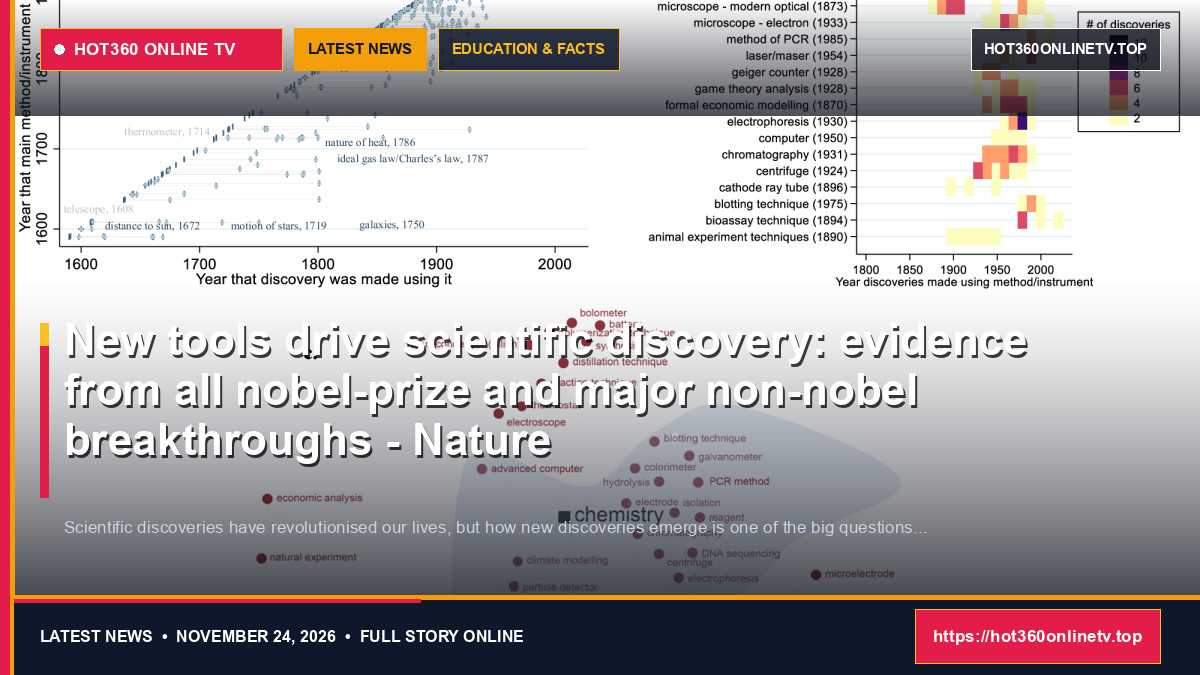
Opening up the papers of science’s major discoveries across fields and over time, we find a striking and consistent trend. Each discovery-making paper relied on a new method or tool—and the study, including usually experiments, could only be conducted by using it. So, we first assess data for science’s major discoveries—spanning from 1575 to the present—and plot the year a new method or instrument was developed by the year the discovery was made using that method or instrument. It is straightforward to visualise: each new method or tool is shown as a vertical line (│) (which all fall on the diagonal 45-degree line), and each breakthrough made using that method or tool is shown as a dot (●) on the same horizontal line (Fig. 1a). If a new tool triggered multiple discoveries, we see a cluster of dots aligned with that tool’s timeline. Take the first particle detector that visualised particle tracks (the cloud chamber) invented in 1911—marked as a vertical line │. It enabled the discovery of the positron in 1932—appearing as a subsequent dot ● on the same horizontal line. Or take the invention of x-ray crystallography in 1913, which led to the discovery of DNA’s double helix structure in 1953. X-ray crystallography, like radar telescopes, chromatography and other central tools, are characteristic of how we make science’s major breakthroughs after developing the needed tools. The length of each horizontal line reflects the time between the year when the method/tool and subsequent discovery were developed (Fig. 1a).
a Data reflect science’s 734 major discoveries since 1575 including all nobel-prize discoveries, with examples provided for three methods/instruments. b Data reflect science’s 308 discoveries made since 1800, including all nobel-prize discoveries, using central methods and instruments that each triggered four or more discoveries. The year reflects when the method or instrument was first developed. c. Data reflect science’s central methods and instruments applied to make two or more discoveries among all 533 nobel-prize Discoveries (Methods section). In (a), when regressing the year of discovery on the year the main method or tool was developed (without any further controls), it yields an R-squared of 0.92. That is, when methods are created is closely correlated with when the discoveries are made (92% of the variation). When we split and compare the data, the share is 88% for all nobel-prize discoveries and 81% for major non-nobel-prize discoveries over the same time period (p-values
Exploring science’s major discoveries, we uncover the striking rise and importance of the most prominent tools in science: hot streaks of discoveries cluster after we develop powerful new tools (as mapped out in Fig. 1b). The discoveries we unlock bundle together not by chance but by extending our tools—from x-ray methods and spectrometers to statistical methods. For each of these tools, the shared link across the diverse discoveries is not the same theory, teams or funding—it is the tool itself that made them possible. Each tool unlocked findings across different disciplines. Chemistry, medicine, biology and physics share many central methods and instruments used to make nobel-prize discoveries—see the network analysis in Fig. 1c.
The strong link is striking: assessing science’s major discoveries, we find that major discoveries are made by developing and using a new method or instrument, as highlighted in Fig. 1a. We find that the new method or tool was applied for the first time to a problem to make the discovery that otherwise would not have been possible. That is what commonly makes it a breakthrough—it reveals something we could not see, detect, develop or test before, without that method. Surprisingly, this key pattern is consistent across science’s major discoveries spanning throughout fields—from physics and chemistry to medicine and economics—and it is consistent across history—from past centuries to contemporary science. It holds across experimental discoveries, such as uncovering the hepatitis A virus with an electron microscope. It applies across theoretical breakthroughs, such as developing Planck’s quantum hypothesis based on experiments using spectrometers and bolometers, and on mathematical methods. And it holds across method discoveries, such as creating gas chromatography, which vastly extended chromatography. Without making new method innovations, we cannot make major advances. We unpack this key finding as we progress through the paper.
In the early 20th century, much of physics focused on the newly detected subatomic world. The first subatomic particle discovered was in 1897—the electron. Joseph Thomson unexpectedly detected it using an instrument he improved the previous year: a cathode ray tube. At first, many physicists relied heavily on mathematical methods—using abstract equations to describe the electron (Kuhn 1962/2012). That changed in 1911 with the invention of the first particle detector: the cloud chamber. For the first time, we could actually see and measure the trails left by charged particles. This groundbreaking instrument introduced an entirely new kind of evidence, launching particle physics as an observational science. Then, in 1929, the particle accelerator was invented. Before it, we did not know that many subatomic particles even existed and we could not study their properties and behaviour. With this new tool, we could propel charged particles to high speeds using electromagnetic fields. It enabled the discovery of the antiproton and the weak force, which broadened our understanding of matter and the forces that govern the physical world, as highlighted in Fig. 2.
Data reflect nobel-prize-winning methods and instruments developed up to 1930 that have led to at least four later nobel-prize discoveries (while those developed since 1930 are presented in the Extended results). The year reflects when the method or instrument was developed and when the resulting discoveries emerged. *The spectrograph is the only instrument included that did not receive a Nobel prize, though it was used to make five of the discoveries. Given the large number of nobel-prize discoveries made using X-ray methods and spectrometers/spectrographs, a number of them could not be included in the limited space in the figure, but are included in all other relevant figures.
In 1952, with the newly constructed bubble chamber, we were able to study particles at much higher energies and this enabled the discovery of quarks in 1964. Our ability to observe and measure atoms has been revolutionised with these powerful instruments: particle detectors and accelerators. These tools opened up new layers of reality that were invisible, unknown and unimaginable before—using our bare mind. Without them, none of these breakthroughs could have been possible. And they redefined the field of physics. These tools are representative of how new major tools spark new scientific advances (Fig. 2; Extended results).
In fact, a range of powerful tools and methods that have made discovery possible were awarded a Nobel prize for their creation: from particle detectors and accelerators, to x-ray methods, spectroscopes and centrifuges; from advanced microscopes, electrophoresis and statistical methods, to chromatography, the laser, the PCR method and many others. Each of these remarkable tools enabled multiple discoveries—experimental, theoretical and methodological—that in turn won a Nobel (Fig. 2; Extended results). Each was designed in one field—like physics—but then triggered discoveries in different fields—like biology, chemistry and medicine. These discoveries were not anticipated by those who created the tools, but still led to the discoveries (ibid.).
Also, within those decades in which we develop more new major methods and instruments, we make more major discoveries by applying them—and this general trend holds across time and fields (Extended results).
Microscopes have uncovered about 7% of science’s major discoveries, an enormous contribution to scientific progress from a single kind of instrument. This spans from the first microscope in 1590 that inspired the achromatic microscope in 1841 to the scanning tunnelling microscopes in the 20th century (Bardell 2004). We were then able, for the first time, to reveal cells, bacteria and mitochondria without deliberately searching for them (cf. Daintith 2009). For each of these cases, the new microscope enabled the discoveries, without existing knowledge that the phenomena may even exist; no one hypothesised or imagined them before—which can be viewed as direct methods-driven discoveries. Robert Hooke, for example, discovered cells in 1665 by looking through his new 300-power microscope designed in 1662, opening up a biological world that nobody knew existed.
About 30 nobel-prize discoveries have been made using a nobel-prize-winning microscope as the central instrument. The electron microscope alone makes up about half of them: from the discovery of cell structure in 1945 to the discovery of ribosomes in 1955 (Extended results). This pushes the electron microscope—as a unifying tool—into the foreground of these breakthroughs, it made possible across fields; while it pushes a particular theory, research team or large-scale funding into the background of these microscope-driven breakthroughs. Moreover, the invention of the scanning tunneling microscope, for instance, opened the path to controlling and understanding nano-scale phenomena like no instrument could before.
Our powerful tools trigger new breakthroughs by extending what and how we can observe, detect and measure the world (an overview of our most important tools)
What are the most commonly used general methods and instruments across fields to advance science? Assessing nobel-prize discoveries, we find that statistical/mathematical methods, microscopes (optical and electron), x-ray methods, centrifuges, spectrometers, chromatography, electrophoresis, lasers, particle accelerators and particle detectors are the ten most universal tools. Our best tools are the foundation of science as they provide the lenses through which we are able to perceive, measure, theorise about and understand the world in innovative ways.
Scientific tools are our lenses, sensors, amplifiers, separators, accelerators and data-processers—vast extensions of our eyes, hands and minds. Without them, most of the universe would remain invisible and unknown. With them, we can see living cells, weigh single atoms, edit genes, detect black holes, experiment with medical treatments and model climate systems. Optical and electron microscopes, x-ray methods and spectrometers, for example, vastly extend our visual scope: revealing unimagined worlds of microorganisms, protein complexes, and galaxies. Statistical and mathematical methods massively expand our cognitive capacity to reason across vast amounts of data: whether mapping how diseases spread, reconstructing past climate conditions from ice cores or modelling human behaviour.
The top 10 methods and instruments most commonly used to make science’s major discoveries since 1900 are illustrated in the Extended results, including when they were first developed and the share of major discoveries using them. Our powerful research tools are a central defining feature of a field. It is difficult to imagine physics without mathematical methods, particle detectors and spectrometers, biology without microscopes, centrifuges and controlled studies, economics without statistics, algebraic equations and equilibrium analysis, or astronomy without radio and space telescopes. Why do some tools transform science more than others? It is because impactful tools are much better at extending our sensory and cognitive range: giving us greater resolving power, higher sensitivity, more computational strength, greater statistical power and entirely new measurement domains we could not reach before. That is when deeper layers of nature become accessible to us.
Take x-ray instruments—over twenty nobel-prize discoveries, across medicine, chemistry and physics, have been made by applying them. Importantly, using these instruments to trigger a number of these discoveries was not intuitively clear before we developed the instruments that go far beyond our bare sensory abilities—from uncovering the inner architecture of viruses to revealing the structure of ribosomes and cholesterol. Take the radiocarbon dating method—nothing has been more important than this method in estimating the age of organic material and developing the fields of archaeology and earth science, and reconstructing the history of our species on our planet.
Science’s most prominent tools are often applied to make discoveries in different fields, highlighting the power of tools developed in one field and then applied in other fields to make new breakthroughs unforeseeable by the tools’ inventors. Lasers and particle accelerators, for example, were initially rooted in physics, but they also drive discoveries in chemistry—while they are even applied in biology and medicine. Both physics and medicine employ, for example, cathode-ray oscilloscopes and counters to measure radioactivity. Such foundational tools cluster together in a shared interdisciplinary methods space—a web of methods and tools that link fields together (depicted in blue in Fig. 1c). The scientific community is largely a tightly knit methodological community.
There are three ways new methods and tools drive new discoveries
When we think of discovery, many imagine a researcher using an existing dominant scientific method or tool. Here we dig deeper to ask: what are the actual channels through which our innovations in tools spark breakthroughs? Examining over 750 discovery-making studies, we find that breakthroughs do not emerge from conventional methods. Instead, they can be categorised into one of three pathways:
• method-to-discovery by the discoverer: a researcher develops a new method or tool themselves that they use to make the scientific discovery.
method-to-discovery by the discoverer: a researcher develops a new method or tool themselves that they use to make the scientific discovery.
• method-to-discovery by another researcher: a researcher develops a new method or tool that another researcher applies—sometimes in a different field—to make the scientific discovery.
method-to-discovery by another researcher: a researcher develops a new method or tool that another researcher applies—sometimes in a different field—to make the scientific discovery.
• method-to-method by the discoverer: a researcher develops a new method or tool that is the major discovery itself, and does so by building on other methods.
method-to-method by the discoverer: a researcher develops a new method or tool that is the major discovery itself, and does so by building on other methods.
Across all nobel-prize discoveries, these three pathways account for 25%, 47% and 28% of discoveries (Fig. 3). Discoveries are thus not just experimental or theoretical, but 28% were awarded for a method breakthrough (149 times out of all 533 nobel-prize discoveries). So, how does this breakdown give us a deeper picture of how science works? It helps understand not just where innovation starts, but how it happens and spreads.
Data reflect science’s 761 major discoveries (a), and all 533 nobel-prize discoveries (which can be viewed as a measure of contemporary science) (b). In (b), analysis expanding the data to include the other major discoveries that did not earn a Nobel prize but were made over the same time period (accounting for 633 discoveries in total) illustrates that results are consistent and serves as a robustness check. For example, the share of method discoveries is 9%, 12%, 28%, 35% and 36% across these five fields, respectively.
The first pathway, in which the discoverer develops both the needed method and then the discovery using it, highlights the direct role of methodological innovation in spurring discoveries. This rare methodological strategy in conventional research is common among major discoveries—at 25%. Kamerlingh Onnes for example, developed an improved liquefier in 1906 (Radebaugh 2007), and a sensitive thermometer in 1907 for measuring temperatures as low as absolute zero (Haven 2007), with which he was then able to discover liquid helium in 1908 and superconductivity in 1911. William and Lawrence Bragg designed an X-ray spectrometer in 1912 that enabled them to uncover the structure of crystals in 1913 and opened the field of X-ray crystallography (Nobel Prize 1915). Moore and Stein invented the first automatic amino-acid analyzer in 1958 and later that year, they discovered the chemical composition of ribonuclease using the new tool. Many major discoverers, such as these nobel-prize winners, thus invent entirely new methods as part of the scientific process—or methodological process of discovery. Such discoverer-inventors have identified the missing methodological link necessary to be able to make a scientific advance.
The second pathway is when a researcher makes a discovery using a method or tool developed by another researcher within a different or the same field, which accounts for 47% of nobel-prize discoveries—with examples provided earlier. Applying an instrument created in a different field is arguably the most powerful indicator of how methodological innovations in one field can drive discoveries in other fields that were not intended by those who designed the instrument, as later outlined. The third pathway is when the new methods or tools are the discoveries themselves, accounting for 28% of all nobel-prize discoveries. This highlights the importance given to new method breakthroughs in science, but without a general understanding or theory existing yet that can explain the mechanism of how new tools drive breakthroughs. A method discovery (like an experimental or theoretical discovery) builds on other methods and tools. The share of method discoveries across some fields is very large: a total of 39% of all nobel-prize discoveries in physics and 36% in chemistry have been awarded for developing a major new method or instrument, with medicine and biology at 10% (Fig. 3b). Nobel-prize-winning method discoveries include: frequency comb spectroscopy created in 2000, the RCT method for poverty alleviation in 2003, an advanced single-molecule microscope in 2006 and the genome-editing method CRISPR in 2012.
In total, for over half of all nobel-prize discoveries at 53%, researchers have realised, although only for an individual discovery, how to better study a phenomenon by developing a new or enhanced method or tool designed for that purpose—reflecting the first and third pathways combined. They have realised the extraordinary power of improving the way we measure and perceive the world to catalyse discovery. They built lenses, detectors and models needed to find the answers. In chemistry, physics and astronomy, this combined number is higher—more than 60% of discoverers developed a particular method in making a new breakthrough. This is an important finding about the methodological nature of discovery. It is a strong sign that science is not just idea-driven or theory-driven—it is tool-driven.
So here we assess changes over time (historical analysis) and analyse different groups in a population to spot differences (comparative analysis) (Fig. 3). When we analyse both, we can uncover the bigger picture: how discovery differs across time and fields.
New breakthroughs often follow soon after developing the new enabling tools
Next, how long is the time gap between when we generate the new tool and the discovery using it? We find that the gap is reducing over time: from an average of 30 years for discoveries made in the 1800s, to 21 and then 10 years for those in the first and second half of the 1900s and finally 6 years for those between 2000 and 2022 (Fig. 4a). This is an important finding but in the absence of a general awareness or theory that accounts for this methodological mechanism of discovery. As we would expect, the gap in time is shorter for discoverers who create a new needed tool (the darker bars in Fig. 4a-b). This highlights a quicker return and impact for method-inclined researchers.
Data reflect science’s 761 major discoveries (a, c), all 533 nobel-prize discoveries (b, e), and the 133 major discoveries since 1975 (d). In (b), analysis expanding the data to include the other major discoveries that did not earn a Nobel prize but were made over the same time period (633 discoveries in total) illustrates that results are also consistent. For example, the share of discoveries that are a method or tool, or made using one developed by the discoverer, is 14%, 12%, 12%, 10% and 3% across these five fields, respectively.
This decreasing delay over time illustrates that science—in part—is becoming more efficient, as research has scaled up over time. Rapid progress in novel technologies such as higher-performance computers, quicker data analytics, high-speed imaging and AI and machine learning methods enables running faster experiments and processing data more quickly than before.
We find that discoveries generally follow directly, or soon after, creating the new tool that must be applied: 10% of discoveries are made in the same year or simultaneously as the needed tool, 21% within two years of developing the needed tool, 33% within four years and 53% within ten years (Fig. 4c). Since 1975, most discoveries—51%—arise within four years of the new tool and 70% within ten years (Fig. 4d). This highlights how innovation in tools is inseparably linked to innovation in science.
What patterns emerge across different fields? Astronomers are the quickest in exploiting new instruments given the nature of the field, with 54% of nobel-prize discoveries triggered within 2 years and 88% within 10 years (Fig. 4e). The discovery of a supermassive compact object at the centre of our galaxy in 2002 was for example made possible using a new adaptive optics spectrometer constructed the same year, together with the world’s largest telescopes (Nobel Prize 2020). The first exoplanet was discovered in 1995 by using a new fibre-fed echelle spectrograph built in 1993—redefining how we view our own planet and our place in the universe (Nobel Prize 2019). Economics, and medicine and biology are slower at translating new tools into new breakthroughs, with 54% and 51% of nobel-prize discoveries emerging within 10 years, respectively (Fig. 4e).
One of the most direct forms of evidence of the power of methodological innovations in driving science is making discoveries the moment the needed tool is invented. A microscope designed with a silver staining technique in 1873 immediately led to discovering the structure of our nervous system—and the first view ever inside our previously invisible nerves and how they could function. The mass spectrograph, invented in 1919, immediately sparked the mapping and identification of different isotopes. The time orbiting potential trap developed in 1995, along with laser cooling, immediately triggered the discovery of an ultra-chilled state of matter: the Bose-Einstein condensate. A powerful expression cloning strategy created in 1997 immediately led to the discovery of our receptors that detect temperature. Yet as outlined, no account of discovery driven by such new methods yet exists, but rather accounts related to broad factors like funding (Stephan 2015, 1996; Singh Chawla 2023), teamwork (Wang and Barabási 2021; Xu et al. 2022; Wu et al. 2019; Wuchty et al. 2007), chance and serendipity (De Rond and Morley 2010; Merton and Barber 2004; Murayama et al. 2015; Nature 2018).
This direct methodological approach to science reflects the quickest path to discoveries by scientists, extending the way we measure and access the world. The immediate method-to-discovery link makes up about one in every eight discoveries since 1975—and about three in every ten discoveries are uncovered within two years (Fig. 4d). That is not just remarkable, it is key to understanding the nature of discovery. In some fields, it can take a year or longer to run experiments with a new tool, write up the study, go through peer review in one or more journals and publish the discovery.
We also compare all nobel-prize discoveries to major non-nobel discoveries (as an independent control) and assess these two groups by the gap in years between the developed tool and discovery. We find that there is a slightly longer gap in time for major non-nobel discoveries (Extended results).
Discovery time lags are an important issue and exist across science, defined as lags in making breakthroughs when a new method already exists for years but is not immediately applied to tackle a specific problem. They are missed opportunities for sparking discoveries using new methods not yet exploited over longer periods (Fig. 4). The innovative tool of optical tweezers, for example, initially created in physics in 1970, enabled better studying particles using lasers. The tool was eventually applied in 1987 in biology and medicine, enabling researchers to successfully grab (like with tweezers) particles, living cells and molecules using a laser beam to manipulate them with extraordinary precision (Nobel Prize 2018). The discovery of cyclin in 1982 illustrated how proteins control the cell cycle and the discoverer Tim Hunt mentioned that ‘I did a very simple experiment … It is very surprising that nobody had spotted this before; it could have been done any time after the invention of the slab SDS polyacrylamide gel [electrophoresis] in about 1970’ (Nobel Prize 2001). As researchers are not always aware of and trained in methods in other related fields, numerous discoveries have at times been delayed.
So why are there large discovery time lags across science? In cases with a delay of more than several decades, we find that the new tools are often developed in other fields and not immediately known in one’s own field. Some discovery delays can thus be explained by artificial borders across fields and their methods. Yet methods are still the binding constraint, but disciplinary isolation underpins that constraint and causes a longer gap in time. Other discovery time lags can be explained by scientists trained to focus on findings and theories, not always on testing and experimenting with a wider range of tools that enable them. Importantly, whether there is a longer time lag or not, the mechanism driving discoveries is generally the new tools never applied before to the specific problem, even if created in one field and adopted later in another. Because new tools can help cure diseases and improve society, every year or decade they lie unused is a year or decade of missed impact (Table 1).
With time lags for years—or even decades—for some discoveries, what is then a new tool? A new tool not only needs to be developed but also applied; innovation comes from application, not just invention. We find that about 70% of discoveries in the last half century are made within ten years of creating the enabling tool—and 90% within twenty years (Fig. 4d). Even if a tool was created decades ago, the first time it is ever applied to a new problem is what commonly unlocks breakthroughs. Yet the longest delays are mostly in the early history of science, when the scientific community was smaller, communication was limited and researchers were scattered across vast distances—significantly slowing progress. Take the telescope. It was invented in 1608 and then improved, yet major breakthroughs like discovering the distance to the sun in 1672, the motion of stars in 1719 and galaxies in 1750 came much later. Even longer time lags occurred before the 1600s. In these exceptional cases, the tool had never been used before to tackle the problem, but with the new lens, the discovery was then possible. Scientific progress relies not just on inventing but also on getting the right tool in our hands.
Predictability of some discoveries
Let us look beyond the timing of tools to an important question: have scientists been able to predict some discoveries before they happened? Some discoveries have, in fact, been anticipated because the right tools and knowledge were already in place. Yet predicted breakthroughs make up only a small fraction of major scientific advances. Take the discovery of DNA’s structure. DNA was first isolated in 1869, using chemical extraction methods and new advanced microscopes capable of observing cell nuclei. Once DNA was detected, we knew—and could predict—it must have a structure. And once X-ray crystallography was invented in 1913, we also had the necessary method at our disposal that could reveal molecular shapes. Eventually, researchers used Rosalind Franklin’s crucial X-ray images to uncover DNA’s double-helix structure—in 1953 (Watson 1969). In turn, after inventing DNA sequencing in 1977, it was no longer a question of if we could decode the entire human genome, but when. A powerful existing method—gel electrophoresis—played a crucial role in separating DNA fragments in the sequencing process. The race for developing the best method could begin and an integrated method for genome mapping created in 2001 sped up the discovery process and enabled mapping the human genome in 2003 (Human Genome Project 2023).
Gravitational waves could also be predicted a year after Einstein published his general theory of relativity in 1915. Gravitational waves move through space at the speed of light, with Einstein’s theory made possible through new advanced mathematical methods such as tensor calculus and experimental findings—especially by Michelson and Morley on the speed of light in 1887, which applied the recently invented interferometer. Even those discoveries that at times seem—at first glance—to be largely theoretical breakthroughs rely heavily on recently developed powerful tools. And later, observing and confirming the existence of gravitational waves also required first creating an instrument sensitive enough to physically detect the waves. The Laser Interferometer Gravitational-Wave Observatory (LIGO) was created and then upgraded in 2015 and within just days, it recorded gravitational waves for the first time—100 years after Einstein predicted them (Abbott et al. 2016).
Mendeleev created the periodic table of elements in 1869 by using an early classification of chemical elements in 1829 and the mathematical law of octaves developed in 1865. He also indirectly relied, beforehand, on several new elements recently identified using the new spectrograph in 1859. And afterwards, the spectrograph was also used to identify some of the predicted elements where empty places remained in the periodic table. So uncovering these exceptional discoveries is often a question of developing or applying the missing method—filling in the missing pieces (Fig. 5).
The timeline shows when the central methods and discoveries were made—and the moment when the breakthrough could be predicted. These predicted discoveries (in bold) have received a Nobel prize, except for the digital electronic computer, the Turing machine and the periodic table of elements. The first three examples build on existing research, though that research does not discuss the role of methods and instruments in making discoveries (Clauset et al. 2017; Kuhn 1962a).
Creating a new method or tool is often more foundational to scientific progress—across different fields and over time—than individual scientific discoveries
Many discoveries are almost inevitable once we create a new tool that enables seeing and measuring further. These breakthroughs range from how we discovered capillaries in 1661, cells in 1665 and bacteria in 1674 after inventing the microscope in 1590. How we found mitochondria in 1898, once we designed an improved achromatic microscope in 1841. These breakthroughs span from how we uncovered Jupiter’s moons in 1610, Saturn’s rings in 1655, galaxies in 1750 and Uranus in 1781 after constructing the telescope in 1608. How we revealed that the universe is expanding in 1929 after making the needed telescope in 1917 and how we detected the first planet outside our solar system in 1995 after building a high-resolution spectrograph in 1993. These extraordinary new tools sparked these discoveries that no one had ever imagined—by extending what we can observe. And they sparked the later theoretical explanations to describe them. These discoveries were triggered by what the tool in our hands made possible. And they were highly likely once we invented the needed tool. Before these tools, we did not know these even existed—the same with microscopes, later triggering breakthroughs from viruses and chromosomes to nerve cells and tissues. The foundational discovery is often the method or instrument itself.
From a new radio telescope that sparked the discovery of pulsars and quasars in the 1960s, to a new highly sensitive spectrograph that enabled the discovery of many exoplanets since the 1990s, this pattern repeats itself. It highlights the fundamental role of a single instrument: one that sparks multiple unintended discoveries and makes it often the more foundational discovery itself. What makes them so powerful is that a single tool triggers a cascade of breakthroughs. Many researchers who would have gotten their hands on the new microscope, optical telescope, spectrograph or radio telescope could have made these discoveries that were not searched for—guided more by empirical observations than theory. They were also made without a large research team. Discovery often comes down to which researchers get access to the new tool first. This commonly pushes our tool innovations into the forefront, and discoverers and other factors into the backdrop of discovery. We trigger many major scientific advances not through testing a clear hypothesis, but through exploratory research using a new tool innovation.
New tools are often the most foundational element of acquiring new bodies of knowledge. What commonly makes new tools the crucial driver of progress is not just that each of these tools has made multiple discoveries possible, but that many do so across different fields and in ways their inventors never imagined—and can also do so in the future (Fig. 1b).
Regression analysis
After exploring how new methods drive discoveries, we turn to the broader question: what other factors support the discovery process and the needed methods? To analyse this, we first conduct a logistic regression analysis. We assess what factors help predict nobel-prize discoveries, compared to major non-nobel-prize discoveries over the same time period as the control group—which reflects the dependent variable. So what are predictors of nobel-prize discoveries? We find that nobel-prize discoveries are more likely to be made within a shorter time span between the developed method or tool and the resulting breakthrough. They are also more likely to be made by highly educated researchers (PhDs or professors), by two or more researchers and through experimentation, while controlling for a common set of factors including discipline, age, gender, university ranking and geographic location. Results illustrate that being at a top university is not an important predictor. These findings hold across two different models. The results also illustrate a more limited role of broader contextual factors such as population size and income per capita in influencing nobel-prize breakthroughs, with the effect sizes of other variables remaining similar in the two models—see the Extended results.
We also assess the gap in years between developing the enabling method or tool and making the discovery using it. The average gap is 14 years for all nobel-prize discoveries. What factors shape this gap? To address this, we conduct a linear regression analysis (OLS estimator) that assesses the number of years between the two (the dependent variable). We find that different disciplines and time periods appear to be the strongest factors shaping the gap between the two. The gap is about 7 years longer for discoveries in medicine and biology compared to those in physics (the reference group), while controlling for the same set of traits and conditions, across earlier and later time periods. Astronomical discoveries have the shortest gap in time between new methods and discoveries, as we would expect: once new observational instruments are developed, they more immediately enable the discovery of new phenomena. Examining time periods, we observe that the gap is about 12 years shorter for discoveries made between 1925–1975 and 16 years shorter for discoveries made between 1976–2022 compared to those made before 1925 (the reference group). The effects of other factors are not very strong or statistically significant in shaping the timing of discoveries (Extended results).
Importantly, assessing the over 750 major discoveries, we find that significant shares of discoveries are made by scientists who can be in small or large teams, low or high funded, young or old, at lower or top-ranked universities, interdisciplinary or not, guided by theory or not, or involve a serendipitous moment or not. Each of these factors varies by discovery, by field and by researcher—and alone are not enough to trigger breakthroughs. But the key factor common across all major discoverers in science is that they leverage a new method to be able to break new ground (see table in Extended results). No major discovery has been made without first applying a novel method or tool; and major extensions to our tools, from microscopes to spectrometers, from electrophoresis to particle accelerators, have generally always led to new discoveries—this is as causal as we can get.
In an analysis on causation, we frame the causal relationship between new methods and new discoveries as a kind of quasi-experimental research design, and we provide five pieces of evidence pointing to the causal link between the two. We show that the probability of making many discoveries, from exoplanets and pulsars to bacteria, is 0 before the needed tools are created, and the probability then jumps when such tools are developed, which have led to new discoveries in different fields—see the causality section later.
The new methods-driven discovery theory
‘No theory exists that can reliably predict which research activities are most likely to lead to scientific advances’, as the National Research Council (2007) in the United States confirms. Yet by examining science’s major discoveries, a remarkable pattern emerges: new methods and tools are a necessary condition and commonly the key driver for how science’s major discoveries emerge. Drawing here on this evidence across science’s major discoveries, we introduce a new framework: the new methods-driven discovery theory. This essential role of methods and instruments in discovery may appear self-evident. However, existing accounts of discovery focus on supporting factors like funding (Stephan 2015, 1996), team collaborations (Wang and Barabási 2021; Xu et al. 2022; Wu et al. 2019; Wuchty et al. 2007), chance and serendipity (De Rond and Morley 2010; Merton and Barber 2004; Murayama et al. 2015; Nature 2018), which vary by discovery—and do not focus on powerful new methods (see introduction). Without a new tool to detect or measure, no amount of funding, collaboration, training or luck will enable a new breakthrough, and theories need them to be meaningfully developed or tested. The central point here is that scientists generally do research while aiming to make discoveries by applying existing tools—that is, conduct conventional research. Importantly, the key novel contribution here is the empirical evidence and theoretical explanation for how using a new method or tool for a specific problem is what has driven science’s major discoveries that soon follow. This has been the key missing piece in understanding how we consistently extend our scope of the world.
The new methods-driven discovery theory presented here is grounded in this evidence across the history of science. It is a general theory of scientific discovery that explains how we unlock science’s major discoveries and fields by using current scientific methods and tools and developing a new method or tool that enables us to observe, solve problems, experiment and theorise and collect new evidence of the world—in ways that are impossible without the new method or tool (Fig. 6). Many think scientific progress is mainly driven by new findings and theories. But digging deeper, we find that creating and applying new methods and tools are commonly what drive those new breakthrough findings and theories—by reshaping how we perceive, detect and imagine in ways not possible before. The power of conceptualising and refining tools enables us to open unexplored opportunities and new research programmes by providing new ways to measure and understand the world. The theory can be expressed simply—see Fig. 6.
The new methods-driven discovery theory.
The theory predicts that if a major new scientific method or instrument is developed, then the likelihood of new discoveries rises sharply (with the definitions outlined earlier). This theory has been tested across fields and history, finding strong and consistent evidence (in previous sections). Establishing this mechanism of discovery is important because it enables us to increase the pace at which we trigger new breakthroughs. It is an empirically-grounded but also normative theory of how to advance science and discovery through new tools. We can thus better explain and advance new breakthroughs in light of this evidence and theory.
With new methods required to make major discoveries—not available methods that reflect conventional research—how do we develop new methods? Scanning science’s over 750 major discoveries, we uncover four common ways. First, we create entirely new methods not yet conceived before, such as electrophoresis that separates molecules—which enabled the discovery of DNA sequencing (Tiselius 1930). Second, we extend methods in novel ways that also represent a new method not ever used before, such as the ultracentrifuge that vastly expanded early centrifuges—which led to the discovery of blood plasma (Svedberg and Rinde 1924). Third, we combine methods in novel ways that also reflect a new method not yet applied before, such as x-ray crystallography that combines x-ray methods with crystal analysis—which made possible the discoveries of the structure of penicillin and DNA’s double-helix (von Laue 1913). Fourth, we adopt new methods developed in other fields, such as the electron microscope created in physics (by extending existing light microscopes) and used for the first time ever in fields like biology and medicine—which brought about the discoveries of the cell structure and antibiotics against tuberculosis (Knoll and Ruska 1932). What all these cases have in common is that we never applied the new method to the problem before; and when applied, discovery followed. New methods are thus defined as developed through these pathways.
Ultimately, a few of the most influential discoveries are seen at times as largely just theoretical. A classic example is quantum theory. Yet Planck’s quantum hypothesis did not just rely on thought, but took the first step by analysing unexplained findings from experiments on blackbody radiation, made possible with powerful tools—spectrometers and bolometers—that measured emitted light (Planck 1900). Einstein’s photoelectric effect was rooted in experiments using electroscopes and cathode ray tubes that showed how light liberated electrons from metal (Einstein 1905). Bohr’s quantum model relied on spectroscopes using prisms to reveal spectral lines that pointed to quantized energy levels (Bohr 1913). Each of these scientists also relied on advanced mathematical methods. Another classic example is Darwin’s theory of evolution. Yet he relied on tools like his advanced microscopes that enabled him to study barnacles, corals and plant structures that shaped his understanding of variation and adaptation (Jardine 2016). Darwin also conducted breeding experiments with plants and pigeons, providing him direct evidence of how artificial (human) selection could drive changes in species over generations. These experiments enabled him to draw the analogy for natural selection. He applied comparative anatomy methods to study finches and dissected animals that provided him further evolutionary evidence, including Malthus’s views on population growth (Darwin 1859). Another classic example is Einstein’s theory of general relativity and we outlined the tools he relied on earlier in the paper. Far from being just an abstract thought, science’s greatest theories—from relativity to quantum mechanics to evolution—are possible by relying heavily on key unexplained experimental findings that scientific tools revealed. These extraordinary tools created the possibility of seeing the world differently in the first place. They provided the necessary empirical foundation on which they could then develop theoretical explanations for what they observed. Yet in fields like theoretical physics, some exceptional theoretical advances have involved larger conceptual leaps—leaps from existing experimental findings and tools to theory—than in most other fields across science.
Finally, many initial tools may not be useful enough or too limited in scope to survive and trigger advances. Just like experimental results and theories, we only observe tools that lead to advances and make it into publications.
Discussion: a method revolution in science
New methods and tools unlock science’s major discoveries by enabling us to see, measure and understand the world in ways that are impossible without them. This key pattern holds across time, fields and all nobel-prize and major non-nobel-prize discoveries. Identifying this new method-to-discovery principle and a science-wide awareness of the principle holds the potential for a method revolution in science—a shift in how we think about discovery and focus our time and resources on developing new tools.
Imagine if scientists in the future categorise science into two eras. The era before the method revolution was marked by tool-building that was ad-hoc and improvised. Powerful instruments were developed in scattered ways, often with unnecessarily long delays between invention and discovery (Fig. 4 and Table 1). We were largely not yet aware that the catalyst of progress is creating the very methods we use to answer our questions. There was no general roadmap, no guiding theory of how discovery happens, no systematic research programmes for tool development. So scientists until now had to experiment and work out on their own—researcher by researcher—hoping the right tool would come along. The era of the method revolution can instead be described as tool-building that would be structured, planned and targeted. We would all have become aware of this powerful general principle of new methods propelling science. Future scientists may look back at the advent of this revolution as the point when the scientific community as a whole began to strategically focus on refining, combining, restructuring and inventing tools that accelerate the pace of new breakthroughs. No longer would tool innovation be the side project of a few tool-inclined researchers who deviated from their initial academic training. A method revolution would be driven by a science-wide understanding of the powerful role of method innovation in triggering new advances that are otherwise not possible. As the quantum revolution transformed physics in the 1920s and the cognitive revolution reshaped cognitive science in the 1960s, the method revolution could accelerate science at an unprecedented rate.
This new methods-driven discovery theory outlined here reflects a generalisable rule we can apply across science. Assessing the pace of tool-building today is the best indicator we have to predict future discoveries. This mechanism not only explains past discoveries but can improve the predictability of future discoveries. When we invent, upgrade, combine or adopt a new method or tool, we can predict where discoveries can come from next, and when. It is about tracking the speed and direction of method innovations: this enables us to spot powerful signals that discovery is soon to follow. The signal can come from a recently invented computational method, an upgraded particle accelerator, an advanced spectrometer combined with AI-tools, or a new experimental method adopted from another field. Each helps us anticipate where the frontiers of science can soon move. The theory can also help lay the foundation for the science of science.
Central implications are that scientists need to shift part of their attention and research to refining the very methods and instruments they use as a central part of the scientific and discovery process. Science agencies, journals, universities and other institutions need to also strategically shift greater shares of resources and provide greater incentives to extend our scientific toolbox—they need to equally support methodological projects and not just science projects. This way, scientific progress would become more coordinated and organised. A set of companion studies examine other aspects of science’s major discoveries—the traits of discoverers, the cumulative nature of science, the scientific method, how we develop new tools and how new fields emerge (Krauss 2024, 2024a, 2024b, 2025, 2026, 2026a)—and are highlighted in a larger book, The Engine of Scientific Discovery (Krauss 2026b).
In terms of constraints of the study, future research could examine how new methods evolve over time to make breakthrough research. Future research could also apply longitudinal research designs to assess the societal impact of new methods and resulting discoveries. This can be measured by assessing their practical applications and benefits on new medical treatments, technologies and environmental solutions (Nature Human Behaviour 2022; Clancy et al. 2023).
Ultimately, tomorrow’s biggest discoveries will be made by those who create and apply the best new methods and tools today. And how we make such method advances is by better focusing our research on addressing the big method bottlenecks we face.
We compile data on science’s major discoveries, defined as all nobel-prize-winning discoveries in science (from the first year of the prize in 1901 to 2022) and all discoveries recognised in science textbooks of the greatest 100 scientists and their discoveries. The Nobel prize is regarded as the most prestigious scientific award for ‘the most important discoveries’, with the selection process led by leading experts in the field (Nobel Prize 2024). The prize is awarded in physics, chemistry, physiology and medicine, and economics. At the time the award was established, the term ‘physiology was used to describe what is today a number of biological fields’ (Nobel Prize 2001a), though some biological discoveries are at times awarded in the chemistry category. Within these core areas of science, the prize has also been awarded to many other scientists—from astronomers and climatologists to psychologists (Nobel Prize 2024). Nobel-prize winners are among the most influential and highly cited researchers in the world (as confirmed via Scopus and Google Scholar). The Nobel committee at times, awards the prize in a given year to two or three scientists, and in those cases the committee states whether the prize was awarded for one, two or three discoveries. This accounts for a higher number of discoveries than the years awarded. For each of the 533 nobel-prize discoveries, the committee highlights the central study as the one awarded the prize; and in cases in which several studies on the same topic that build on each other are referenced by the committee, the first study they reference has been included.
Since other major discoveries have been made before the prize or were not awarded the prize, we also include all discoveries identified in science textbooks that list the top 100 greatest scientists and their discoveries—and that span across fields and history. A total of seven general textbooks have been published and incorporated here (Tiner 2022; Salter 2021; Gribbin 2008; Rogers 2009; Simmons 2000; Balchin 2014; Haven 2007) (with textbooks specific to a field or time period not included). After excluding duplicate cases across the seven textbooks, 302 of the 700 discoveries remained (i.e., 398 out of 700 overlapped and were already captured in the data), and after excluding duplicate cases that also received a Nobel, then 228 of the 700 discoveries remained. Combining the 533 nobel-prize discoveries and 228 major non-nobel discoveries, a total of 761 major discoveries have been included in the study. If the Nobel prize had existed earlier, eminent scientists like Galileo, Newton, Hooke, Boyle, Darwin and Maxwell would almost certainly have received the prize—and are all included here among the major non-nobel discoveries. The study of the major non-nobel discoveries provides a replication analysis of the study of the nobel-prize discoveries—namely, a systematic control and robustness check. Figure 7 outlines how science’s major discoveries have been identified. This comprehensive approach covers not just discoveries in specific disciplines or time periods, but science’s major discoveries across fields and history. The discoveries covered make up the basis of the sciences. Likely, everyone will find their top 50 or 100 greatest scientific discoveries among these over 750 discoveries.
aOf the 100 discoveries in textbook i, five cases actually combine two distinct discoveries into a single entry—and were separated for this analysis. These include: levers and buoyancy; infrared and ultraviolet; antineuritic vitamins and growth-stimulating vitamins; the weak force and strong force; and quasars and pulsars. bSeveral discoverers whose work is less scientific in nature were not included: Leonardo da Vinci, John Audubon and Plato were excluded from the top 100 list in textbook ii; Asclepius and Jacques Cousteau were omitted from the list in textbook iii; Anaximander and Zhang Heng from textbook vi; and Omar Khayyam and Shen Kuo from textbook vii. In textbook vii, George Zweig, Jocelyn Bell Burnell and John Ambrose Fleming were not incorporated. Zweig’s work of the quark model was developed independently by Nobel laureate Murray Gell-Mann, who was already included. Bell Burnell’s discovery of pulsars was largely credited to her supervisor, Nobel laureate Antony Hewish, who was already included. And Fleming’s central discovery—the thermionic valve—was already included. The full List of discoveries is provided as a supplementary file.
The data were compiled over a fifteen-month period of extensive, full-time research. For each of the 761 discoveries, 32 variables—over 20,000 data points in total—have been collected and verified, one by one. To trace the methods applied in each discovery, the key source used to compile the data is the original publication for each of the 761 discoveries, which indicates the referenced methods used to make the breakthrough (Nobel Prize 2024). For the nobel-prize-winning discoveries, this refers to the main prize-winning paper of each scientist (accounting for over 500 papers). All years in this study reflect the year that the discovery or central method was published. As outlined earlier, the central method or instrument is defined as a major method or instrument applied in the discovery-making study and commonly highlighted by the discoverers throughout the discovery-making publication (and often also in the nobel-prize lectures) as central to the breakthrough. The discovery-making paper commonly cites the publication of the method they used (and thus the year the method was published); and in the remaining cases in which the method used is only highlighted and discussed but not explicitly cited, then the publication of the particular method used was identified in one of six encyclopaedias of science (Encyclopaedia Britannica 2024; Daintith 2009; Bunch and Hellemans 2004; Oakes 2007; Simonis 1999; Lerner and Lerner 2004), official nobel-prize documents (Nobel Prize 2024)—or for a final few instances via Google Scholar. The main source for compiling the educational, geographic and institutional data are Encyclopaedia Britannica (2024) and official nobel-prize documents (each scientist’s prize-winning lecture and biographical information) (Nobel Prize 2024); remaining data were derived from one of those five other encyclopaedias of science and the seven science textbooks. All relevant data have been cross-validated using one of these six encyclopaedias. After exhausting these main data sources in the first phase, the remaining data not yet identified were extracted in a second phase using other publication sources. These include sources such as A Century of Nobel Prize Recipients: Chemistry, Physics, and Medicine (Leroy 2003) and The Who’s Who of Nobel Prize Winners 1901–2000 (Sherby 2002). All compiled data are thus derived and verified through published sources. (For an overview of the factors in the analysis, see Fig. 8).
Variables are defined in the methods section or below Table 2.
A series of other analyses are included in Figs. 9–14. To ensure reliable findings, we have adopted a set of measures and controls: the results are not limited to—and take us beyond current studies—using data for one field, time period, data source, or measure of science. We studied across science, across centuries, across all nobel-prize and major non-nobel discoveries, and across different measures of science—scientific discoveries and methods. We did not study just one factor, but examined a broad set: scientific, demographic, institutional and economic. We did not rely on a single method: the analysis combines descriptive statistics, regression models, growth dynamics, analysis across methods (Fig. 15), across nobel-prize and non-nobel discoveries (Fig. 16) and across methodological, experimental and theoretical discoveries (Figs. 17 and 18), and network analysis (Fig. 19). Importantly, we did not only focus on empirical evidence, but developed a theory grounded in that evidence. A key feature here has been comparing results between all nobel-prize and major non-nobel discoveries. This serves as an independent control, enabling us to test the results—and we verified they are robust and not an artefact of the data. Across both these groups, we find consistent and reliable patterns.
Data reflect 616 major discoveries that include all nobel-prize discoveries compared to major non-nobel discoveries made over the same time period (as an independent control).
Data reflect science’s major discoveries since 1800 including all nobel-prize discoveries in each field: 200, 155, 194 and 89 discoveries, respectively. Major breakthroughs in economics mostly only emerged from the early 1900s onward. A regression scatter plot of this data illustrates that across fields, the year the main method or instrument is developed has high predictive power for the year the discovery is made, explaining most variation at 87% in physics, 86% in chemistry, 84% in medicine and biology and 82% in economics (the R-squared). As a robustness test, these four shares for all nobel-prize discoveries are 86%, 83%, 82% and 70%—and for major non-nobel discoveries over this period, they are 76%, 94%, 87% and 86%. The aggregate data across science is illustrated in Fig. 1a. Here, the five central methods and instruments most used in contemporary science are outlined for each field.
Data reflect science’s 734 major discoveries since 1575, including all nobel-prize discoveries. The data captures the same data in Fig. 1a but is presented here as a heatmap to illustrate the concentration of discoveries.
Data reflect nobel-prize-winning methods and instruments developed since 1930, and each has led to at least four later nobel-prize discoveries (while Fig. 2 reflects those developed up to 1930). The year listed refers to when the tool was created and when the resulting discoveries emerged. *There are two exceptions: an improved microscope (fulfilling the Abbe sine condition) developed in 1873, and chromatography, initially developed in 1906 but significantly enhanced and widely spread in 1931. Although these two tools did not receive a Nobel prize themselves, they were used to make several discoveries—and more advanced microscopes and chromatography methods that were later awarded a Nobel. Due to space limitations, a number of nobel-prize discoveries made using econometrics, chromatography and microscopes could not be included in the figure; but they are included in all other relevant figures in the study. Other foundational methods and instruments (that did not receive a Nobel prize) which have led to at least four or more nobel-prize discoveries include the geiger-müller counter, blotting techniques, the galvanometer and the cathode ray tube.
Data reflect science’s 653 major discoveries and the 196, 155, 191 and 78 major discoveries made since 1800 in each of the fields, respectively, and include all nobel-prize discoveries. They show the number of central methods/instruments and discoveries that emerged during each period. We observe that the pace at which we develop new scientific tools accelerated, especially around the turn of the 20th century.
Data reflect science’s major discoveries since 1900, accounting for 572 discoveries across science, and in the four disciplinary areas for 168, 133, 168 and 87 discoveries (in that order). The data reflect when the methods and instruments were first developed and the share of major discoveries made using them in the given field. Mathematical methods, including statistics, calculus, algebra, geometry and arithmetic, are grouped together as one of the 10 methods and instruments.
Data reflect science’s 761 major discoveries (including all nobel-prize discoveries) (a), and all 533 nobel-prize discoveries (b). Mathematics and statistics are methods widely used across science, with statistics first developed in the 1600 s and experiencing exponential growth since then. Analysis expanding the data in (b) to include the other major discoveries that did not earn a Nobel prize but were made over the same time period (633 discoveries in total) illustrates highly consistent results and serves as a robustness check, with for example the share of discoveries made using an instrument at 85%, 88%, 85%, 97% and 98% across these five fields, respectively.
Data reflect 633 major discoveries that include all 533 nobel-prize discoveries, compared to 100 major non-nobel discoveries made over the same time period—as an independent control. NP stands for Nobel Prize. b. Each box reflects the range of the gap in years, between the 25th and 75th percentile, and the line inside each box reflects the median gap in years. c. Analysing the differences in the features of the two groups illustrates that nobel-prize discoveries are more likely to be made by discoverers who have two or more different academic degrees, have reached the highest level of education and are professors, and are male, among other features. d. We observe that the Nobel prize places greater weight on method discoveries than on experimental and theoretical discoveries across fields—compared to major non-nobel discoveries.
Data reflect science’s 761 major discoveries (a), and all 533 nobel-prize discoveries (b). Discoveries are classified here into three types: method discoveries (that are a new major method or tool), experimental discoveries (that reveal a new experimental finding and are not a method discovery), and theoretical discoveries (that introduce a new theory). Analysis expanding the data in figure b to include the other major discoveries that did not earn a Nobel prize but were made over the same time period (633 discoveries in total) illustrates consistent results and serves as a robustness check, with for example the share of method discoveries at 9%, 12%, 28%, 35% and 36% across these five fields, respectively.
Data reflect science’s 761 major discoveries (a), and all 533 nobel-prize discoveries (b). For all nobel-prize discoveries, the average gap in time—between the year the new tool and the discovery are made—is 15 years for experimental discoveries, 13 years for theoretical discoveries and 12 years for method discoveries. *One discovery is a large outlier, Fermat’s Last Theorem, which builds on Pythagoras’s theorem—and a break in the relevant bar for this theoretical discovery from the 1600 s is included.
Data reflect science’s central methods and tools used in making eight or more discoveries (across any field) among all nobel-prize discoveries, namely 71, 58, 39 and 73 discoveries, respectively. Network analysis illustrates how discoveries cluster together around the central methods and tools of a field.
Overall, examining all nobel-prize and major non-nobel discoveries does not necessarily reflect selection bias (for example, if only focusing on elite, Western universities for one time period or field). The data covered here illustrate the study’s vast scope: the discoveries span over centuries across the history of science. They illustrate that about two-thirds of nobel-prize and other major discoveries were not made at the top 50-ranked universities but at less well-known institutions. And 54% of major discoverers were based in Europe, 42% in North America and 5% in other regions (Asia, Africa and Latin America) at the time of discovery (Table 2). This geographic pattern reflects the historical concentration of scientific institutions in Europe and North America, rather than a methodological bias on major discoveries. To be clear, we cover the entire population of nobel-prize discoveries—and these were considered a major discovery in the year they were awarded (e.g., 1905 or 1955 or 2020).
In terms of measuring discoveries, we have directly assessed science’s major discoveries—using all nobel-prize and major non-nobel-prize discoveries. This comprehensive approach enables tackling the limitations of the most used—but indirect—measure of the impact of discoveries: citation counts (Nature Human Behaviour 2022; Sugimoto 2021). This is because citations, while easy to measure, do not capture the impact of most major discoveries throughout history (as most were made before the widespread use of citations that began in the second half of the 20th century) (Clarivate 2022). Citations cannot provide a mechanistic explanation for why some research becomes breakthrough research. Researchers with limited time often cite more cited research just because it is already highly cited (which can impede the spread of new major ideas), among other reasons (Merton 1968; Clauset et al. 2017).
Moreover, for modern statistics, 1925 is applied as the year it was developed, as this is when Ronald Fisher, commonly viewed as the father of the field, published ‘Statistical Methods for Research Workers’; it marked the first full-length book on statistical methods and was critical in establishing and spreading modern statistics (Fisher 1925). For animal experiment techniques, these became standardised and widespread around 1890, including the production and preparation of animals for experimental purposes (Fig. 1b).
One final clarification on the data: among the 761 discoveries, three cases before the 1820s lacked specific data about the type of microscope used—and thus the year it was developed. In those three instances, the year in which the most commonly used and popular microscope at the time was developed is used as a proxy. All other data reflect the year the method or instrument was created.
The role of technology—a robustness check. About 3% of major discoveries also have a strong technological component, such as the invention of the transistor (by Nobelists Shockley, Bardeen and Brattain) and wireless telegraphy (by Nobelists Marconi and Braun). When examined separately, these discoveries follow similar trends to other major discoveries: over time, the gap between the development of new methods and new discoveries is decreasing. For discoveries made since 1930, the relationship is as direct for technological discoveries, with the main method or tool developed on average 11.4 years before these discoveries were made—compared to 11.7 years for science’s other major discoveries.
Extended results
Extended regression analysis
We conduct regression analyses to assess determinants of discoveries and the methods and instruments applied to make discoveries by controlling simultaneously for the common influencing factors and comparing their relative importance. To assess what predicts new discoveries and new methods, each regression analysis applies two regression models. Model 1 controls for the gap in years between the developed method or tool and the discovery it enabled, and for whether the discoverers conducted experiments, tested hypotheses and made observations (commonly viewed as central to the scientific method and doing science) (Merriam-Webster Dictionary 2023); and it also controls for the common set of background factors of discoverers’ discipline, age, the number of discoverers (collaborators), their gender and level of education (the independent variables). Model 2 extends these variables, controlling also for whether the discoverers had two or more different academic degrees, whether they were at a top 50 ranked university worldwide (a proxy for greater access to funding, networks and higher salaries) and broader country-level factors: the geographic location of discoverers, and the population size and income per capita of the country they lived in. The data here, for all variables, reflect the year the discovery was made. All variables are binary (1 or 0), which enables more easily comparing and interpreting the relative importance of each factor. Descriptive data for all variables used in the regressions are provided in Table 2. See Figs. 20 and 21.
Data reflect 616 major discoveries that include all nobel-prize discoveries compared to major non-nobel discoveries made over the same time period. Statistical significance: ***
Data reflect all 533 nobel-prize discoveries. Statistical significance: ***
Causal evidence of new methods and tools triggering new discoveries
We have seen how discoveries follow the invention of powerful new tools. Here we dig deeper: how does this cause-and-effect relationship work? We provide five forms of evidence that show how new methods and instruments spark new discoveries.
First, science’s top ten most influential methods and instruments were not designed with different discoveries in mind, but they still made them possible. Charles Townes did not invent the maser (the precursor of the laser) to unlock the structure of molecules. Ernst Ruska did not design the electron microscope to trigger major advances on viruses and nanotechnology. Max von Laue did not create X-ray diffraction to enable breakthroughs on the atomic structure of complex proteins or in materials science. And yet, each of these tools triggered more than ten such major discoveries. In fact, these ten general-purpose tools are responsible for 21% of all nobel-prize discoveries—over 100 of the 533 breakthroughs they could not have predicted. And remarkably, about 55 methods and tools have led to two or more nobel-prize discoveries and make up about 80% of all those breakthroughs (426 of 533). This leads to a key insight: each powerful new tool unlocks multiple questions and findings we cannot predict. And because each of the ten most powerful discovery tools uncovered multiple breakthroughs across different fields, their impact often outweighs the varying role of serendipity, funding or specific theories.
Second, all the top ten tools, and most of the 55 most used tools in science, were invented in one field but went on to trigger discoveries in other fields. Lasers and electron microscopes came out of physics, but ended up transforming biology, chemistry and medicine. The tools’ inventors did not anticipate the different breakthroughs across disciplines (Fig. 2 and Fig. 12). This is one of the strongest signs of a causal relationship: when scientists working in completely different fields pick up a tool and spark major discoveries using it—with supporting factors like collaboration and funding varying by context. It is not necessarily about who holds the tool, but what the tool can do across fields. Third, not just new tools, but extensions to science’s best x-ray devices, lasers and centrifuges, improvements to our best statistical, microscopic and electrophoretic methods, have consistently brought about new breakthrough advances. Fourth, we have not found a major breakthrough that did not rely on a novel method or tool (Fig. 1a). If we want to uncover something new, we need a new lens, detector or technique to reveal it. There is no way around it. Fifth, many discoveries have not been guided by a hypothesis or theory, but by designing a new tool and doing exploratory research with it. In fact, serendipitous discoveries commonly depend on using a new tool that enables the surprising breakthrough observation (Krauss 2026).
We can frame a causal relationship between new methods and new discoveries using a kind of experimental logic: a quasi-experiment. How does this causal mechanism work? Before we develop the new enabling tool (the treatment), we cannot trigger the breakthroughs (the outcome); but after the tool is created, the breakthroughs follow—often soon. The probability of making many discoveries is 0 beforehand, but jumps when we develop the tools. The timing matters. The invention year is the baseline, and the discovery year is the endline. The breakthroughs—like uncovering DNA’s structure with x-ray crystallography—were not possible without the enabling tools (the counterfactual). The breakthroughs are not bound to occur specifically when they do—but they cannot happen without the right method in hand.
Inventing a powerful new method is like getting the clock ticking towards uncovering a discovery that was previously out of reach. The biochemists Archer Martin and Richard Synge invented chromatographic methods that enabled breakthroughs they could not have imagined: from the structure of insulin and sugar nucleotides to carbon dioxide assimilation in plants. The physicist Max von Laue developed x-ray diffraction that led to X-ray crystallography and discoveries he could never have predicted: from the structure of vitamin B12 and penicillin to the DNA’s double-helix, and so on.
No discovery is intended when some major tools are developed with no specific purpose, such as the first maser/laser. Or are developed for non-research purposes, such as the first microscope and telescope. Or are serendipitously found, such as X-rays, etc. Townes (2003) famously described his new maser as ‘a solution looking for a problem’ since it had no clear relevance at first. The first microscope and telescope were both constructed not by scientists but eyeglass makers as an extension of eyeglasses and simple magnifying glasses, and no one imagined they would become foundational for modern biology and astronomy—with the telescope for example, first thought to be useful for navigating (Bardell 2004; King 2011). Röntgen discovered X-rays by unexpectedly observing a photographic plate that happened to be placed next to a discharge tube, which generated an image of one of his keys on the photographic plate.
This gives us a powerful way to understand cause and effect in science: if a tool is not designed to make specific discoveries, and yet still makes them possible—often in completely unrelated fields—then the tool itself is the key cause. This is clear when looking at science’s most used tools. Using quasi-experimental reasoning, this lack of an initial relationship to the outcome (not originally intended as tools to make different discoveries) is important to identify the causal effect of the new tools in catalysing the discoveries they commonly were not even designed for. The microscope was not invented to discover bacteria, and a sensitive spectrograph was not created to reveal planets around distant stars—yet both tools enabled such transformative discoveries. This lack of an initial intended relationship helps isolate the new tool as the causal spark (the independent variable) in driving the new breakthrough (the outcome) that is otherwise not possible—see Fig. 22. With the tools already developed, it also reduces alternative explanations—confounding variables like just funding or research teams as the key triggers. Our tools directly unlock a major advance by providing a completely new perspective.
Each of the tools, and resulting discoveries, earned a Nobel prize, except for those made with the first microscope and telescope. Six examples of tools are provided.
It is not only discoveries that are surprising but also some tools are unforeseen. While eyeglass makers unexpectedly developed the first microscope (Zacharias Janssen) and the first telescope (Hans Lippershey) as instruments we could later use in science, they caused unexpected discoveries: from cells and bacteria, to the motion of stars, and galaxies (Fig. 22). Why are these unintended discoveries? Because they were not just unintentional for the inventors—who had no idea the tools would be used in science (Bardell 2004; King 2011)—they were often also unintentional for the scientists who made the discoveries using them. Their unexpected observations were not guided by theory. The theories only came after, built to explain what the tools had revealed. Again, before these tools existed, the chance of making such discoveries was zero: there was no way to see exoplanets, or pulsars, or bacteria. And then, suddenly, there was. That is as causal as science can get. New tools do not just help us discover—they cause discovery. This causal link holds across time and across fields—from medicine to chemistry.
We are not able to predict which scientists will make what path-breaking discovery when. But we can predict the much greater likelihood that we will make new discoveries when we develop new methods and instruments. This new methods-driven discovery mechanism expands the present limits of the predictability of new groundbreaking research: we can predict the pace of new discoveries by looking at how fast, where and when we scale up our tools. Scientific discovery has, however, commonly been viewed as blind, unexplainable and unpredictable (Nature 2018; Murayama et al. 2015; Fink et al. 2017; National Research Council 2007). This evidence here suggests that scientific discovery is not blind but driven by a new method or instrument. Existing research also motivates scientists to develop a specific new tool to bring about a given discovery. For the small share of predicted discoveries, they required first developing new tools to be able to make the discovery and observe the phenomenon (see the predictability section). Even the theory of the Higgs particle was developed independently in 1964 by Higgs in Scotland and Englert and Brout in Belgium, both using mathematical gauge theory formulated in 1954, while also building on recent empirical breakthroughs in particle physics—and motivated by key insights into how particles interact. This field discovered many fundamental particles over the previous decades using particle detectors and accelerators. The existence of the particle was then confirmed using the world’s most powerful particle accelerator, the Large Hadron Collider.
Other important implications emerge here. Methods are commonly the most important feature of how we can directly influence and advance science, but in learning how to conduct research, students commonly only focus on the methods in their own field, not those in other relevant fields. This leads to path dependency, a kind of method inertia: a field-wide anchoring effect on the specific methods that researchers already use, while powerful new techniques from other fields often go unnoticed. One important methodological strategy to spark new advances is to scan other fields and learn about the range of methods and instruments that can be used to solve problems in one’s own field. For we would make new discoveries more quickly by disseminating tools developed in one field to other fields more quickly.
Another important methodological strategy is to opportunistically exploit methods developed in other fields for solving problems not yet clearly defined in one’s own field—that is, conducting greater exploratory research. Scientists can search within a new research area or a different field for novel techniques, such as new statistical and machine learning methods, without aiming to solve a preestablished problem. Such scientists are methodological opportunists who can identify a new pattern or result. It reflects methods-driven science, not problem- or hypothesis-orientated science. These two methodological strategies involve tackling interdisciplinary obstacles, and more general strategies are discussed in the conclusion.
Research funding and size of the scientific community
We now turn to a final analysis. Ask scientists what drives discoveries, and the two most common factors stated are research funding (Stephan 2015, 1996) and teams and the scientific community (Wang and Barabási 2021; Xu et al. 2022; Wu et al. 2019; Wuchty et al. 2007). Yet at the end of a chain of questions of how such broad factors contribute to science and advances, we get to the development of new methods and instruments. While our system of science relies on both funding and a research community as basic inputs to foster science at a broader level, developing new methods and instruments has a direct and immediate impact on making new discoveries. Given the vast breakthroughs achieved in science, the role of governments after the Second World War changed: for the first time, public funding for science was spent strategically and in a coordinated way. With this shift, a global awareness emerged of the importance of science: the Chinese Academy of Sciences was founded in 1949, the National Science Foundation (NSF) in the US in 1950 and the German Research Foundation (DFG) in 1951. Before the war, science spending was negligible, making up only 0.1 billion US$ in 1930 in the US. After the war, the US arose as the most important player in science funding. Research and development (R&D) spending in the US surged nine-fold, increasing from 1.5 billion US$ in 1945 to 13.6 billion US$ in 1965. Strikingly, in the 1940s and early 1950s, over 80% of this spending was targeted to national defence alone. At the time, the number of PhDs awarded in the US also jumped 10-fold, from 1634 awarded in 1945 to 16,340 in 1965 (Fig. 23).
Data reflect science’s 620 major discoveries made since 1875 (light orange) and the 90 major non-nobel discoveries since 1875 (dark orange). Once again, all data on discoveries reflect the year discoveries are made (not when the Nobel prizes are awarded). Data on total R&D spending are derived from Federal Reserve Economic Data (2020) and total PhDs awarded are derived from NSF (2020).
Yet science’s biggest discoveries throughout history cannot simply be attributed to strategic science funding and a large, trained scientific community—because these factors largely only began after the Second World War. By 1945, more than half of science’s major discoveries—almost 400 breakthroughs—had already been made, including the majority of major non-nobel discoveries since 1875 (Fig. 23). If strategic science funding had played a very strong role, we would observe a very strong, sustained spike in discoveries following the establishment of major science agencies and large-scale funding. Yet we do not observe a sustained spike (Fig. 23). Instead, we uncover a common pattern throughout the history of science: major discoveries consistently follow after the newly invented methods needed to make them. Remarkably, before the mid-1930s, scientists already developed many of the central methods and tools of science—and the discoveries they enabled. These include modern microscopes since 1873, particle detectors since 1911, x-ray crystallography methods since 1913, the centrifuge in 1924, modern statistics in 1925, particle accelerators since 1929, electrophoresis in 1930 and chromatography in 1931. To create these powerful tools, large-scale research funding and a large scientific community were not the most important factors—or even an important factor—as they did not yet exist.
Simply investing more money and people into science is not a focused strategy. But researchers’ salaries and recurring overhead costs account for the vast majority of total science spending—it sustains the day-to-day running costs. Without them, we can be constrained in cumulatively building on the knowledge and methods of others and funding the costs of some labs and instruments, at least more expensive instruments. Yet science’s major discoveries reveal that expensive tools are not always needed for most breakthroughs, beyond exceptional discoveries using instruments like large particle accelerators at CERN and space telescopes at NASA. Several of the ten most used central methods and tools of discovery are remarkably low-cost, including statistical and mathematical methods, light microscopes, electrophoresis, chromatography methods, centrifuges and thermometers (and later the PCR method and other assay techniques). We can buy these new for less than a thousand or even a few hundred dollars. Ultimately, methods and tools can directly trigger a major advance on their own, and without them, supporting factors like funding, collaborations and education are not enough and theories cannot generally be created or tested.
Data availability
Data used for the analysis are available online from these sources outlined in the Methods section; the study uses data compiled from the nobel-prize-winning papers (Nobel Prize 2024), the publications of the discoveries indicated in the seven science textbooks, and six encyclopaedias of science that are publicly available (see Methods section).
References
• Abbott BP et al. (2016) (LIGO Scientific Collaboration and VIRGO Collaboration). Observation of gravitational waves from a binary black hole merger. Phys Rev Lett 116:061102, https://journals.aps.org/prl/abstract/10.1103/PhysRevLett.116.061102Article ADS CAS PubMed Google Scholar
Abbott BP et al. (2016) (LIGO Scientific Collaboration and VIRGO Collaboration). Observation of gravitational waves from a binary black hole merger. Phys Rev Lett 116:061102, https://journals.aps.org/prl/abstract/10.1103/PhysRevLett.116.061102
Article ADS CAS PubMed Google Scholar
• Balchin J (2014) Quantum Leaps: 100 Scientists Who Changed the World. Arcturus Publishing Limited, London Google Scholar
Balchin J (2014) Quantum Leaps: 100 Scientists Who Changed the World. Arcturus Publishing Limited, London
• Bardell D (2004) The Invention of the Microscope. Bios 75(2):78–84Article Google Scholar
Bardell D (2004) The Invention of the Microscope. Bios 75(2):78–84
• Bohr N On the Constitution of Atoms and Molecules. Philosophical Magazine, Series 6, Vol. 26, pp. 1–25 (1913)
Bohr N On the Constitution of Atoms and Molecules. Philosophical Magazine, Series 6, Vol. 26, pp. 1–25 (1913)
• Breit W, Hirsch B Eds (2004) Lives of the Laureates: Eighteen Nobel Economists. MIT Press, Cambridge, MA Google Scholar
Breit W, Hirsch B Eds (2004) Lives of the Laureates: Eighteen Nobel Economists. MIT Press, Cambridge, MA
• Bunch B, Hellemans A (2004) The History of Science and Technology. Houghton Mifflin Company, Boston/New York Google Scholar
Bunch B, Hellemans A (2004) The History of Science and Technology. Houghton Mifflin Company, Boston/New York
• Chan H, Torgler B (2015) The implications of educational and methodological background for the career success of Nobel laureates: an investigation of major awards. Scientometrics 102(1):847–863Article CAS Google Scholar
Chan H, Torgler B (2015) The implications of educational and methodological background for the career success of Nobel laureates: an investigation of major awards. Scientometrics 102(1):847–863
Article CAS Google Scholar
• Chen C, Chen Y, Horowitz M, Hou H, Liu Z, Pellegrino D (2009) Towards an explanatory and computational theory of scientific discovery. Journal of Informetrics 3(3):191–209Article ADS Google Scholar
Chen C, Chen Y, Horowitz M, Hou H, Liu Z, Pellegrino D (2009) Towards an explanatory and computational theory of scientific discovery. Journal of Informetrics 3(3):191–209
Article ADS Google Scholar
• Chu J, Evans J (2021) Slowed canonical progress in large fields of science. PNAS 118(41):e2021636118Article CAS PubMed PubMed Central Google Scholar
Chu J, Evans J (2021) Slowed canonical progress in large fields of science. PNAS 118(41):e2021636118
Article CAS PubMed PubMed Central Google Scholar
• Clancy M, Correa D, Dworkin J, Niehaus P, Watney C, Williams H (2023) Want to speed up scientific progress? First understand how science policy works. Nature 620:724–726Article ADS CAS PubMed Google Scholar
Clancy M, Correa D, Dworkin J, Niehaus P, Watney C, Williams H (2023) Want to speed up scientific progress? First understand how science policy works. Nature 620:724–726
Article ADS CAS PubMed Google Scholar
• Clarivate (2022) History of citation indexing. Clarivate. https://clarivate.com/webofsciencegroup/essays/history-of-citation-indexing/
Clarivate (2022) History of citation indexing. Clarivate. https://clarivate.com/webofsciencegroup/essays/history-of-citation-indexing/
• Clauset A, Larremore D, Sinatra R (2017) Data-driven predictions in the science of science. Science 355:477–480Article ADS CAS PubMed Google Scholar
Clauset A, Larremore D, Sinatra R (2017) Data-driven predictions in the science of science. Science 355:477–480
Article ADS CAS PubMed Google Scholar
• Daintith J (2009) Biographical encyclopedia of scientists, 3rd ed. Taylor & Francis Group, Boca Raton Google Scholar
Daintith J (2009) Biographical encyclopedia of scientists, 3rd ed. Taylor & Francis Group, Boca Raton
• Danús L, Muntaner C, Krauss A, Sales-Pardo M, R Guimerà R (2023) Differences in collaboration structures and impact among prominent researchers in Europe and North America. EPJ Data Sci
Danús L, Muntaner C, Krauss A, Sales-Pardo M, R Guimerà R (2023) Differences in collaboration structures and impact among prominent researchers in Europe and North America. EPJ Data Sci
• Darwin C (1859) On the Origin of Species by Means of Natural Selection, or the Preservation of Favoured Races in the Struggle for Life. John Murray, LondonBook Google Scholar
Darwin C (1859) On the Origin of Species by Means of Natural Selection, or the Preservation of Favoured Races in the Struggle for Life. John Murray, London
• De Rond M, Morley I (2010) Serendipity: Fortune and the Prepared Mind. Cambridge University Press, Cambridge Google Scholar
De Rond M, Morley I (2010) Serendipity: Fortune and the Prepared Mind. Cambridge University Press, Cambridge
• Dunbar K (1994) How scientists really reason: Scientific reasoning in real-world laboratories. In R. J. Sternberg & J Davidson (Eds.), The nature of insight (pp. 365-395). Cambridge, MA: MIT Press
Dunbar K (1994) How scientists really reason: Scientific reasoning in real-world laboratories. In R. J. Sternberg & J Davidson (Eds.), The nature of insight (pp. 365-395). Cambridge, MA: MIT Press
• Dunbar K (2000) How scientists think in the real world: Implications for science education. J Appl Dev Psychol 21:49–58Article Google Scholar
Dunbar K (2000) How scientists think in the real world: Implications for science education. J Appl Dev Psychol 21:49–58
• Dunbar K, Baker LA (1994) Goals, analogy, and the social constraints of scientific discovery. Behav Brain Sci 17:538–539Article Google Scholar
Dunbar K, Baker LA (1994) Goals, analogy, and the social constraints of scientific discovery. Behav Brain Sci 17:538–539
• Einstein A (1905) Über einen die Erzeugung und Verwandlung des Lichtes betreffenden heuristischen Gesichtspunkt. (On a Heuristic Point of View Concerning the Production and Transformation of Light). Annalen der Physik 17:132–148Article ADS CAS Google Scholar
Einstein A (1905) Über einen die Erzeugung und Verwandlung des Lichtes betreffenden heuristischen Gesichtspunkt. (On a Heuristic Point of View Concerning the Production and Transformation of Light). Annalen der Physik 17:132–148
Article ADS CAS Google Scholar
• Encyclopaedia Britannica (2024) Encyclopaedia Britannica. www.britannica.com
Encyclopaedia Britannica (2024) Encyclopaedia Britannica. www.britannica.com
• Federal Reserve Economic Data (2020) Investment in Government Fixed Assets. Federal Reserve Bank of St. Louis. https://fred.stlouisfed.org/release/tables?rid=356&eid=145951#snid=145952
Federal Reserve Economic Data (2020) Investment in Government Fixed Assets. Federal Reserve Bank of St. Louis. https://fred.stlouisfed.org/release/tables?rid=356&eid=145951#snid=145952
• Feist, G, Gorman M (2013) Handbook of the Psychology of Science. Springer Press
Feist, G, Gorman M (2013) Handbook of the Psychology of Science. Springer Press
• Fink T, Reeves M, Palma R, Farr R (2017) Serendipity and strategy in rapid innovation. Nature Communications 8:2002Article ADS CAS PubMed PubMed Central Google Scholar
Fink T, Reeves M, Palma R, Farr R (2017) Serendipity and strategy in rapid innovation. Nature Communications 8:2002
Article ADS CAS PubMed PubMed Central Google Scholar
• Fisher RA (1925) Statistical Methods for Research Workers. Oliver & Boyd, Edinburgh Google Scholar
Fisher RA (1925) Statistical Methods for Research Workers. Oliver & Boyd, Edinburgh
• Fortunato, S et al. (2018) Science of science. Science. 359
Fortunato, S et al. (2018) Science of science. Science. 359
• Galison P (1987) How experiments end. University of Chicago Press, Chicago Google Scholar
Galison P (1987) How experiments end. University of Chicago Press, Chicago
• Gibney E (2022) Could machine learning fuel a reproducibility crisis in science? Nature 608:250–251Article ADS CAS PubMed Google Scholar
Gibney E (2022) Could machine learning fuel a reproducibility crisis in science? Nature 608:250–251
Article ADS CAS PubMed Google Scholar
• Gribbin J (2008) Britannica Guide to 100 Most Influential Scientists. Encyclopedia Britannica, Robinson Publishing, UK Google Scholar
Gribbin J (2008) Britannica Guide to 100 Most Influential Scientists. Encyclopedia Britannica, Robinson Publishing, UK
• Haven K (2007) 100 greatest science discoveries of all time. Libraries Unlimited, London Google Scholar
Haven K (2007) 100 greatest science discoveries of all time. Libraries Unlimited, London
• Hesse MB (1966) Models and analogies in science. University of Notre Dame Press, Notre Dame, IN Google Scholar
Hesse MB (1966) Models and analogies in science. University of Notre Dame Press, Notre Dame, IN
• Holmes FL (1985) Lavoisier and the chemistry of life: An exploration of scientific creativity. University of Wisconsin Press, Madison Google Scholar
Holmes FL (1985) Lavoisier and the chemistry of life: An exploration of scientific creativity. University of Wisconsin Press, Madison
• Human Genome Project (2023) Human Genome Project. NIH, National Human Genome Research Institute, www.genome.gov/human-genome-project/
Human Genome Project (2023) Human Genome Project. NIH, National Human Genome Research Institute, www.genome.gov/human-genome-project/
• Jardine B (2016) Charles Darwin’s microscopes. Whipple Museum of the History of Science, University of Cambridge, www.whipplemuseum.cam.ac.uk/explore-whipple-collections/microscopes/charles-darwins-microscopes
Jardine B (2016) Charles Darwin’s microscopes. Whipple Museum of the History of Science, University of Cambridge, www.whipplemuseum.cam.ac.uk/explore-whipple-collections/microscopes/charles-darwins-microscopes
• Jones B, Reedy E, Weinberg B (2014) Age and Scientific Genius. In D. K. Simonton (Ed.), The Wiley Handbook of Genius. John Wiley & Sons; pp. 422–450
Jones B, Reedy E, Weinberg B (2014) Age and Scientific Genius. In D. K. Simonton (Ed.), The Wiley Handbook of Genius. John Wiley & Sons; pp. 422–450
• Khurana M (2023) The Trajectory of Discovery: What Determines the Rate and Direction of Medical Progress? Introduction. Cambridge University Press
Khurana M (2023) The Trajectory of Discovery: What Determines the Rate and Direction of Medical Progress? Introduction. Cambridge University Press
• King H (2011) The history of the telescope. Dover Publications
King H (2011) The history of the telescope. Dover Publications
• Kitano H (2021) Nobel Turing Challenge: creating the engine for scientific discovery. Nat Syst Biol Appl 7:29Article Google Scholar
Kitano H (2021) Nobel Turing Challenge: creating the engine for scientific discovery. Nat Syst Biol Appl 7:29
• Klahr D, Simon H (1999) Studies of scientific discovery: complementary approaches and convergent findings. Psychol Bull 125(5):524–543Article Google Scholar
Klahr D, Simon H (1999) Studies of scientific discovery: complementary approaches and convergent findings. Psychol Bull 125(5):524–543
• Knoll M, Ruska E (1932) Das Elektronenmikroskop. Zeitschrift für Physik 78:318–339Article ADS CAS Google Scholar
Knoll M, Ruska E (1932) Das Elektronenmikroskop. Zeitschrift für Physik 78:318–339
Article ADS CAS Google Scholar
• Krauss A (2024) Science’s greatest discoverers: a shift towards greater interdisciplinarity, top universities and older age. Nature, Hum Soc Sci Commun 11:272. https://doi.org/10.1057/s41599-024-02781-4Article Google Scholar
Krauss A (2024) Science’s greatest discoverers: a shift towards greater interdisciplinarity, top universities and older age. Nature, Hum Soc Sci Commun 11:272. https://doi.org/10.1057/s41599-024-02781-4
• Krauss A (2024a) Debunking revolutionary paradigm shifts: Evidence of cumulative scientific progress across science. Proc Royal Soc A 480. https://doi.org/10.1098/rspa.2024.0141
Krauss A (2024a) Debunking revolutionary paradigm shifts: Evidence of cumulative scientific progress across science. Proc Royal Soc A 480. https://doi.org/10.1098/rspa.2024.0141
• Krauss A (2024b) Redefining the scientific method: as the use of sophisticated scientific methods that extend our mind. PNAS Nexus 3:4. https://doi.org/10.1093/pnasnexus/pgae112Article Google Scholar
Krauss A (2024b) Redefining the scientific method: as the use of sophisticated scientific methods that extend our mind. PNAS Nexus 3:4. https://doi.org/10.1093/pnasnexus/pgae112
• Krauss A (2025) New scientific fields are triggered by powerful new methods. Nature, Hum Soc Sci Commun 12:1590. https://doi.org/10.1057/s41599-025-05797-6Article Google Scholar
Krauss A (2025) New scientific fields are triggered by powerful new methods. Nature, Hum Soc Sci Commun 12:1590. https://doi.org/10.1057/s41599-025-05797-6
• Krauss A (2026) Predictable serendipity: How new tools turn serendipity into systematic breakthroughs. Scientometrics. https://doi.org/10.1007/s11192-025-05503-y
Krauss A (2026) Predictable serendipity: How new tools turn serendipity into systematic breakthroughs. Scientometrics. https://doi.org/10.1007/s11192-025-05503-y
• Krauss A (2026a) Discovery tools: How powerful new scientific methods and instruments emerge and catalyse innovation. PNAS Nexus. https://doi.org/10.1093/pnasnexus/pgag107
Krauss A (2026a) Discovery tools: How powerful new scientific methods and instruments emerge and catalyse innovation. PNAS Nexus. https://doi.org/10.1093/pnasnexus/pgag107
• Krauss A (2026b) The engine of scientific discovery: how new methods and tools spark major breakthroughs. Oxford University Press, Oxford. https://doi.org/10.1093/oso/9780197829790.001.0001
Krauss A (2026b) The engine of scientific discovery: how new methods and tools spark major breakthroughs. Oxford University Press, Oxford. https://doi.org/10.1093/oso/9780197829790.001.0001
• Kuhn T The Structure of Scientific Revolutions. Chicago: University of Chicago Press, (1st edition 1962; 4th edition 2012)
Kuhn T The Structure of Scientific Revolutions. Chicago: University of Chicago Press, (1st edition 1962; 4th edition 2012)
• Kuhn T (1962a) Historical Structure of Scientific Discovery. Science 136(3518):760–764Article ADS CAS PubMed Google Scholar
Kuhn T (1962a) Historical Structure of Scientific Discovery. Science 136(3518):760–764
Article ADS CAS PubMed Google Scholar
• Kuhn T (2022) The Last Writings of Thomas S. Kuhn: Incommensurability in Science. University of Chicago Press, Chicago, (Ed. Bojana Mladenovic)Book Google Scholar
Kuhn T (2022) The Last Writings of Thomas S. Kuhn: Incommensurability in Science. University of Chicago Press, Chicago, (Ed. Bojana Mladenovic)
• Langley P, Simon HA, Bradshaw GL, Zytkow JM (1987) Scientific discovery: Computational explorations of the creative processes. MIT Press, Cambridge, MABook Google Scholar
Langley P, Simon HA, Bradshaw GL, Zytkow JM (1987) Scientific discovery: Computational explorations of the creative processes. MIT Press, Cambridge, MA
• Langley P (2019) Scientific discovery, causal explanation, and process model induction. Mind & Society 18:43–56Article Google Scholar
Langley P (2019) Scientific discovery, causal explanation, and process model induction. Mind & Society 18:43–56
• Langley P, Arvay A (2019) Scientific Discovery, Process Models, and the Social Sciences. In: Scientific Discovery in the Social Sciences (eds. Addis M, Lane P, Sozou P, Gobet F). Cham, Switzerland: Springer
Langley P, Arvay A (2019) Scientific Discovery, Process Models, and the Social Sciences. In: Scientific Discovery in the Social Sciences (eds. Addis M, Lane P, Sozou P, Gobet F). Cham, Switzerland: Springer
• Lerner KL, Lerner B (Eds) (2004) Gale Encyclopedia of Science, Third Edition. Thomson/Gale, Michigan Google Scholar
Lerner KL, Lerner B (Eds) (2004) Gale Encyclopedia of Science, Third Edition. Thomson/Gale, Michigan
• Leroy F (Ed.) (2003) A Century of Nobel Prize Recipients: Chemistry, Physics, and Medicine. Marcel Dekker, New York Google Scholar
Leroy F (Ed.) (2003) A Century of Nobel Prize Recipients: Chemistry, Physics, and Medicine. Marcel Dekker, New York
• Maddison Project Database. Maddison Project Database. (developed by: Bolt, Jutta, Robert Inklaar, Herman de Jong and Jan Luiten van Zanden), www.ggdc.net/maddison (2018)
Maddison Project Database. Maddison Project Database. (developed by: Bolt, Jutta, Robert Inklaar, Herman de Jong and Jan Luiten van Zanden), www.ggdc.net/maddison (2018)
• Merriam-Webster Dictionary (2023) Scientific method. Merriam-Webster, www.merriam-webster.com/dictionary/scientific_method
Merriam-Webster Dictionary (2023) Scientific method. Merriam-Webster, www.merriam-webster.com/dictionary/scientific_method
• Merton R (1968) The Matthew effect in science. Science 159:56–63Article ADS CAS PubMed Google Scholar
Merton R (1968) The Matthew effect in science. Science 159:56–63
Article ADS CAS PubMed Google Scholar
• Merton R, Barber E (2004) The Travels and Adventures of Serendipity: A Study in Sociological Semantics and the Sociology of Science. Princeton University Press
Merton R, Barber E (2004) The Travels and Adventures of Serendipity: A Study in Sociological Semantics and the Sociology of Science. Princeton University Press
• Min C, Bu Y, Sun J (2021) Predicting scientific breakthroughs based on knowledge structure variations. Technol Forecast Soc Change 164:120502Article Google Scholar
Min C, Bu Y, Sun J (2021) Predicting scientific breakthroughs based on knowledge structure variations. Technol Forecast Soc Change 164:120502
• Murayama K, Nirei M, Shimizu H (2015) Management of science, serendipity, and research performance: Evidence from a survey of scientists in Japan and the U.S. Research Policy, Volume 44, Issue 4
Murayama K, Nirei M, Shimizu H (2015) Management of science, serendipity, and research performance: Evidence from a survey of scientists in Japan and the U.S. Research Policy, Volume 44, Issue 4
• National Research Council (2007) Progress in Science. In: A Strategy for Assessing Science: Behavioral and Social Research on Aging. (Eds. I. Feller; P. Stern). Washington DC: National Academies Press
National Research Council (2007) Progress in Science. In: A Strategy for Assessing Science: Behavioral and Social Research on Aging. (Eds. I. Feller; P. Stern). Washington DC: National Academies Press
• Nature (2018) The serendipity test. Nature 554:5Article Google Scholar
Nature (2018) The serendipity test. Nature 554:5
• Nature Human Behaviour (2022) Broader scope is key to the future of ‘science of science’. Nat Hum Behav 6:899–900Article Google Scholar
Nature Human Behaviour (2022) Broader scope is key to the future of ‘science of science’. Nat Hum Behav 6:899–900
• Nersessian N (2002) The cognitive basis of model-based reasoning in science. In: The Cognitive Basis of Science. Cambridge University Press
Nersessian N (2002) The cognitive basis of model-based reasoning in science. In: The Cognitive Basis of Science. Cambridge University Press
• Nobel Prize (1915) Speed read: Crystal Patterns Made Plane and Simple. Nobel Prize, www.nobelprize.org/prizes/physics/1915/speedread/
Nobel Prize (1915) Speed read: Crystal Patterns Made Plane and Simple. Nobel Prize, www.nobelprize.org/prizes/physics/1915/speedread/
• Nobel Prize (2001) Tim Hunt – Biographical. Nobel Prize, https://www.nobelprize.org/prizes/medicine/2001/hunt/biographical/
Nobel Prize (2001) Tim Hunt – Biographical. Nobel Prize, https://www.nobelprize.org/prizes/medicine/2001/hunt/biographical/
• Nobel Prize (2001a) The Nobel Prize in Physiology or Medicine, 1901-2000. Nobel Prize, (Authors: Jan Lindsten and Nils Ringertz), www.nobelprize.org/prizes/themes/the-nobel-prize-in-physiology-or-medicine-1901-2000/
Nobel Prize (2001a) The Nobel Prize in Physiology or Medicine, 1901-2000. Nobel Prize, (Authors: Jan Lindsten and Nils Ringertz), www.nobelprize.org/prizes/themes/the-nobel-prize-in-physiology-or-medicine-1901-2000/
• Nobel Prize (2018) Arthur Ashkin – Facts, and Biographical. Nobel Prize, https://www.nobelprize.org/prizes/physics/2018/ashkin/
Nobel Prize (2018) Arthur Ashkin – Facts, and Biographical. Nobel Prize, https://www.nobelprize.org/prizes/physics/2018/ashkin/
• Nobel Prize (2019) Michel Mayor - Biographical, and Nobel Lecture. Nobel Prize, www.nobelprize.org/prizes/physics/2019/mayor/
Nobel Prize (2019) Michel Mayor - Biographical, and Nobel Lecture. Nobel Prize, www.nobelprize.org/prizes/physics/2019/mayor/
• Nobel Prize (2020) Press release: The Nobel Prize in Physics 2020. Nobel Prize, https://www.nobelprize.org/prizes/physics/2020/press-release/
Nobel Prize (2020) Press release: The Nobel Prize in Physics 2020. Nobel Prize, https://www.nobelprize.org/prizes/physics/2020/press-release/
• Nobel Prize (2024) Nobel Prize. Nobel Media AB, www.nobelprize.org
Nobel Prize (2024) Nobel Prize. Nobel Media AB, www.nobelprize.org
• NSF (2020) Survey of Earned Doctorates. National Science Foundation; National Center for Science and Engineering Statistics. https://ncses.nsf.gov/pubs/nsf21308/data-tables#group1
NSF (2020) Survey of Earned Doctorates. National Science Foundation; National Center for Science and Engineering Statistics. https://ncses.nsf.gov/pubs/nsf21308/data-tables#group1
• Oakes E (2007) Encyclopedia of World Scientists, Revised Edition. Infobase Publishing, New York Google Scholar
Oakes E (2007) Encyclopedia of World Scientists, Revised Edition. Infobase Publishing, New York
• Park M, Leahey E, Funk RJ (2023) Papers and patents are becoming less disruptive over time. Nature 613:138–144Article ADS CAS PubMed Google Scholar
Park M, Leahey E, Funk RJ (2023) Papers and patents are becoming less disruptive over time. Nature 613:138–144
Article ADS CAS PubMed Google Scholar
• Planck M (1900) Zur Theorie des Gesetzes der Energieverteilung im Normalspectrum. (On the Theory of the Energy Distribution Law of the Normal Spectrum). Verhandlungen der Deutschen Physikalischen Gesellschaft 2:237–245CAS Google Scholar
Planck M (1900) Zur Theorie des Gesetzes der Energieverteilung im Normalspectrum. (On the Theory of the Energy Distribution Law of the Normal Spectrum). Verhandlungen der Deutschen Physikalischen Gesellschaft 2:237–245
• Popper K (2005) The Logic of Scientific Discovery, 2nd edition. Routledge, London, 1959/Book Google Scholar
Popper K (2005) The Logic of Scientific Discovery, 2nd edition. Routledge, London, 1959/
• Popper K (1994) Zwei Bedeutungen von Falsifizierbarkeit. In: Handlexikon zur Wissenschaftstheorie; (Eds. Seiffert and Radnitzky), München: Ehrenwirth (2nd ed.); pp. 82–85
Popper K (1994) Zwei Bedeutungen von Falsifizierbarkeit. In: Handlexikon zur Wissenschaftstheorie; (Eds. Seiffert and Radnitzky), München: Ehrenwirth (2nd ed.); pp. 82–85
• QS World University Rankings (2021) QS World University Rankings. London, UK: QS World University Rankings, www.topuniversities.com/university-rankings/world-university-rankings/2021
QS World University Rankings (2021) QS World University Rankings. London, UK: QS World University Rankings, www.topuniversities.com/university-rankings/world-university-rankings/2021
• Rabesandratana T (2014) Age is an advantage. Science
Rabesandratana T (2014) Age is an advantage. Science
• Radebaugh R (2007). Historical summary of cryogenic activity prior to 1950. In: Cryogenic Engineering: Fifty Years of Progress. Eds. Klaus D. Timmerhaus, Richard P. Reed. Springer
Radebaugh R (2007). Historical summary of cryogenic activity prior to 1950. In: Cryogenic Engineering: Fifty Years of Progress. Eds. Klaus D. Timmerhaus, Richard P. Reed. Springer
• Raghu M, Schmidt E (2020) A survey of deep learning for scientific discovery. ArXiv, https://doi.org/10.48550/arxiv.2003.11755
Raghu M, Schmidt E (2020) A survey of deep learning for scientific discovery. ArXiv, https://doi.org/10.48550/arxiv.2003.11755
• Reichenbach H (1949) Experience and Prediction: An Analysis of the Foundations and the Structure of Knowledge. Literary Licensing, LLC
Reichenbach H (1949) Experience and Prediction: An Analysis of the Foundations and the Structure of Knowledge. Literary Licensing, LLC
• Roberts RM (1989) Serendipity: Accidental Discoveries in Science. John Wiley & Sons
Roberts RM (1989) Serendipity: Accidental Discoveries in Science. John Wiley & Sons
• Rogers K (2009) The 100 Most Influential Scientists of All Time. New York: Britannica Educational Publishing
Rogers K (2009) The 100 Most Influential Scientists of All Time. New York: Britannica Educational Publishing
• Salter C (2021) 100 Science Discoveries That Changed the World. London: Pavilion
Salter C (2021) 100 Science Discoveries That Changed the World. London: Pavilion
• Schickore J (2018) Scientific Discovery. The Stanford Encyclopedia of Philosophy
Schickore J (2018) Scientific Discovery. The Stanford Encyclopedia of Philosophy
• Schmidt M, Lipson H (2009) Distilling free-form natural laws from experimental data. Science 324:81–85Article ADS CAS PubMed Google Scholar
Schmidt M, Lipson H (2009) Distilling free-form natural laws from experimental data. Science 324:81–85
Article ADS CAS PubMed Google Scholar
• Sherby L (2002) The Who’s Who of Nobel Prize Winners 1901-2000. Oryx Press, London Google Scholar
Sherby L (2002) The Who’s Who of Nobel Prize Winners 1901-2000. Oryx Press, London
• Simmons J (2000) The Scientific 100: A Ranking of the Most Influential Scientists, Past and Present. Citadel Press, New York Google Scholar
Simmons J (2000) The Scientific 100: A Ranking of the Most Influential Scientists, Past and Present. Citadel Press, New York
• Simon HA, Langley P, Bradshaw GL (1981) Scientific discovery as problem solving. Synthese 47:1–27Article Google Scholar
Simon HA, Langley P, Bradshaw GL (1981) Scientific discovery as problem solving. Synthese 47:1–27
• Simonis D (ed.) (1999) Lives and Legacies: An Encyclopedia of People Who Changed the World Scientists, Mathematicians, and Inventors. The Oryx Press, Phoenix Google Scholar
Simonis D (ed.) (1999) Lives and Legacies: An Encyclopedia of People Who Changed the World Scientists, Mathematicians, and Inventors. The Oryx Press, Phoenix
• Simonton D (1997) Creative productivity: A predictive and explanatory model of career trajectories and landmarks. Psychol. Rev. 104:66–89Article Google Scholar
Simonton D (1997) Creative productivity: A predictive and explanatory model of career trajectories and landmarks. Psychol. Rev. 104:66–89
• Sinatra R, Wang D, Deville P, Song C, Barabási A (2016) Quantifying the evolution of individual scientific impact. Science 354:aaf5239Article PubMed Google Scholar
Sinatra R, Wang D, Deville P, Song C, Barabási A (2016) Quantifying the evolution of individual scientific impact. Science 354:aaf5239
Article PubMed Google Scholar
• Singh Chawla D (2023) US agency launches experiments to find innovative ways to fund research. Nature
Singh Chawla D (2023) US agency launches experiments to find innovative ways to fund research. Nature
• Stephan P (1996) The economics of science. J Econ Lit 34(3):1199–1235 Google Scholar
Stephan P (1996) The economics of science. J Econ Lit 34(3):1199–1235
• Stephan P (2015) How Economics Shapes Science. Harvard University Press, Cambridge, MA Google Scholar
Stephan P (2015) How Economics Shapes Science. Harvard University Press, Cambridge, MA
• Sugimoto C (2021) Scientific success by numbers. Nature; 593
Sugimoto C (2021) Scientific success by numbers. Nature; 593
• Svedberg T, Rinde H (1924) The ultra-centrifuge, a new instrument for the determination of size and distribution of size of particle in amicroscopic colloids. J Am Chem Soc 46.12:2677–2693Article Google Scholar
Svedberg T, Rinde H (1924) The ultra-centrifuge, a new instrument for the determination of size and distribution of size of particle in amicroscopic colloids. J Am Chem Soc 46.12:2677–2693
• Thagard P (1992) Conceptual revolutions. Princeton University Press, Princeton, NJBook Google Scholar
Thagard P (1992) Conceptual revolutions. Princeton University Press, Princeton, NJ
• The Royal Society (2019) The AI Revolution in Scientific Research. The Royal Society and The Alan Turing Institute, London Google Scholar
The Royal Society (2019) The AI Revolution in Scientific Research. The Royal Society and The Alan Turing Institute, London
• Thompson G (2012) Nobel Prizes That Changed Medicine. Imperial College Press, London Google Scholar
Thompson G (2012) Nobel Prizes That Changed Medicine. Imperial College Press, London
• Tiner J (2022) 100 Scientists Who Shaped World History. Sourcebooks, Naperville Google Scholar
Tiner J (2022) 100 Scientists Who Shaped World History. Sourcebooks, Naperville
• Tiselius A (1930) The moving boundary method of studying the electrophoresis of proteins. Nova Acta Regiae Soc. Sci. Uppsala; Ser. 4(7.4):1–107 Google Scholar
Tiselius A (1930) The moving boundary method of studying the electrophoresis of proteins. Nova Acta Regiae Soc. Sci. Uppsala; Ser. 4(7.4):1–107
• Townes C (2003) The first laser. In: A Century of Nature: Twenty-One Discoveries that Changed Science and the World. (Eds. Laura Garwin; Tim Lincoln); University of Chicago Press. pp. 107–12
Townes C (2003) The first laser. In: A Century of Nature: Twenty-One Discoveries that Changed Science and the World. (Eds. Laura Garwin; Tim Lincoln); University of Chicago Press. pp. 107–12
• Uzzi B, Mukherjee S, Stringer M, Jones B (2013) Atypical combinations and scientific impact. Science 342:468–472Article ADS CAS PubMed Google Scholar
Uzzi B, Mukherjee S, Stringer M, Jones B (2013) Atypical combinations and scientific impact. Science 342:468–472
Article ADS CAS PubMed Google Scholar
• von Laue M (1913) Eine quantitative Prüfung der Theorie für die Interferenzerscheinungen bei Röntgenstrahlen. Ann Phys 346:989–1002Article Google Scholar
von Laue M (1913) Eine quantitative Prüfung der Theorie für die Interferenzerscheinungen bei Röntgenstrahlen. Ann Phys 346:989–1002
• Wang D, Barabási A (2021) The Science of Science. Cambridge University Press, CambridgeBook Google Scholar
Wang D, Barabási A (2021) The Science of Science. Cambridge University Press, Cambridge
• Watson J (1969) The Double Helix. New American Library, New York Google Scholar
Watson J (1969) The Double Helix. New American Library, New York
• Wu L, Wang D, Evans JA (2019) Large teams develop and small teams disrupt science and technology. Nature 566:378–382Article ADS CAS PubMed Google Scholar
Wu L, Wang D, Evans JA (2019) Large teams develop and small teams disrupt science and technology. Nature 566:378–382
Article ADS CAS PubMed Google Scholar
• Wuchty S, Jones B, Uzzi B (2007) The increasing dominance of teams in production of knowledge. Science 316:1036–1039Article ADS CAS PubMed Google Scholar
Wuchty S, Jones B, Uzzi B (2007) The increasing dominance of teams in production of knowledge. Science 316:1036–1039
Article ADS CAS PubMed Google Scholar
• Xu F, Wu L, Evans J (2022) Flat teams drive scientific innovation. PNAS 119(23):e2200927119Article CAS PubMed PubMed Central Google Scholar
Xu F, Wu L, Evans J (2022) Flat teams drive scientific innovation. PNAS 119(23):e2200927119
Article CAS PubMed PubMed Central Google Scholar
• Ye S, Xing R, Liu J, Xing F (2013) Bibliometric analysis of Nobelists’ awards and landmark papers in physiology or medicine during 1983–2012. Ann Med 45(8):532–538Article PubMed Google Scholar
Ye S, Xing R, Liu J, Xing F (2013) Bibliometric analysis of Nobelists’ awards and landmark papers in physiology or medicine during 1983–2012. Ann Med 45(8):532–538
Article PubMed Google Scholar
• Zuckerman H (1977) Scientific Elite: Nobel Laureates in the United States. Free Press, New York Google Scholar
Zuckerman H (1977) Scientific Elite: Nobel Laureates in the United States. Free Press, New York
Acknowledgements
The author is thankful for comments from Corinna Peters, Nikolas Schöll, Milan Quentel, Uwe Peters, Joseph Emmens, Julia Hoefer Marti, Alina Velias, Alfonso García Lapeña, and Nebojsa Rodic. I received funding from the Ministry of Science and Innovation of the Government of Spain (grant RYC2020-029424-I).
Author information
Authors and Affiliations
• Spanish National Research Council, Barcelona, SpainAlexander Krauss
Spanish National Research Council, Barcelona, Spain
• London School of Economics, London, UKAlexander Krauss
London School of Economics, London, UK
• Alexander KraussView author publicationsSearch author on:PubMed Google Scholar
Search author on:PubMed Google Scholar
Contributions
Alexander Krauss is the sole author.
Corresponding author
Correspondence to Alexander Krauss.
Ethics declarations
Competing interests
The author declares no competing interests.
Ethical approval
All data in the study are anonymized, no human experiments were conducted and no ethical approval was required.
Informed consent
No informed consent was required.
Additional information
Publisher’s note Springer Nature remains neutral with regard to jurisdictional claims in published maps and institutional affiliations.
Supplementary information
List of science's major discoveries (download PDF )
Rights and permissions
About this article
Cite this article
Krauss, A. New tools drive scientific discovery: evidence from all nobel-prize and major non-nobel breakthroughs. Humanit Soc Sci Commun 13, 500 (2026). https://doi.org/10.1057/s41599-026-06865-1
• Received: 28 July 2025
• Accepted: 24 February 2026
Accepted: 24 February 2026
• Published: 20 April 2026
• Version of record: 20 April 2026
Version of record: 20 April 2026
• DOI: https://doi.org/10.1057/s41599-026-06865-1
DOI: https://doi.org/10.1057/s41599-026-06865-1
Anyone you share the following link with will be able to read this content:
Sorry, a shareable link is not currently available for this article.
Provided by the Springer Nature SharedIt content-sharing initiative