Conventional machine learning approaches accelerate in-silico inorganic materials design via accurate property prediction and targeted material generation, yet they operate as single-shot models limited by the latent knowledge baked into their training data. A central challenge lies in creating an intelligent system capable of autonomously executing the full in-silico inorganic materials discovery cycle, from ideation and planning to experimentation and iterative refinement. We introduce SparksMatter, a multi-agent AI model for automated inorganic materials design that addresses user queries by generating ideas, designing and executing experimental workflows, continuously evaluating and refining results, and ultimately proposing candidate materials that meet the target objectives. SparksMatter also critiques and improves its own responses, identifies research gaps and limitations, and suggests rigorous follow-up validation steps, including DFT calculations and experimental synthesis and characterization, embedded in a well-structured final report. The model’s performance is evaluated across case studies in thermoelectrics, semiconductors, and perovskite oxide materials design. The results demonstrate the capacity of SparksMatter to generate novel stable inorganic structures that target the user’s needs. Benchmarking against frontier models reveals that SparksMatter consistently achieves higher scores in relevance, novelty, and scientific rigor, with a significant improvement in novelty across multiple real-world design tasks as assessed by a blinded evaluator. These results demonstrate SparksMatter’s unique capacity to generate chemically valid, physically meaningful, and creative inorganic materials hypotheses beyond existing materials knowledge.
Topological feature engineering for machine learning based halide perovskite materials design
Machine learning prediction of DFT-derived electrical conductivity in perovskite and double perovskite materials using physically motivated descriptors
Accelerated identification of equilibrium structures of multicomponent inorganic crystals using machine learning potentials
Explore related subjects
• Machine Learning Applications in Materials Design
Introduction
The design of novel inorganic materials underpins progress across diverse scientific and engineering domains, from next-generation batteries and catalysts to advanced semiconductors and high-performance structural materials1,2,3,4,5. Historically, materials innovation has relied on empirical exploration, domain intuition, and time-consuming experimental or computational screening. While high-throughput density functional theory (DFT) calculations have accelerated discovery in recent years, the sheer scale and complexity of chemical and structural spaces remain formidable barriers6, calling for the need for more scalable yet accurate approaches.
Data-driven and machine learning methods have become a transformative force in materials science to accelerate the discovery of promising materials from massive chemical and compositional spaces7,8,9,10. Models trained on open materials databases11,12,13 can predict material properties with remarkable accuracy and at speeds far beyond those achievable with traditional first-principles methods14,15. Generative models target inverse materials design by generating novel material structures, unconditionally or conditioned on target properties16,17,18,19. AI has also significantly advanced the accurate simulation of inorganic materials through the development of foundational machine-learned force fields20,21,22,23,24,25. Most recently, large language models (LLMs)26,27 have marked a paradigm shift in materials science, contributing to various aspects including knowledge extraction and reasoning28,29, hypothesis generation30,31, materials design32,33,34 and property prediction35.
Despite these advances, existing approaches to inorganic materials design remain fragmented and inadequate for end-to-end autonomous discovery. As shown in Table 1, generative models can propose novel structures but lack property evaluation, limiting their practical utility. Surrogate models provide fast predictions but struggle to generalize beyond their training data, especially for unseen properties or compositions. Databases are confined to known compounds and do not support exploration of new materials. More critically, existing tools lack the capacity for reasoning, adaptive planning, and iterative decision-making, rendering them insufficient for autonomous materials discovery. While LLMs introduce new capabilities in reasoning and reflection, their isolated use remains inadequate for the demands of inorganic materials design, which requires physically grounded validation, multi-step workflows, and integration of domain-specific simulations and data.
To overcome these challenges, LLM-driven multi-agent systems have emerged, combining the reasoning capabilities of LLMs with the power of specialized tools36,37,38,39. These systems enable the orchestration of specialized LLM agents and support seamless integration with external tools, such as deep learning models or physics-based simulators to solicit physics and enforce domain-specific constraints. Notably, such systems can be designed to be self-improving, continuously augmenting their capabilities by learning from prior results, adapting strategies, and incorporating new knowledge. LLM-based multi-agent frameworks have demonstrated early promise in accelerating scientific discovery across domains including AI40, chemistry41, biomaterials31,42,43, and alloy design44,45. However, their application to inorganic materials discovery remains largely unexplored. This highlights the need for intelligent, self-improving agents capable of autonomously generating hypotheses across vast chemical and structural spaces, proposing novel candidate materials, predicting relevant properties, and reasoning about synthesizability and experimental feasibility to accelerate the materials discovery process.
In this work, we present SparksMatter, a multi-agent AI framework for inorganic materials design that integrates the reasoning capabilities of large language models (LLMs) with domain-specific tools. SparksMatter is developed to accelerate and automate the materials design process by performing key tasks such as retrieving materials from repositories, generating novel structures with target properties, and predicting material properties. The system is composed of a suite of specialized LLM agents, each responsible for a specific function within the overall workflow. This agentic architecture forms a concrete foundation for SparksMatter to operate as an autonomous AI scientist capable of addressing user-defined queries.
SparksMatter follows a structured ideation-planning-experimentation-reporting pipeline. During the ideation phase, agents collaboratively generate hypotheses to address the posed design challenge. In the planning phase, these hypotheses are translated into actionable research plans. The experimentation phase involves executing these plans through tool use and evaluation. This cycle continues iteratively until the research objectives are met, at which point the system enters the reporting phase to produce a comprehensive summary of findings.
SparksMatter incorporates several features that work together to reduce hallucination, a persistent concern in LLM-driven scientific systems46,47. The system is grounded by physics-based tools, including MatterGen, MatterSim, and CGCNN, which evaluate stability and properties using objective physical criteria. It also uses a generation and reflection mechanism where each agent’s output is reviewed by a paired reflection agent that checks for missing logic or unsupported claims before the workflow moves forward. These combined elements, physical validation and self-critique, help keep the system focused on scientifically meaningful results and make hallucination unlikely in practice.
SparksMatter is designed to emulate scientific thinking where agents engage in reflection, critique, and revision, continually improving their outputs based on newly gathered information. This in-situ reasoning capability is the driving force behind SparksMatter’s transformation from a static inference engine to a dynamic, goal-oriented system capable of handling the complexity of real-world inorganic materials discovery. Furthermore, SparksMatter is designed to be modular and extensible, allowing seamless integration of new tools and workflows. It is envisioned as a general-purpose AI researcher for autonomous inorganic materials design. We demonstrate SparksMatter’s capabilities across a diverse set of materials design tasks and benchmark its performance against state-of-the-art models, including GPT-4 and O3-deep-research.
Results and Discussion
Automating inorganic materials design with SparksMatter
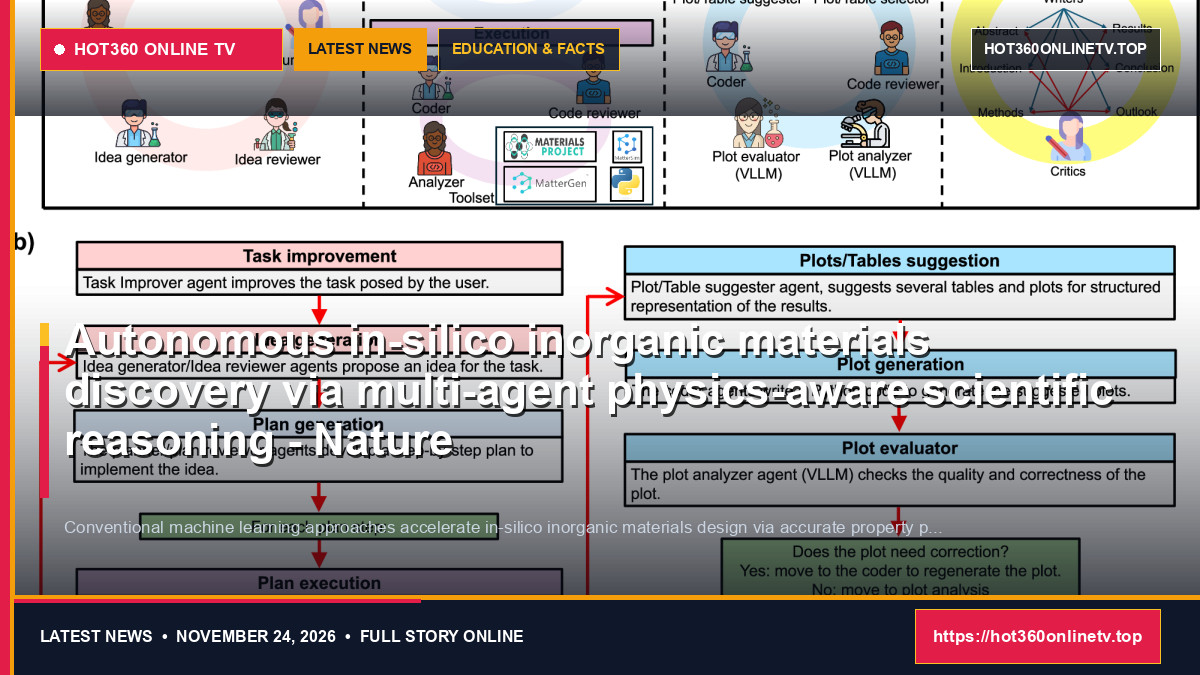
The SparksMatter framework operates through an ideation-planning-experimentation-documentation pipeline, as illustrated in Fig. 1. The process begins with a user-defined query that articulates a specific materials design objective, such as discovering a novel, sustainable inorganic compound with targeted mechanical properties, or finding targeted materials candidates for specific applications.
a SparksMatter operates through an ideation, planning, experimentation, and documentation pipeline. The system consists of specialized AI agents for each phase, with every agent responsible for a distinct role. b A typical workflow executed by SparksMatter for inorganic materials design. After the user poses a query, the scientist agents analyze and clarify the key terms and propose a well-reasoned idea. The planner agents then develop a detailed plan to execute the idea aligned with the available tools. The assistant agent writes Python code to implement the plan, calls computational tools, generates and stores results, and proposes follow-up experiments when needed. Each phase is inspected by the user, who can adjust or approve intermediate outcomes. Finally, the writer agents review the results, identify limitations and gaps, and produce a well-structured final report which is subsequently reviewed by a critic for refinement. These agents operate in a fully self-directed, feedback-driven environment that enables adaptive decision-making and iterative refinement.
The ideation phase begins with a task improver agent that improves and clarifies the provided task so that it becomes unambiguous and well specified for execution by downstream agents, while preserving the original intent and goal of the user query. This step is essential for framing the scientific context and identifying the critical research objectives (such as sustainability, novelty, or stability), especially when these objectives are not explicitly stated in the user’s query. Next, the idea generator agent formulates a research idea that addresses the task while remaining consistent with the available computational tools. In the planning phase, the plan generator agent translates the research idea into a detailed, executable plan, outlining specific tasks and tool invocations. Each idea and plan is evaluated by designated critics (idea reflector and plan reflector agents) for clarity, accuracy, and completeness before proceeding to the next step.
In the experimentation phase, coder agents implement the plan: for each plan step, they generate and execute Python code to call domain-specific tools, generate and collect results, and store them for final review and reporting. This is where existing materials are retrieved from repositories such as the Materials Project11,48, novel structures are generated using diffusion models like MatterGen19, their stability is assessed, and material properties are predicted using deep learning models. This phase is iterative-agents continuously reflect on the code outputs and ensure that all relevant data is systematically gathered based on the plan step objectives. All generated artifacts, including CSV and JSON files as well as Python code, are stored locally to ensure full transparency and reproducibility.
After execution of each plan step, the analyzer agent evaluates the generated results to determine whether they align with the local objectives of the step and the overall research goals. If all plan steps are executed successfully and the results support the proposed idea, the system proceeds to the documentation phase. However, if the results are not aligned with these objectives, the idea is marked as failed, the remaining plan execution is terminated, and the system proceeds to the next round of ideation where a new idea is proposed. This iterative loop enables the system to learn from unsuccessful attempts, refine its strategy, and adapt its reasoning based on feedback from prior executions, leading to more robust and targeted exploration over time.
Before entering the documentation phase, SparksMatter organizes the results through a dedicated Plots/Tables phase, where a set of visualizations and tables are proposed and generated to present the outcomes in a structured and readable way. The agents in this phase are designed to focus on the materials screening workflow, capturing both successful and rejected candidates, along with the reasons behind rejection. The process begins with the suggestion of candidate tables by the Table suggester, followed by refinement and selection by the Table selector. The plotting workflow is handled by a group of specialized agents. The Plot suggester proposes a set of candidate plots, including their type, description, and axis labels, from which a subset is selected by the Plot selector. The Coder, together with the Code reviewer, then develops and refines a Python script required to generate these plots. Once generated, the Plot evaluator (a VLLM) checks each plot for correctness, including labels, units, formatting, readability, and consistency with the intended description. If issues are detected, the plots are revised accordingly by the Coder; otherwise, the process proceeds to the Plot analyzer (a VLLM), which interprets the results, identifies key patterns, and produces captions and scientific insights to accompany the visualizations.
In the final documentation phase, multiple agents collaborate to synthesize a complete scientific report based on the query, the proposed idea, the execution plan, and the obtained results, both successful and unsuccessful. An important component of this phase is the research gap analyzer, which identifies limitations of the current study, highlights open questions, and points to missing validation steps such as DFT calculations or experimental synthesis. Then, the validation planner develops a detailed plan to address these gaps and guide future work. Building on these components, a set of writer agents, including introduction, methods, results, discussion, conclusion, and outlook agents, assemble the final document in a structured and coherent format. The resulting report presents the motivation and impact of the study, explains the workflow and methodology, summarizes the key findings with their interpretation, and discusses limitations, along with recommendations for further improvement and future research directions.
The main driver behind the materials discovery process is the coordinated interaction of agents across the ideation, planning, and experimentation modules. A detailed overview of the workflow is shown in Fig. 2. From the initial user query to the final decision on the proposed idea, the system operates through an automated collaboration among agents, where each stage builds on the outcomes of the previous one. As shown in Fig. 2, the model employs an iterative feedback mechanism to improve the reliability of LLM responses and reduce hallucinations. As illustrated in the iterative refinement block, an initial response generated by one agent is evaluated by another agent (critic or reviewer), which provides targeted feedback. This feedback is then used to refine the response in subsequent iterations. The process is repeated for N refinement cycles, allowing the system to progressively improve its outputs. Through this feedback-driven adaptive strategy, the model can revise its reasoning based on intermediate results and past outcomes. As a result, SparksMatter not only improves the quality of individual LLM responses but also enhances overall efficiency in the workflow. In practice, this mechanism is applied across multiple stages, including task refinement, idea generation, plan construction, and code generation, ensuring consistent improvement throughout the discovery process.
The framework follows an iterative refinement strategy (shown in the iterative refinement block), in which each output from the generator agent is evaluated by a reflector (critic) agent and then used to improve subsequent responses. This process is repeated for N refinement cycles and is applied across multiple stages, including task improvement, idea generation, plan construction, and code generation. The main hyperparameters in the workflow are: N, the number of refinement iterations; Ni, the maximum number of idea-generation attempts; Np, the maximum number of steps in the generated plan; and Nc, the maximum number of code attempts allowed to achieve successful execution of each plan step.
Another important aspect of the workflow is the use of controlled iterative processes at both the idea and coding levels. At the idea level, the system follows a sequential exploration strategy in which each proposed idea is tested and either accepted or rejected; if an idea fails, the system proceeds to the next one, up to a maximum of Ni attempts. This ensures a structured search over alternative hypotheses while avoiding unbounded exploration. If no idea is supported within this limit, the system terminates the search and documents the key reasons for failure. In parallel, at the coding level, potential execution errors are handled through an iterative refinement loop, where the generated code is corrected and re-executed for up to Nc attempts. If the issue persists, the corresponding idea is marked as failed, and the system returns to the ideation stage. Together, these mechanisms enable systematic exploration, robust error handling, and adaptive progression through the discovery process.
Empowered by advanced reasoning models like o3, SparksMatter can generate novel ideas and hypotheses, such as previously unconsidered material chemistries that meet sustainability constraints. Through integration with domain-specialized tools, SparksMatter is also capable of designing materials with targeted properties (e.g., band gap, mechanical strength), evaluating their stability, and predicting their performance, thereby ensuring the generated structures are physically reliable. These capabilities distinguish SparksMatter from tool-less LLMs such as o3 and o3-deep-research, promoting both novelty and scientific relevance in materials generation and discovery. Its performance in addressing real-world materials design challenges, evaluated across multiple scientific metrics, is benchmarked against baseline models in Section. The list of tools and functions integrated into the SparksMatter framework is provided in the Materials and Methods section.
SparksMatter thus represents a step toward autonomous scientific reasoning and tool use where complex materials design tasks are navigated by a coordinated ensemble of AI agents capable of reflection, adaptability, and continual improvement. In the sections that follow, we present several real-world applications that demonstrate the efficacy and versatility of this framework.
Experiments
In this section, we present a series of inorganic materials design experiments to demonstrate the effectiveness and versatility of SparksMatter in addressing diverse challenges in inorganic materials research. The first example represents a materials retrieval task, where the objective is to identify known materials that satisfy specified criteria. In contrast, the second and third examples focus on materials discovery tasks, where the goal is to generate and evaluate previously unexplored candidate materials that meet the desired properties. The full documents generated by SparksMatter for these experiments are provided in the Supplementary Information.
The agents are implemented using the GPT-4 family of LLMs, and we used AG2 as the underlying framework for agent design, orchestration, handoffs, and message routing. More details are provided in the Materials and Methods section. Also, the following hyperparameters were used for all the experiments: number of refinement iterations N = 1, maximum number of idea-generation attempts Ni = 3, maximum number of steps in the plan Np = 3, maximum number of code attempts allowed Nc = 3.
In the first example, SparksMatter is queried with the following materials retrieval-oriented task:
This task addresses replacing PbTiO3, a widely used ferroelectric perovskite, with a compositionally safe and environmentally benign alternative that preserves its desirable electronic and structural characteristics. PbTiO3 belongs to the ABO3 perovskite family, whose structural flexibility enables a wide range of electronic, dielectric, and ferroic properties. Identifying Pb-free analogues within this structural class therefore represents a promising strategy for developing sustainable functional oxide materials.
To address this task, SparksMatter proposes a data-driven retrieval workflow that systematically searches existing materials repositories for non-toxic perovskite oxides satisfying structural, thermodynamic, and electronic constraints, as shown in Fig. 3a. The system begins by querying the Materials Project database and filtering entries to retain only compounds with the canonical ABO3 stoichiometry and three-element compositions containing oxygen. Toxic elements such as Pb, Cd, Hg, Tl, As, Se, Sb, and Bi are excluded to ensure environmental compatibility. Additional crystallographic constraints are imposed by restricting the search to common perovskite space groups. Thermodynamic stability is enforced by requiring an energy above the convex hull below 0.1 eV/atom, while an electronic band-gap window of 1–4 eV is used to target semiconducting or insulating oxides suitable for electronic applications.
a Overall workflow used by SparksMatter to systematically search Materials Project for candidate materials. b–e Plots proposed, generated, and integrated into the final document by the SparksMatter agents, showing the filtering funnel, bandgap distribution, space group distribution, and top 10 A-site elements in the final retrieved candidates, respectively.
Applying these criteria sequentially reduces the initial Materials Project dataset of 154,879 entries to a final set of 162 candidate materials. This progressive filtering process is illustrated by the screening funnel shown in Fig. 3b. Among the surviving compounds are several well-known Pb-free perovskite oxides such as LaAlO3, BaZrO3, SrSnO3, CaTiO3, and SrTiO3, which satisfy all structural, stability, and electronic requirements. These materials exhibit near-hull stability and band gaps spanning approximately 1.5–3.5 eV (Fig. 3c), indicating their potential suitability for electronic and ferroelectric device applications.
Beyond identifying candidate materials, SparksMatter analyzes trends within the filtered dataset. As shown in Fig. 3d, the majority of candidates adopt orthorhombically distorted perovskite structures (space group 62), indicating that octahedral tilting distortions are energetically favored within the chemically constrained search space. The band-gap distribution spans the full target range, suggesting that the perovskite chemical landscape supports both moderate-gap and wide-gap oxides suitable for different functional roles. Importantly, the analysis also reveals that thermodynamic stability and electronic band gap are largely decoupled across the candidate set, enabling the identification of materials that simultaneously satisfy both criteria.
In addition to identifying candidates, SparksMatter outlines a forward-looking plan for computational and experimental validation. Proposed next steps include phonon calculations to confirm dynamic stability, Berry-phase calculations of spontaneous polarization, defect modeling to evaluate defect tolerance, and high-accuracy electronic structure calculations using hybrid density functionals. The system also recommends experimental synthesis through solid-state or sol-gel routes followed by structural and functional characterization. This response illustrates SparksMatter’s end-to-end capability not only to retrieve and evaluate candidate materials, but also to propose actionable next steps toward the development of sustainable, high-performance Pb-free perovskite oxides.
As the demand for eco-friendly technologies grows, so does the need for materials that are safe, ethically sourced, and environmentally responsible. Sustainable materials are essential for clean energy systems, low-impact manufacturing, and reduced electronic waste. In this example, we demonstrate how SparksMatter can identify green thermoelectric materials tailored to specific sustainability constraints.
For this inorganic materials discovery task, the user poses the following query:
The overall workflow of SparksMatter for this task is shown in Fig. 4a. The system focuses on the previously unexplored CaMg2Si2 Zintl phase as a promising thermoelectric candidate. The novelty of this composition is first verified through a systematic query of the Materials Project database, which reveals no stable entries corresponding to CaMg2Si2, highlighting the unexplored nature of this chemical space.
a Materials screening pipeline as proposed and executed by SparksMatter. b The materials candidate funnel for the different screening stages. Only 6 out of 100 initial candidates pass ala the screening criteria. c The bandgap and bulk modulus for final candidates. The plots are proposed, generated, and integrated in the final document by the SparksMatter agents in plot and documentation modules.
To explore this chemical system, SparksMatter activates an inverse-design workflow combining generative crystal structure modeling, thermodynamic screening, and machine-learning-based property prediction. Using a chemical-system-conditioned generative model (MatterGen), the system generates 100 candidate Ca-Mg-Si crystal structures. These hypothetical structures are then evaluated for thermodynamic stability using a surrogate model that predicts energy above the convex hull. Applying a stability threshold of Ehull < 0.10 eV/atom identifies six CaMg2Si2 candidates that satisfy the thermodynamic screening criteria.
The six thermodynamically viable structures are subsequently evaluated using a pretrained Crystal Graph Convolutional Neural Network (CGCNN) to predict key electronic and mechanical properties. All candidates exhibit predicted band gaps between 0.44 and 0.57 eV and bulk moduli in the range of 53–54 GPa. These values fall within commonly accepted ranges for thermoelectric screening, where moderate band gaps enable efficient carrier transport while relatively low elastic moduli serve as proxies for reduced lattice thermal conductivity.
The predicted properties of CaMg2Si2 compare favorably with established thermoelectric silicides. For instance, Mg2Si exhibits a band gap of approximately 0.6 eV but relatively higher lattice thermal conductivity. In contrast, the insertion of Ca into the Mg-Si framework is expected to enhance phonon scattering through mass contrast and weaker bonding interactions, consistent with the phonon-glass electron-crystal paradigm observed in many Zintl phases. This structural motif suggests that CaMg2Si2 could exhibit reduced lattice thermal conductivity while maintaining favorable electronic transport properties.
Upon completion of the workflow, SparksMatter identifies multiple CaMg2Si2 candidates that satisfy all screening criteria. While these candidates are crystallographically distinct, their close structural similarity—reflected in nearly identical lattice thermal transport (Fig. 6)—indicates that they represent closely related configurations of the same composition rather than markedly different polymorphs. This observation nonetheless highlights the usefulness of generative modeling for exploring underrepresented chemical spaces and proposing a set of viable candidate structures rather than a single configuration.
SparksMatter also explicitly acknowledges several limitations of the current computational screening. In particular, the stability and property predictions rely on machine-learned surrogate models rather than direct first-principles calculations. As a result, further validation is required to confirm the thermodynamic and electronic properties of the proposed structures. More importantly, the workflow did not include lattice-dynamic analysis to estimate lattice thermal conductivity (κlat). The use of low elastic moduli as an indirect metric for low κlat may not capture the full complexity of phonon transport. To address these gaps, SparksMatter proposes a detailed validation roadmap including density functional theory (DFT) calculations for structural relaxation, phonon dispersion analysis to confirm dynamical stability, and Boltzmann transport simulations to evaluate κlat. Experimental synthesis routes are also suggested, such as solid-state reaction or spark plasma sintering using Ca, Mg, and Si precursors, followed by structural characterization using X-ray diffraction and transport measurements.
The full document generated by SparksMatter for this experiment is provided in task1 of the SI. This example illustrates how SparksMatter integrates generative modeling, machine-learned property prediction, and scientific reasoning to identify promising sustainable materials candidates. Beyond proposing novel compositions, the system constructs a coherent workflow that spans novelty verification, computational screening, physical interpretation, and experimental validation strategies, thereby demonstrating a comprehensive approach to autonomous materials discovery in sustainable energy applications.
In the next discovery example, SparksMatter is queried with the task:
This query addresses a critical challenge in materials design for flexible electronics, where mechanical softness and environmental stability are essential. Organic semiconductors provide the necessary flexibility but often suffer from limited carrier mobility, thermal instability, and degradation under ambient conditions. In contrast, conventional inorganic semiconductors are typically too stiff for applications requiring mechanical compliance. Bridging this materials gap by identifying soft, stable, and purely inorganic semiconductors could unlock a new generation of durable, high-performance components for wearable and bendable devices.
To address this task, SparksMatter activates an inverse-design workflow that combines property-conditioned generative modeling with multi-stage screening and prediction. The overall workflow conducted by SparksMatter is shown in Fig. 5. The process begins with the generation of 112 candidate crystal structures using a property-conditioned model (MatterGen) targeting a bulk modulus of 15 GPa. After filtering out structures containing toxic elements (Pb, Cd, Hg, Tl, As, U, Be, F), the generated candidates are then screened for thermodynamic stability using energy-above-hull calculations, retaining 61 nontoxic, stable candidates. Next, their mechanical softness and electronic band gaps are predicted using a CGCNN surrogate model, identifying 60 candidates satisfying all design criteria (K < 30 GPa, bandgap from 0.4 to 3.9 eV). Exclusion of compositions present in the Materials Project yielded 59 novel candidates.
a Materials screening pipeline proposed and executed by SparksMatter and the retained materials count for the materials discovery task in Experiment 3. b Distribution of energy above hull for the non-toxic materials structures. c Bulk modulus and bandgap as predicted by the surrogate model for non-toxic and stable materials candidates. The plots are proposed, generated, and integrated in the final document by the plot and documentation agents.
The final candidates span a diverse range of chemical compositions and crystal structures while consistently satisfying the key design requirements of mechanical softness and semiconducting behavior. Representative structures include Cs5Te5Zn2, Al5K3Te12, Cs2MgSe4Sn, and K3MnSe4. The large number of surviving candidates indicates that the generative model successfully explored a region of materials space that simultaneously supports low elastic stiffness and semiconducting electronic structures. Importantly, the novelty filtering step ensures that these materials are not simply rediscoveries of known compounds, but represent previously unexplored compositions that may provide new opportunities for flexible electronic applications. Together, these results demonstrate that the integrated generative-screening workflow implemented in SparksMatter can efficiently navigate a large design space and narrow it down to a set of promising and compositionally novel inorganic semiconductor candidates.
Beyond simply identifying candidate materials, as outlined in the final documentation by SparksMatter, the workflow provides several insights into the design space of mechanically soft semiconductors:
• First, the relatively high survival rate across the screening stages indicates that the generative model successfully explored a region of chemical space already biased toward soft bonding networks. This suggests that conditioning on bulk modulus is an effective strategy for guiding generative models toward mechanically soft crystal chemistries.
First, the relatively high survival rate across the screening stages indicates that the generative model successfully explored a region of chemical space already biased toward soft bonding networks. This suggests that conditioning on bulk modulus is an effective strategy for guiding generative models toward mechanically soft crystal chemistries.
• Second, the generated candidates exhibit a pronounced compositional bias toward chloride-rich chemistries combined with alkali and alkaline-earth cations. Such chemistries are consistent with weakly bonded lattice frameworks that naturally produce low bulk moduli while still allowing semiconducting electronic structures.
Second, the generated candidates exhibit a pronounced compositional bias toward chloride-rich chemistries combined with alkali and alkaline-earth cations. Such chemistries are consistent with weakly bonded lattice frameworks that naturally produce low bulk moduli while still allowing semiconducting electronic structures.
• Third, the filtered candidate set reveals weak correlations between predicted mechanical, electronic, and thermodynamic descriptors. This indicates that properties such as bulk modulus, band gap, and stability can be tuned relatively independently within this region of materials space. As a result, the final candidates span a broad range of band gaps (0.4–3.9 eV) while maintaining low bulk moduli (11–24 GPa), suggesting that mechanically soft semiconductors can still support substantial electronic tunability. This diversity opens opportunities for flexible electronic devices operating across different optical and electronic regimes, including photodetectors, flexible transistors, and strain-sensitive optoelectronic components.
Third, the filtered candidate set reveals weak correlations between predicted mechanical, electronic, and thermodynamic descriptors. This indicates that properties such as bulk modulus, band gap, and stability can be tuned relatively independently within this region of materials space. As a result, the final candidates span a broad range of band gaps (0.4–3.9 eV) while maintaining low bulk moduli (11–24 GPa), suggesting that mechanically soft semiconductors can still support substantial electronic tunability. This diversity opens opportunities for flexible electronic devices operating across different optical and electronic regimes, including photodetectors, flexible transistors, and strain-sensitive optoelectronic components.
The model also explicitly recognizes several limitations of the present study. In particular, the screening pipeline relies on machine-learned surrogate models for stability, mechanical, and electronic property predictions rather than direct first-principles calculations. In addition, thermodynamic stability is assessed using an energy-above-hull threshold, which serves as a practical screening metric but does not fully guarantee synthesizability under experimental conditions. The workflow also does not directly evaluate certain device-relevant properties such as carrier mobility, lattice thermal conductivity, or defect tolerance, mainly due to the lack of reliable fast predictive models for these quantities. As a result, the proposed materials should be interpreted as promising candidates that require further validation through high-fidelity simulations and experimental studies. Importantly, SparksMatter identifies these limitations within its final report and proposes follow-up computational and experimental steps to address them.
In addition to identifying candidate materials, SparksMatter outlines a comprehensive roadmap for follow-up validation to address the limitations of the current screening workflow. The proposed next steps include first-principles calculations of elastic tensors and phonon spectra to verify mechanical and dynamical stability, finite-temperature simulations to evaluate thermal robustness, and defect analysis to assess dopability and charge transport properties. The model also recommends potential experimental synthesis routes, such as solid-state or vapor-phase growth, along with thin-film processing strategies relevant to flexible electronic devices. Environmental and materials safety considerations are further highlighted to guide practical implementation. These recommendations illustrate how the system extends beyond candidate generation by proposing concrete computational and experimental steps needed to validate and refine the proposed materials.
The full document created by SparksMatter for this experiment is provided in S1 of the SI. This case study exemplifies SparksMatter’s integrated approach to autonomous materials discovery by merging generative modeling, machine-learned property prediction, and LLM-based scientific reasoning into a coherent workflow. Beyond identifying promising candidates, the system interprets structure-property relationships, proposes mechanistic explanations, and outlines rigorous computational and experimental validation strategies. Its ability to connect structural features to macroscopic behavior and anticipate viable synthesis pathways reflects a level of scientific reasoning typically associated with expert-driven materials design.
Validation of the materials candidates
SparksMatter relies on surrogate deep learning models for rapid prediction of materials properties such as band gap and elastic modulus. While these models enable efficient screening across large candidate spaces, they do not capture certain key properties required for specific applications. In particular, for the thermoelectric case study, lattice thermal conductivity is not directly evaluated within the discovery pipeline. To address this limitation, we performed a post-analysis to further validate the proposed CaMg2Si2 candidates.
For this purpose, we computed the lattice thermal conductivity using the Wigner transport equation. The full computational methodology is described in Section. Figure 6 presents the temperature-dependent lattice thermal conductivity for the three CaMg2Si2 polymorphs. The nearly identical κlat profiles reflect their close structural similarity. At room temperature, κlat ≈ 6.2 W/m.k, which is relatively high compared with leading thermoelectrics (e.g., ~1–2 W/m·K for optimized Bi₂Te₃ or PbTe and
Lattice thermal conductivity as a function of temperature for three CaMg2Si2 polymorphs generated by SparksMatter in Task 2.
Overall, these results demonstrate the value of validating AI-generated candidates using higher-fidelity physics-based calculations. While the predicted lattice thermal conductivity is higher than that of leading thermoelectric materials, this analysis identifies a key limitation that can guide subsequent optimization. This highlights the iterative nature of SparksMatter, where additional computational tools, such as thermal conductivity predictors, can be integrated into future discovery cycles to refine candidate selection and improve the quality of the proposed materials.
Effect of query wording on model performance
SparksMatter is designed as a framework for autonomous materials retrieval and discovery driven by the objectives specified in the user’s query. In practice, however, users may express the same scientific objective using slightly different wording. In this section, we investigate how such variations influence the model’s behavior, including idea generation and the resulting candidate materials. To this end, for each task we tested three additional variations of the original query while keeping the overall objective unchanged. The queries used in this analysis are listed in Table 2 along with the corresponding final candidates. Moreover, the ideas proposed by the model for each variation are summarized in Tables S1, S2, and S3 in the Supplementary Information for tasks, 1, 2, and 3, respectively.
For Task 1, which focuses on materials retrieval, the generated ideas remain largely consistent across the different query formulations. In particular, the model consistently searches for perovskite oxides with the general formula ABO3 while enforcing constraints related to toxicity and thermodynamic stability. However, slight differences in the query wording lead to different filtering strategies and therefore different numbers of final candidates. For example, the original query implicitly introduces a band-gap filter (1–4 eV), whereas Variants 1 and 2 do not impose such a constraint. As a result, these variants return a larger number of candidates. In Variant 3, where novelty is explicitly requested, the model initially attempts to generate new ABO3 structures from selected cation combinations. When this strategy fails to produce viable candidates (the generative model has no control over the stoichiometry of the materials systems), the system adapts its approach and instead searches for theoretical compounds in the Materials Project database as a proxy for novelty. This strategy yields a smaller set of candidates. However, the novelty claim in this case should be interpreted cautiously because theoretical entries may still correspond to previously explored computational materials.
For Task 2, which involves materials discovery for thermoelectric applications, the model proposes a wider variety of ideas across the query variations, leading to different discovery workflows and candidate outcomes. In three of the four cases, the model employs a property-conditioned generative strategy based on a selected chemical system, but the specific chemical systems vary across queries. The original idea targets the Ca-Mg-Si system, leading to CaMg2Si2-type candidates. In contrast, Variant 1 adopts a hybrid strategy that first mines the Materials Project database to identify chemical systems that already exhibit desirable thermoelectric properties. Based on this search, the model selects Ca-Si, K-P, and Na-P systems and subsequently generates new structures within these systems. Variant 2 directly targets the Cu-Zn-Sn-S chemical system and generates new candidates within that space. Finally, Variant 3 adopts yet another strategy by using a band-gap-conditioned generative model to generate new materials without restricting the chemical system in advance.
For Task 3, the influence of query wording is even more pronounced. In the original query, the model conditions structure generation on a low bulk modulus target, which biases the generative model toward mechanically soft crystal frameworks. This strategy produces a large number of viable candidates (59). In contrast, the three query variations constrain the generation process primarily through electronic structure targets, particularly band gap. Because mechanical softness is no longer directly enforced during generation, the subsequent screening stages remove a larger fraction of candidates, leading to significantly fewer final materials. This difference highlights how the choice of conditioning objective can influence the region of materials space explored by the generative model.
Two primary factors contribute to the variation in ideas and final candidate materials. First, large language models, particularly reasoning models such as the o3 model used for idea generation, exhibit inherent stochasticity in their responses. Even when the overall objective remains the same, small differences in phrasing can lead to different reasoning pathways and therefore different research strategies. Second, the generative models used to construct candidate crystal structures are themselves stochastic. As a result, even when targeting the same material property, the generated structures may differ between runs, leading to variation in the resulting candidate sets.
Several insights can be derived from this analysis. First, despite variations in query wording and workflow design, the final candidates consistently satisfy the main objectives specified in the task. This indicates that SparksMatter remains robust to moderate variations in natural language input while still converging toward scientifically meaningful solutions. Second, the system often incorporates additional implicit constraints that are not explicitly stated in the query. For example, thermodynamic stability and novelty checking is frequently included as a screening criterion even when it is not explicitly requested by the user.
It should also be emphasized that the nature of these queries corresponds to open-ended materials discovery problems in which only the application domain and, in a few cases, target properties are specified. In such cases, there is typically no single ground-truth material or unique solution. Instead, multiple chemistries and crystal structures may satisfy the desired criteria. The variation in candidate materials observed across different query formulations therefore reflects the ability of SparksMatter to explore diverse regions of chemical space while still meeting the core objectives of the task.
Computational cost and latency
We analyze the computational cost and latency of SparksMatter across the three representative tasks to better understand its practical performance. The results, shown in Fig. 7, indicate a clear separation between lightweight reasoning stages and compute-intensive execution stages. In general, ideation and planning are consistently fast and low-cost, which suggests that LLM-based reasoning introduces only a small overhead. In contrast, the overall runtime is mainly dominated by the execution phase, where external tools are invoked, and candidate materials are generated and evaluated.
Top panel: Left, runtime of each module for the three tasks; right, total runtime to complete each task. Bottom panel: Left, cost of each module for the three tasks; right, total cost for each task.
A closer inspection shows that most of the time is spent in the early execution steps of the discovery tasks. In Tasks 2 and 3, these steps can take up to about one hour, since they involve generating a large number of candidate structures and evaluating their stability and properties. This means that the latency is more sensitive to the size of the explored design space than to the reasoning itself. On the other hand, Task 1 is much faster because it is mainly a retrieval problem and does not require extensive generation or screening. The plotting and documentation stages remain moderate in runtime, but their cost is driven by multiple LLM calls required for plotting, interpretation, and final report generation.
From a cost perspective, the documentation stage is the main contributor, mainly due to high token usage when assembling structured scientific outputs. The total cost remains moderate overall (on the order of a few dollars per task), but the distribution shows an important imbalance: reasoning, while validation and reporting are more expensive. This suggests a key design principle for future systems: efficient scientific discovery pipelines should prioritize reducing redundant evaluations and compressing the execution step. For example, one could reduce the number of evaluated candidates, reuse intermediate results, or run parts of the workflow in parallel. Moreover, hybrid deployment strategies, where smaller or open-source models handle documentation, can further reduce cost. Overall, the results show that SparksMatter is already practical for moderate-scale studies, but its efficiency will strongly benefit from advances in tool integration and scalable compute infrastructure.
Benchmark
To evaluate the performance of the SparksMatter framework, we benchmarked its responses against three baseline reasoning models developed by OpenAI: o3, o3-deep-research, and o4-mini-deep-research. Each model was instructed to act as an expert materials scientist with access to internet browsing but without integration with external scientific tools such as generative crystal models or property-prediction deep learning surrogate models. All models were presented with the same set of queries corresponding to Tasks 1, 2, and 3. Their responses were collected and subsequently evaluated by a separate evaluator LLM (GPT-5.4), which received both the model outputs and the final reports produced by SparksMatter. The evaluator was asked to critically assess each submission, identify strengths and weaknesses, and assign scores on a scale of 1-5 across four key metrics: Relevance (how well the response addresses the task), Scientific Soundness (validity of methods, data, and conclusions), Novelty (originality of ideas or approaches), and Depth and Rigor (quality and completeness of analysis and reasoning).
The use of an LLM evaluator ensures uniform and consistent scoring across models. A deeper assessment involving domain experts in chemistry and materials science would provide an additional level of validation, which we leave for future work. Moreover, due to the inherent variability of LLM outputs, each evaluation was repeated ten times, and the scores were averaged to obtain more stable performance estimates.
Representative evaluations of SparksMatter and the baseline OpenAI models for Tasks 1, 2, and 3 are provided in Sections S1, S2, and S3 in the Supplementary Information, respectively. The corresponding evaluation scores are summarized in Fig. 8a, while aggregated results across all benchmark tasks are shown in Fig. 8b. Overall, SparksMatter consistently achieves higher scores than the baseline reasoning models across most evaluation metrics, particularly in Novelty, Depth, and Rigor. The evaluations indicate that baseline models often rely on literature-style responses that summarize previously reported materials rather than proposing new candidates or systematic discovery workflows. In contrast, SparksMatter generates candidate materials through a structured discovery pipeline that combines generative models, property prediction tools, and database filtering, enabling more original and methodical exploration of the materials design space. This difference is reflected in the higher novelty scores assigned to SparksMatter in multiple evaluations.
a Per-task performance comparison based on evaluations by GPT-5.4, using the criteria of relevance, scientific soundness, novelty, and depth and rigor. To account for variability in LLM outputs, each evaluation was repeated ten times, and each dot corresponds to one evaluation. b Aggregated performance scores for each model across all tasks.
At the same time, the benchmark scores for task 1 highlight an important limitation of SparksMatter for purely retrieval-oriented tasks that primarily require recalling established materials reported in the literature. In this task, SparksMatter receives comparatively lower Relevance and Scientific Soundness scores than the baseline models. The evaluation notes indicate that baseline models are often able to retrieve well-known materials directly from the literature or online resources, whereas SparksMatter is constrained to structured scientific databases such as the Materials Project. As a result, the baseline models provide responses that more directly match the query in retrieval-based scenarios. We note that this limitation can be addressed in future versions of the framework by incorporating internet-based information retrieval or retrieval-augmented knowledge modules that allow the system to access broader scientific literature beyond structured databases.
Moreover, SparksMatter shows a modest limitation in Scientific Soundness across discovery tasks 2 and 3. This primarily reflects the fact that the proposed candidate materials are evaluated using surrogate machine-learning models and screening proxies rather than direct first-principles validation or experimental confirmation. For instance, several evaluations note that key properties such as thermoelectric performance or lattice thermal conductivity are inferred from proxy descriptors rather than computed explicitly. However, SparksMatter explicitly recognizes these limitations in its generated reports and recommends follow-up validation steps, including density functional theory (DFT) calculations, phonon stability analysis, and experimental synthesis and characterization. We note that these limitations can be addressed by integrating first-principles simulators or experimental feasibility predictors as additional tools within the framework. We leave these extensions for future work, where they can further strengthen the scientific rigor of SparksMatter without altering its core architecture.
Overall, the benchmark results reveal a clear distinction between the capabilities of the compared systems. The baseline reasoning models frequently produce responses that resemble literature summaries, compiling known materials and reported properties from existing studies. While this approach can perform well for retrieval-oriented queries, it rarely results in the proposal of genuinely new materials or systematic discovery workflows. In contrast, SparksMatter consistently generates candidate materials through an explicit discovery pipeline that integrates generative models, database screening, and property prediction tools. Overall, the results demonstrate that combining reasoning models with domain-specific scientific tools enables a qualitatively different mode of operation, shifting the system from passive knowledge retrieval toward active materials discovery.
Discussion
In this work, we introduced SparksMatter, an LLM-driven multi-agent framework designed to automate the full cycle of in-silico inorganic materials discovery. By combining the reasoning, planning, and coding capabilities of large language models with a suite of specialized scientific tools, SparksMatter enables an integrated, closed-loop platform for the autonomous generation, evaluation, and refinement of novel inorganic compounds. Through the coordinated operation of expert agents, the system can generate candidate materials, predict their properties, and iteratively optimize its search strategies-all with minimal human input.
One of the key advantages of SparksMatter lies in its ability to promote scientific novelty by leveraging generative models that extend beyond known materials space. This addresses a central limitation in tool-less reasoning models such as o3-deep-research, which primarily perform knowledge synthesis without producing original hypotheses or exploring uncharted chemical systems.
A central innovation of the framework is its modularity and adaptability. New agents and tools can be seamlessly integrated to expand its capabilities across various areas of computational materials science. This flexibility is particularly important for overcoming current limitations in SparksMatter, such as the lack of essential property predictions (e.g., lattice thermal conductivity in Task 1), by incorporating additional simulation engines or first-principles methods. Moreover, SparksMatter can be extended with fine-tuned LLMs specifically tailored to processing pathways, synthesizability estimation, and experimental constraints, ensuring that the proposed materials are not only promising in theory but also viable in practice.
In addition to the reasoning capabilities of the LLM agents, SparksMatter relies heavily on scientific tools, particularly during the validation stage. As a result, the framework is naturally influenced by the current capabilities and limitations of available AI models for inorganic materials. For example, the generative model used in this work, MatterGen, when conditioned on target properties such as band gap or bulk modulus, does not provide direct control over the chemical system of the generated compounds. This can lead to candidates that contain undesired or toxic elements. Conversely, when the model is conditioned on a specific chemical system, it does not enforce a desired stoichiometry. In practice, this can lead to cases where no generated structure satisfies a required composition. For instance, in the first iteration of the third variation of Task 1 (Table 2), the proposed idea was rejected because none of the generated structures followed the intended ABO3 stoichiometry. Another limitation lies in the scarcity of reliable surrogate models for certain fundamental materials properties, such as lattice thermal conductivity. Addressing these gaps will require the development of more accurate and comprehensive machine-learning models for materials property prediction. As the underlying scientific tools continue to improve in both capability and accuracy, the overall effectiveness of frameworks such as SparksMatter is expected to improve accordingly.
Another important direction for future work is the development of carefully designed benchmark tasks to evaluate LLM-driven systems for inorganic materials discovery. At present, systematic benchmarks for this emerging class of models remain limited. Establishing meaningful evaluation protocols will require close collaboration between chemists, materials scientists, and experimentalists to design tasks with clear objectives and, where possible, well-defined ground-truth outcomes. Such benchmarks will be essential for assessing progress, identifying limitations, and guiding the development of more reliable AI systems for materials discovery.
Overall, SparksMatter supports fully autonomous, interpretable inorganic materials design and acts as a virtual AI research assistant, lowering entry barriers for non-experts and enhancing productivity for domain specialists. Its structured, reproducible, and adaptable workflow positions it as a valuable tool for accelerating innovation in the materials community.
Looking ahead, SparksMatter provides a robust foundation for the next generation of autonomous scientific discovery. Future work will focus on integrating experimental feedback, advancing synthesizability and processing-awareness, and deepening its connection to first-principles validation. By embedding domain-specific expertise and harnessing reinforcement learning, SparksMatter aspires to further accelerate, democratize, and scale the discovery of sustainable and high-performance materials.
Agent design
AI agents are implemented using the GPT-4 family of LLMs49 as tabulated in Table 3. The temperature parameter was set equal to zero for all non-reasoning LLM calls. Agent design, orchestration, handoffs, and message routing are implemented with AG250, an open-source framework for agent-based AI systems. Each agent is initialized with a system_message parameter that defines its role within the system and expected response format. These system messages are composed using detailed prompts, which may include one or more runtime placeholders dynamically updated each time the agent is invoked, implemented via update_agent_state_before_reply in AG2. The full prompts defining each agent’s system_message are available in the SparksMatter codebase.
Agentic generation-reflection mechanism
SparksMatter integrates a structured generation-reflection mechanism in which each primary agent–such as the scientist, planner, or coder–is paired with a dedicated reflection agent that critiques, verifies, and refines its output. In this framework, the reflection agent either approves the generator’s response or provides constructive feedback for improving it. Through iterative multi-turn reasoning, the system achieves higher reliability and fidelity to the intended scientific objective while mitigating typical large language model hallucinations through consistency checks and cross-agent validation.
All computational tools are implemented as Python functions and stored in the functions_SparksMatter.py module. These functions are created outside the agent environment and thus are not inherently known to the SparksMatter agents. The agents are informed by these tools via a detailed description detailing the tool name, full functionality description, input parameters, and output format. Each tool description is provided in the tool’s docstring. The execution agent (coder agent) is specifically instructed to import the relevant functions from the functions_SparksMatter module to be able to use it in the code to generate the desired results.
The following tools are implemented in SparksMatter.
We used the Materials Project11 as the primary database for existing materials retrieval.
We employed MatterGen19, a generative model for inorganic materials design, for inorganic materials design. Four modes of generation were implemented: (a) unconditional generation, which produces random inorganic materials without constraints; (b) band gap-conditioned generation, targeting materials with specified electronic properties; (c) bulk modulus-conditioned generation, focused on mechanical stiffness; and (d) chemical system-conditioned generation, which generates structures based on a specified chemical system. Each conditional mode guides the generative process toward desired properties or compositions, enabling targeted exploration of materials space.
We assessed the thermodynamic stability of the generated structures using the evaluation module provided in ref. 51. This module leverages MatterSim25, a machine-learned interatomic force field, to perform structure relaxation and construct the convex hull of formation energies.
We used Crystal Graph Convolutional Neural Networks (CGCNN)14 as a deep-learning surrogate model for rapid prediction of materials properties, including formation energy, band gap, bulk modulus, and shear modulus.
Lattice thermal conductivity calculations
To investigate the thermal transport properties of the CaMgSi polymorphs, we performed lattice dynamics simulations52. The essential second (2nd) and third (3rd) -order interatomic force constants were computed using the finite displacement (frozen phonon) approach with a 0.03 Å atomic displacement. For these force evaluations, we employed the MACE-MH153 machine-learning interatomic potential utilizing the omat_pbe head, ensuring first-principles accuracy. The 2nd and 3rd order force constants were extracted using 6 × 6 × 4 and 3 × 3 × 2 supercell replicas, respectively.
With these parameters established, subsequent diagonalization of the mass-rescaled 2nd-order force constants using phonopy54 yields phonon dispersion relations free from imaginary frequencies across the whole Brillouin zone (see Figures S1–S3 in the Supplementary Information), indicating all three polymorphs to be dynamically stable at 0 K.
Using both 2nd and 3rd force constants as inputs for the phono3py54 software package, the lattice thermal conductivity was evaluated on an 18 × 18 × 12 reciprocal space mesh. Crucially, we utilized the Wigner transport equation (WTE)55,56 rather than the standard Peierls-Boltzmann transport equation52. The WTE formalism and its equivalent quasi-harmonic Green-Kuo (QHGK) framework57,58, has been proven to be effective in capturing the wave-like tunneling coherence between closely spaced phonon branches, a contribution that is non-negligible for materials exhibiting ultra-low thermal conductivity59.
Data availability
The data that support the findings of this study are available in the supplementary information of this article.
Code availability
The SparksMatter framework used to perform the experiments in this paper is available on GitHub at https://github.com/lamm-mit/SparksMatter.
References
• Croguennec, L. & Palacin, M. R. Recent achievements on inorganic electrode materials for lithium-ion batteries. J. Am. Chem. Soc. 137, 3140–3156 (2015).Article CAS PubMed Google Scholar
Croguennec, L. & Palacin, M. R. Recent achievements on inorganic electrode materials for lithium-ion batteries. J. Am. Chem. Soc. 137, 3140–3156 (2015).
Article CAS PubMed Google Scholar
• Ning, C.-Z., Dou, L. & Yang, P. Bandgap engineering in semiconductor alloy nanomaterials with widely tunable compositions. Nat. Rev. Mater. 2, 1–14 (2017).Article Google Scholar
Ning, C.-Z., Dou, L. & Yang, P. Bandgap engineering in semiconductor alloy nanomaterials with widely tunable compositions. Nat. Rev. Mater. 2, 1–14 (2017).
• Alberi, K. et al. The 2019 materials by design roadmap. J. Phys. D: Appl. Phys. 52, 013001 (2018).Article Google Scholar
Alberi, K. et al. The 2019 materials by design roadmap. J. Phys. D: Appl. Phys. 52, 013001 (2018).
• Zhao, Z.-J. et al. Theory-guided design of catalytic materials using scaling relationships and reactivity descriptors. Nat. Rev. Mater. 4, 792–804 (2019).Article Google Scholar
Zhao, Z.-J. et al. Theory-guided design of catalytic materials using scaling relationships and reactivity descriptors. Nat. Rev. Mater. 4, 792–804 (2019).
• Zhao, Q., Stalin, S., Zhao, C.-Z. & Archer, L. A. Designing solid-state electrolytes for safe, energy-dense batteries. Nat. Rev. Mater. 5, 229–252 (2020).Article CAS Google Scholar
Zhao, Q., Stalin, S., Zhao, C.-Z. & Archer, L. A. Designing solid-state electrolytes for safe, energy-dense batteries. Nat. Rev. Mater. 5, 229–252 (2020).
Article CAS Google Scholar
• Saal, J. E., Kirklin, S., Aykol, M., Meredig, B. & Wolverton, C. Materials design and discovery with high-throughput density functional theory: the open quantum materials database (oqmd). Jom. 65, 1501–1509 (2013).Article CAS Google Scholar
Saal, J. E., Kirklin, S., Aykol, M., Meredig, B. & Wolverton, C. Materials design and discovery with high-throughput density functional theory: the open quantum materials database (oqmd). Jom. 65, 1501–1509 (2013).
Article CAS Google Scholar
• Guo, K., Yang, Z., Yu, C.-H. & Buehler, M. J. Artificial intelligence and machine learning in design of mechanical materials. Mater. Horiz. 8, 1153–1172 (2021).Article CAS PubMed Google Scholar
Guo, K., Yang, Z., Yu, C.-H. & Buehler, M. J. Artificial intelligence and machine learning in design of mechanical materials. Mater. Horiz. 8, 1153–1172 (2021).
Article CAS PubMed Google Scholar
• Reiser, P. et al. Graph neural networks for materials science and chemistry. Commun. Mater. 3, 93 (2022).Article CAS PubMed PubMed Central Google Scholar
Reiser, P. et al. Graph neural networks for materials science and chemistry. Commun. Mater. 3, 93 (2022).
Article CAS PubMed PubMed Central Google Scholar
• Choudhary, K. et al. Recent advances and applications of deep learning methods in materials science. npj Comput. Mater. 8, 59 (2022).Article Google Scholar
Choudhary, K. et al. Recent advances and applications of deep learning methods in materials science. npj Comput. Mater. 8, 59 (2022).
• Merchant, A. et al. Scaling deep learning for materials discovery. Nature 624, 80–85 (2023).Article CAS PubMed PubMed Central Google Scholar
Merchant, A. et al. Scaling deep learning for materials discovery. Nature 624, 80–85 (2023).
Article CAS PubMed PubMed Central Google Scholar
• Jain, A. et al. Commentary: The materials project: a materials genome approach to accelerating materials innovation. APL Mater. 1, 011002-1–011002-11 (2013).Article Google Scholar
Jain, A. et al. Commentary: The materials project: a materials genome approach to accelerating materials innovation. APL Mater. 1, 011002-1–011002-11 (2013).
• Kirklin, S. et al. The open quantum materials database (oqmd): assessing the accuracy of dft formation energies. npj Comput. Mater. 1, 1–15 (2015).Article Google Scholar
Kirklin, S. et al. The open quantum materials database (oqmd): assessing the accuracy of dft formation energies. npj Comput. Mater. 1, 1–15 (2015).
• Curtarolo, S. et al. Aflow: An automatic framework for high-throughput materials discovery. Comput. Mater. Sci. 58, 218–226 (2012).Article CAS Google Scholar
Curtarolo, S. et al. Aflow: An automatic framework for high-throughput materials discovery. Comput. Mater. Sci. 58, 218–226 (2012).
Article CAS Google Scholar
• Xie, T. & Grossman, J. C. Crystal graph convolutional neural networks for an accurate and interpretable prediction of material properties. Phys. Rev. Lett. 120, 145301 (2018).Article CAS PubMed Google Scholar
Xie, T. & Grossman, J. C. Crystal graph convolutional neural networks for an accurate and interpretable prediction of material properties. Phys. Rev. Lett. 120, 145301 (2018).
Article CAS PubMed Google Scholar
• Park, C. W. & Wolverton, C. Developing an improved crystal graph convolutional neural network framework for accelerated materials discovery. Phys. Rev. Mater. 4, 063801 (2020).Article CAS Google Scholar
Park, C. W. & Wolverton, C. Developing an improved crystal graph convolutional neural network framework for accelerated materials discovery. Phys. Rev. Mater. 4, 063801 (2020).
Article CAS Google Scholar
• Xie, T., Fu, X., Ganea, O.-E., Barzilay, R. & Jaakkola, T. Crystal diffusion variational autoencoder for periodic material generation. In Proc. International Conference on Learning Representations (ICLR, 2022).
Xie, T., Fu, X., Ganea, O.-E., Barzilay, R. & Jaakkola, T. Crystal diffusion variational autoencoder for periodic material generation. In Proc. International Conference on Learning Representations (ICLR, 2022).
• Ren, Z. et al. An invertible crystallographic representation for general inverse design of inorganic crystals with targeted properties. Matter 5, 314–335 (2022).Article CAS Google Scholar
Ren, Z. et al. An invertible crystallographic representation for general inverse design of inorganic crystals with targeted properties. Matter 5, 314–335 (2022).
Article CAS Google Scholar
• Zhao, Y. et al. Physics guided deep learning for generative design of crystal materials with symmetry constraints. npj Comput. Mater. 9, 38 (2023).Article CAS Google Scholar
Zhao, Y. et al. Physics guided deep learning for generative design of crystal materials with symmetry constraints. npj Comput. Mater. 9, 38 (2023).
Article CAS Google Scholar
• Zeni, C. et al. A generative model for inorganic materials design. Nature 639, 624–632 (2025).Article CAS PubMed PubMed Central Google Scholar
Zeni, C. et al. A generative model for inorganic materials design. Nature 639, 624–632 (2025).
Article CAS PubMed PubMed Central Google Scholar
• Chen, C. & Ong, S. P. A universal graph deep learning interatomic potential for the periodic table. Nat. Comput. Sci. 2, 718–728 (2022).Article PubMed Google Scholar
Chen, C. & Ong, S. P. A universal graph deep learning interatomic potential for the periodic table. Nat. Comput. Sci. 2, 718–728 (2022).
Article PubMed Google Scholar
• Batatia, I., Kovacs, D. P., Simm, G., Ortner, C. & Csányi, G. Mace: Higher order equivariant message passing neural networks for fast and accurate force fields. Adv. Neural Inf. Process. Syst. 35, 11423–11436 (2022).Article Google Scholar
Batatia, I., Kovacs, D. P., Simm, G., Ortner, C. & Csányi, G. Mace: Higher order equivariant message passing neural networks for fast and accurate force fields. Adv. Neural Inf. Process. Syst. 35, 11423–11436 (2022).
• Deng, B. et al. Chgnet as a pretrained universal neural network potential for charge-informed atomistic modelling. Nat. Mach. Intell. 5, 1031–1041 (2023).Article Google Scholar
Deng, B. et al. Chgnet as a pretrained universal neural network potential for charge-informed atomistic modelling. Nat. Mach. Intell. 5, 1031–1041 (2023).
• Batatia, I. et al. A Foundation Model for Atomistic Materials Chemistry. J. Chem. Phys. 163, 184110 (2025).Article CAS PubMed Google Scholar
Batatia, I. et al. A Foundation Model for Atomistic Materials Chemistry. J. Chem. Phys. 163, 184110 (2025).
Article CAS PubMed Google Scholar
• Barros-Luque, L. et al. The Open Materials 2024 (OMat24) inorganic materials dataset and models. Nat Comput Sci. 6, 642–652 (2026).Article CAS PubMed Google Scholar
Barros-Luque, L. et al. The Open Materials 2024 (OMat24) inorganic materials dataset and models. Nat Comput Sci. 6, 642–652 (2026).
Article CAS PubMed Google Scholar
• Yang, H. et al. Mattersim: A deep learning atomistic model across elements, temperatures and pressures. arXiv preprint arXiv:2405.04967 (2024).
Yang, H. et al. Mattersim: A deep learning atomistic model across elements, temperatures and pressures. arXiv preprint arXiv:2405.04967 (2024).
• Wei, J. et al. Emergent abilities of large language models. arXiv preprint arXiv:2206.07682 (2022).
Wei, J. et al. Emergent abilities of large language models. arXiv preprint arXiv:2206.07682 (2022).
• Bubeck, S. et al. Sparks of artificial general intelligence: Early experiments with GPT-4 https://arXiv.org/abs/2303.12712 (2023).
Bubeck, S. et al. Sparks of artificial general intelligence: Early experiments with GPT-4 https://arXiv.org/abs/2303.12712 (2023).
• Buehler, M. J. Generative retrieval-augmented ontologic graph and multiagent strategies for interpretive large language model-based materials design. ACS Eng. Au 4, 241–277 (2024).Article CAS PubMed PubMed Central Google Scholar
Buehler, M. J. Generative retrieval-augmented ontologic graph and multiagent strategies for interpretive large language model-based materials design. ACS Eng. Au 4, 241–277 (2024).
Article CAS PubMed PubMed Central Google Scholar
• Yang, Z., Yorke, S. K., Knowles, T. P. & Buehler, M. J. Learning the rules of peptide self-assembly through data mining with large language models. Sci. Adv. 11, eadv1971 (2025).Article CAS PubMed PubMed Central Google Scholar
Yang, Z., Yorke, S. K., Knowles, T. P. & Buehler, M. J. Learning the rules of peptide self-assembly through data mining with large language models. Sci. Adv. 11, eadv1971 (2025).
Article CAS PubMed PubMed Central Google Scholar
• Buehler, M. J. Accelerating scientific discovery with generative knowledge extraction, graph-based representation, and multimodal intelligent graph reasoning. Mach. Learn. Sci. Technol. https://doi.org/10.1088/2632-2153/ad7228 (2024).
Buehler, M. J. Accelerating scientific discovery with generative knowledge extraction, graph-based representation, and multimodal intelligent graph reasoning. Mach. Learn. Sci. Technol. https://doi.org/10.1088/2632-2153/ad7228 (2024).
• Ghafarollahi, A. & Buehler, M. J. Sciagents: Automating scientific discovery through bioinspired multi-agent intelligent graph reasoning. Adv. Mater. 37, 2413523 (2024).Article PubMed PubMed Central Google Scholar
Ghafarollahi, A. & Buehler, M. J. Sciagents: Automating scientific discovery through bioinspired multi-agent intelligent graph reasoning. Adv. Mater. 37, 2413523 (2024).
Article PubMed PubMed Central Google Scholar
• Ni, B., Kaplan, D. L. & Buehler, M. J. Forcegen: End-to-end de novo protein generation based on nonlinear mechanical unfolding responses using a language diffusion model. Sci. Adv. 10, eadl4000 (2024).Article CAS PubMed PubMed Central Google Scholar
Ni, B., Kaplan, D. L. & Buehler, M. J. Forcegen: End-to-end de novo protein generation based on nonlinear mechanical unfolding responses using a language diffusion model. Sci. Adv. 10, eadl4000 (2024).
Article CAS PubMed PubMed Central Google Scholar
• Buehler, M. J. Melm, a generative pretrained language modeling framework that solves forward and inverse mechanics problems. J. Mech. Phys. Solids 181, 105454 (2023).Article Google Scholar
Buehler, M. J. Melm, a generative pretrained language modeling framework that solves forward and inverse mechanics problems. J. Mech. Phys. Solids 181, 105454 (2023).
• Buehler, M. J. Cephalo: Multi-modal vision-language models for bio-inspired materials analysis and design. Adv. Funct. Mater. 34, 2409531 (2024).Article CAS Google Scholar
Buehler, M. J. Cephalo: Multi-modal vision-language models for bio-inspired materials analysis and design. Adv. Funct. Mater. 34, 2409531 (2024).
Article CAS Google Scholar
• Liu, S. et al. Large language models for material property predictions: elastic constant tensor prediction and materials design. Digit. Discov. 4, 1625–1638 (2025).Article Google Scholar
Liu, S. et al. Large language models for material property predictions: elastic constant tensor prediction and materials design. Digit. Discov. 4, 1625–1638 (2025).
• Hafner, J., Wolverton, C. & Ceder, G. Toward computational materials design: the impact of density functional theory on materials research. MRS Bull. 31, 659–668 (2006).Article Google Scholar
Hafner, J., Wolverton, C. & Ceder, G. Toward computational materials design: the impact of density functional theory on materials research. MRS Bull. 31, 659–668 (2006).
• Jain, A., Shin, Y. & Persson, K. A. Computational predictions of energy materials using density functional theory. Nat. Rev. Mater. 1, 1–13 (2016).Article Google Scholar
Jain, A., Shin, Y. & Persson, K. A. Computational predictions of energy materials using density functional theory. Nat. Rev. Mater. 1, 1–13 (2016).
• Szymanski, N. J. et al. An autonomous laboratory for the accelerated synthesis of novel materials. Nature 624, 86–91 (2023).Article CAS PubMed PubMed Central Google Scholar
Szymanski, N. J. et al. An autonomous laboratory for the accelerated synthesis of novel materials. Nature 624, 86–91 (2023).
Article CAS PubMed PubMed Central Google Scholar
• Tom, G. et al. Self-driving laboratories for chemistry and materials science. Chem. Rev. 124, 9633–9732 (2024).Article CAS PubMed PubMed Central Google Scholar
Tom, G. et al. Self-driving laboratories for chemistry and materials science. Chem. Rev. 124, 9633–9732 (2024).
Article CAS PubMed PubMed Central Google Scholar
• Lu, C., Lu, C. & Lange, R.T. Towards end-to-end automation of AI research. Nature 651, 914–919 (2026).Article CAS PubMed PubMed Central Google Scholar
Lu, C., Lu, C. & Lange, R.T. Towards end-to-end automation of AI research. Nature 651, 914–919 (2026).
Article CAS PubMed PubMed Central Google Scholar
• M. Bran, A. et al. Augmenting large language models with chemistry tools. Nat. Mach. Intell. 6, 525–535 (2024).Article PubMed PubMed Central Google Scholar
M. Bran, A. et al. Augmenting large language models with chemistry tools. Nat. Mach. Intell. 6, 525–535 (2024).
Article PubMed PubMed Central Google Scholar
• Ghafarollahi, A. & Buehler, M. J. ProtAgents: protein discovery via large language model multi-agent collaborations combining physics and machine learning. Digital Discov. 3, 1389–1409 (2024).Article Google Scholar
Ghafarollahi, A. & Buehler, M. J. ProtAgents: protein discovery via large language model multi-agent collaborations combining physics and machine learning. Digital Discov. 3, 1389–1409 (2024).
• Ghafarollahi, A. & Buehler, M. J. Sparks: Multi-agent artificial intelligence model discovers protein design principles. arXiv preprint arXiv:2504.19017 (2025).
Ghafarollahi, A. & Buehler, M. J. Sparks: Multi-agent artificial intelligence model discovers protein design principles. arXiv preprint arXiv:2504.19017 (2025).
• Ghafarollahi, A. & Buehler, M. J. Automating alloy design and discovery with physics-aware multimodal multiagent ai. Proc. Natl. Acad. Sci. 122, e2414074122 (2025).Article CAS PubMed PubMed Central Google Scholar
Ghafarollahi, A. & Buehler, M. J. Automating alloy design and discovery with physics-aware multimodal multiagent ai. Proc. Natl. Acad. Sci. 122, e2414074122 (2025).
Article CAS PubMed PubMed Central Google Scholar
• Ghafarollahi, A. & Buehler, M. J. Rapid and automated alloy design with graph neural network-powered large language model-driven multi-agent AI. MRS Bull. 50, 1309–1324 (2025).Article CAS Google Scholar
Ghafarollahi, A. & Buehler, M. J. Rapid and automated alloy design with graph neural network-powered large language model-driven multi-agent AI. MRS Bull. 50, 1309–1324 (2025).
Article CAS Google Scholar
• Tang, X. et al. Risks of ai scientists: prioritizing safeguarding over autonomy. Nat. Commun. 16, 8317 (2025).Article CAS PubMed PubMed Central Google Scholar
Tang, X. et al. Risks of ai scientists: prioritizing safeguarding over autonomy. Nat. Commun. 16, 8317 (2025).
Article CAS PubMed PubMed Central Google Scholar
• Binz, M. et al. How should the advancement of large language models affect the practice of science? Proc. Natl. Acad. Sci. 122, e2401227121 (2025).Article CAS PubMed PubMed Central Google Scholar
Binz, M. et al. How should the advancement of large language models affect the practice of science? Proc. Natl. Acad. Sci. 122, e2401227121 (2025).
Article CAS PubMed PubMed Central Google Scholar
• Horton, M. K. et al. Accelerated data-driven materials science with the materials project. Nat. Mater. 24, 1522–1532 (2025).Article CAS PubMed Google Scholar
Horton, M. K. et al. Accelerated data-driven materials science with the materials project. Nat. Mater. 24, 1522–1532 (2025).
Article CAS PubMed Google Scholar
• Achiam, J. et al. Gpt-4 technical report. arXiv preprint arXiv:2303.08774 (2023).
Achiam, J. et al. Gpt-4 technical report. arXiv preprint arXiv:2303.08774 (2023).
• Wang, C., Wu, Q. & the AG2 Community. Ag2: Open-source agentos for AI agents https://github.com/ag2ai/ag2. Available at https://docs.ag2.ai/. (2024).
Wang, C., Wu, Q. & the AG2 Community. Ag2: Open-source agentos for AI agents https://github.com/ag2ai/ag2. Available at https://docs.ag2.ai/. (2024).
• CZeni, C. et al. Mattergen implementation. https://github.com/microsoft/mattergen. Available at https://github.com/microsoft/mattergen (2024).
CZeni, C. et al. Mattergen implementation. https://github.com/microsoft/mattergen. Available at https://github.com/microsoft/mattergen (2024).
• Lindsay, L. First principles peierls-boltzmann phonon thermal transport: a topical review. Nanoscale Microscale Thermophys. Eng. 20, 67–84 (2016).Article CAS Google Scholar
Lindsay, L. First principles peierls-boltzmann phonon thermal transport: a topical review. Nanoscale Microscale Thermophys. Eng. 20, 67–84 (2016).
Article CAS Google Scholar
• Batatia, I. et al. Cross learning between electronic structure theories for unifying molecular, surface, and inorganic crystal foundation force fields. arXiv preprint arXiv:2510.25380 (2025).
Batatia, I. et al. Cross learning between electronic structure theories for unifying molecular, surface, and inorganic crystal foundation force fields. arXiv preprint arXiv:2510.25380 (2025).
• Togo, A. First-principles phonon calculations with phonopy and phono3py. J. Phys. Soc. Jpn. 92, 012001 (2023).Article Google Scholar
Togo, A. First-principles phonon calculations with phonopy and phono3py. J. Phys. Soc. Jpn. 92, 012001 (2023).
• Simoncelli, M., Marzari, N. & Mauri, F. Unified theory of thermal transport in crystals and glasses. Nat. Phys. 15, 809–813 (2019).Article CAS Google Scholar
Simoncelli, M., Marzari, N. & Mauri, F. Unified theory of thermal transport in crystals and glasses. Nat. Phys. 15, 809–813 (2019).
Article CAS Google Scholar
• Simoncelli, M., Marzari, N. & Mauri, F. Wigner formulation of thermal transport in solids. Phys. Rev. X 12, 041011 (2022).CAS Google Scholar
Simoncelli, M., Marzari, N. & Mauri, F. Wigner formulation of thermal transport in solids. Phys. Rev. X 12, 041011 (2022).
• Isaeva, L., Barbalinardo, G., Donadio, D. & Baroni, S. Modeling heat transport in crystals and glasses from a unified lattice-dynamical approach. Nat. Commun. 10, 3853 (2019).Article PubMed PubMed Central Google Scholar
Isaeva, L., Barbalinardo, G., Donadio, D. & Baroni, S. Modeling heat transport in crystals and glasses from a unified lattice-dynamical approach. Nat. Commun. 10, 3853 (2019).
Article PubMed PubMed Central Google Scholar
• Barbalinardo, G., Chen, Z., Lundgren, N. W. & Donadio, D. Efficient anharmonic lattice dynamics calculations of thermal transport in crystalline and disordered solids. J. Appl. Phys. 128, 135104 (2020).Article CAS Google Scholar
Barbalinardo, G., Chen, Z., Lundgren, N. W. & Donadio, D. Efficient anharmonic lattice dynamics calculations of thermal transport in crystalline and disordered solids. J. Appl. Phys. 128, 135104 (2020).
Article CAS Google Scholar
• Xia, Y. et al. A unified understanding of minimum lattice thermal conductivity. Proc. Natl. Acad. Sci. 120, e2302541120 (2023).Article PubMed PubMed Central Google Scholar
Xia, Y. et al. A unified understanding of minimum lattice thermal conductivity. Proc. Natl. Acad. Sci. 120, e2302541120 (2023).
Article PubMed PubMed Central Google Scholar
Acknowledgements
We acknowledge support from MIT’s Generative AI Initiative. AG gratefully acknowledges the financial support from the Swiss National Science Foundation (project #P500PT_214448). Part of this work was supported by the U.S. Department of Energy, Office of Science, Office of Advanced Scientific Computing Research and Office of Basic Energy Sciences, Scientific Discovery through Advanced Computing (SciDAC) program under the FORUM-AI project. We sincerely thank Zekun Chen from Lawrence Berkeley National Lab for the fruitful discussions and suggestions on lattice thermal conductivity calculations.
Author information
Authors and Affiliations
• Laboratory for Atomistic and Molecular Mechanics (LAMM), Massachusetts Institute of Technology, Cambridge, MA, USAAlireza Ghafarollahi
Laboratory for Atomistic and Molecular Mechanics (LAMM), Massachusetts Institute of Technology, Cambridge, MA, USA
• Laboratory for Atomistic and Molecular Mechanics (LAMM), Center for Computational Science and Engineering Schwarzman College of Computing Massachusetts Institute of Technology, Cambridge, MA, USAMarkus J. Buehler
Laboratory for Atomistic and Molecular Mechanics (LAMM), Center for Computational Science and Engineering Schwarzman College of Computing Massachusetts Institute of Technology, Cambridge, MA, USA
• Alireza GhafarollahiView author publicationsSearch author on:PubMed Google Scholar
Search author on:PubMed Google Scholar
• Markus J. BuehlerView author publicationsSearch author on:PubMed Google Scholar
Search author on:PubMed Google Scholar
Contributions
A.G. and M.J.B. designed research; A.G. performed research, developed algorithms and codes; A.G. and M.J.B. analyzed data; and A.G. and M.J.B. wrote the paper.
Corresponding author
Correspondence to Markus J. Buehler.
Ethics declarations
Competing interests
The authors declare no competing interests.
Additional information
Publisher’s note Springer Nature remains neutral with regard to jurisdictional claims in published maps and institutional affiliations.
Supplementary information
Supplementary information (download PDF )
Rights and permissions
About this article
Cite this article
Ghafarollahi, A., Buehler, M.J. Autonomous in-silico inorganic materials discovery via multi-agent physics-aware scientific reasoning. npj Comput Mater 12, 357 (2026). https://doi.org/10.1038/s41524-026-02205-8
• Received: 12 August 2025
• Accepted: 20 June 2026
• Published: 08 July 2026
• Version of record: 02 November 2026
Version of record: 02 November 2026
• DOI: https://doi.org/10.1038/s41524-026-02205-8
DOI: https://doi.org/10.1038/s41524-026-02205-8
Anyone you share the following link with will be able to read this content:
Sorry, a shareable link is not currently available for this article.
Provided by the Springer Nature SharedIt content-sharing initiative